


An Interactive 5-Day Training Course
Ichnology & Trace Fossils for Reservoir Interpretation
Burrows, Environments and Permeability
Secure your spot now!
Duration
5 Days
Price
$ 3,500
Starting From
17 May 2027



Home Geology and Geoscience Ichnology & Trace Fossils for Reservoir Interpretation
Ichnology & Trace Fossils for Reservoir Interpretation
Have Questions ?
Ichnology & Trace Fossils for Reservoir Interpretation - GG-ICHNO-PEA27
| Code | Date | Time | Duration | Location | Currency | Early Bird Fee Per Person |
|---|---|---|---|---|---|---|
| GG-ICHNO-PEA27 | 17 - 21 May 2027 | 10 AM CST | 4 Hours Per Day |
Online |
USD |
3500 |
Need this for a group? We deliver the same course in-house — face-to-face at your location or online — tailored to your assets and team level. Contact info@peassociations.com
Boost your team's skills and your budget! Enjoy group discounts for collaborative learning. Send an inquiry to info@peassociations.com.
Ichnology & Trace Fossils for Reservoir Interpretation
Description
Trace fossils record behaviour in response to conditions at the sediment surface, which makes them a direct environmental indicator independent of the sediment itself. They are produced in place so they cannot be transported and reworked, they are preserved where body fossils are not, and they respond to salinity, oxygenation, energy, substrate consistency and sedimentation rate. For a reservoir geologist working from core, ichnology frequently resolves environmental interpretations that sedimentary structures leave ambiguous.
Ichnology also has a direct reservoir consequence that is often overlooked. Bioturbation physically rearranges sediment: it mixes mud into sand and reduces permeability, it destroys primary lamination and the permeability anisotropy that went with it, and in some fabrics it introduces sand-filled burrows that connect otherwise isolated sand bodies through mudstone. These effects can be quantified and carried into rock typing and permeability modelling.
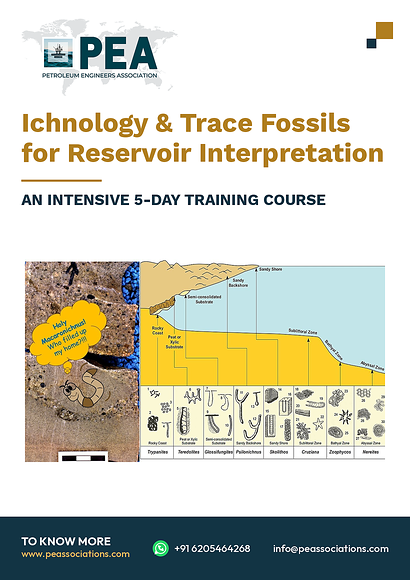
This training covers both sides. Trace fossil basics are established first: preservation, classification, ethological categories and the identification of the principal forms encountered in core. Ichnofacies models follow, covering the archetypal marine ichnofacies from Skolithos through Cruziana to Zoophycos and Nereites, their bathymetric and energy associations and the limits of their application. Ichnofabric analysis is then developed as the practical core-based method, covering bioturbation indices, tiering, cross-cutting relationships and the reconstruction of colonisation history. Environmental interpretation follows, covering salinity stress and brackish water assemblages, oxygen restriction, sedimentation rate and substrate consistency. Substrate controlled ichnofacies and their use in identifying omission surfaces, firmgrounds and hardgrounds is developed as a stratigraphic tool. The training closes with the reservoir effects of bioturbation on permeability, anisotropy, net to gross and log response.
Brackish water assemblages are the most commercially useful ichnological signal. Salinity stress reduces diversity sharply while leaving abundance high, produces simple opportunistic forms, and often shows a reduction in burrow size. An assemblage with two or three ichnogenera, abundant individuals and small burrow diameters indicates brackish conditions, which identifies estuarine, lagoonal or delta plain settings and distinguishes them from fully marine shoreface successions that may look similar in grain size and structure. That distinction changes the predicted sand body geometry entirely.
Bioturbation has opposite permeability effects depending on fabric, and the distinction is practical rather than academic. Where burrows homogenise interbedded sand and mud, permeability falls because mud is mixed through the sand, and the effect can be an order of magnitude. Where sand-filled burrows penetrate downward from a sand into an underlying mudstone, they create vertical permeability pathways through what the model would otherwise treat as a seal, and reservoir units thought to be isolated may be connected. Both require the ichnofabric to be described, not just a bioturbation index recorded.
Substrate controlled ichnofacies identify surfaces that nothing else marks. The Glossifungites ichnofacies, formed by firm-walled burrows cut into a compacted, dewatered substrate, indicates that sediment was exhumed and the surface was exposed to colonisation before burial resumed. These surfaces are commonly sequence boundaries, ravinement surfaces or the bases of incised valleys and channels. In core, a firmground surface may be the only evidence that a significant stratigraphic break is present, since the lithological change across it can be minimal.
Finally, the bioturbation index that appears in most core descriptions is a weaker piece of data than it could be. Recording a number from zero to six records intensity but not fabric, and permeability depends on the fabric, the ichnogenera present and their fill. A description that records the ichnofabric, the dominant traces and the nature of the burrow fill supports permeability interpretation; one that records intensity alone does not.
By the end of this training, participants will be able to:
- Identify the principal trace fossils encountered in subsurface core
- Apply ethological classification and interpret behaviour from form
- Apply archetypal ichnofacies models and recognise their limitations
- Conduct ichnofabric analysis including tiering and cross-cutting relationships
- Interpret depositional environment from trace fossil assemblages
- Recognise salinity stress and brackish water assemblages
- Assess oxygen restriction and sedimentation rate from ichnological evidence
- Identify substrate controlled ichnofacies and the stratigraphic surfaces they mark
- Assess the effects of bioturbation on permeability and anisotropy
- Integrate ichnological data into facies schemes, rock typing and log evaluation
Organisations sending participants to this training will:
- Resolve ambiguous environmental interpretations from core
- Identify brackish and marginal marine settings correctly
- Identify stratigraphic surfaces that lithology alone does not mark
- Quantify bioturbation effects on permeability and net pay
- Improve rock typing in bioturbated reservoirs
- Extract more interpretive value from core already held
Participants will:
- Identify trace fossils and describe ichnofabrics competently
- Interpret environment, salinity and oxygenation from traces
- Recognise firmgrounds and the surfaces they mark
- Assess permeability consequences of bioturbation
- Resolve interpretations that structures leave ambiguous
- Add a capability that strengthens all core-based work
- Reservoir geologists and sedimentologists describing core
- Operations and wellsite geologists
- Petrophysicists working on bioturbated reservoirs
- Stratigraphers identifying key surfaces
- Reservoir modellers working with facies schemes
- Exploration geoscientists interpreting environments from core
- Graduate geoscientists entering core-based roles
Module 1 - Trace Fossil Fundamentals
- Trace fossils against body fossils
- Formation and preservation of traces
- Preservational classification and toponomy
- Full relief and semi-relief preservation
- Ethological classification of behaviour
- Dwelling, feeding, grazing, resting and escape traces
- Trace maker identification and its uncertainty
- Ichnotaxonomy and nomenclature
- One organism and multiple traces
- Trace fossils in core against outcrop
- Describing traces in core systematically
Module 2 - Principal Trace Fossils in Core
- Skolithos, Ophiomorpha and Diplocraterion
- Arenicolites and Palaeophycus
- Planolites and Thalassinoides
- Chondrites and its environmental significance
- Zoophycos and its distribution
- Teichichnus and Rhizocorallium
- Rosselia, Asterosoma and Cylindrichnus
- Phycosiphon and Nereites
- Macaronichnus and its setting
- Escape structures and their significance
- Root traces and continental ichnofossils
- Identification guides and their use in core
Module 3 - Ichnofacies Models
- Ichnofacies concept and its basis
- Skolithos ichnofacies and high energy settings
- Cruziana ichnofacies and its breadth
- Zoophycos ichnofacies
- Nereites ichnofacies and deep water
- Psilonichnus and marginal settings
- Scoyenia and continental settings
- Bathymetric association and its limitations
- Energy and substrate as the real controls
- Mixed and transitional assemblages
- Common misapplications of ichnofacies models
- Using ichnofacies alongside sedimentary facies
Module 4 - Ichnofabric Analysis
- Ichnofabric concept and its practical value
- Bioturbation index scales
- Describing ichnofabric beyond intensity
- Tiering and its reconstruction
- Cross-cutting relationships and colonisation order
- Primary fabric preservation and destruction
- Discrete burrows against homogenised fabric
- Burrow fill character and its origin
- Sand-filled burrows in mudstone
- Mud-lined and mud-filled burrows in sand
- Ichnofabric constituent diagrams
- Recording ichnofabric for downstream use
Module 5 - Environmental Interpretation
- Energy and substrate interpretation
- Water depth indication and its reliability
- Salinity stress and its ichnological signature
- Brackish water assemblage characteristics
- Diversity, abundance and size reduction
- Oxygen restriction and dysaerobic assemblages
- Chondrites and low oxygen conditions
- Sedimentation rate effects on colonisation
- Event beds and opportunistic colonisation
- Storm beds and their ichnological record
- Turbidite colonisation patterns
- Integrating ichnology with sedimentary facies
Module 6 - Substrate Controlled Ichnofacies and Surfaces
- Substrate consistency and its ichnological control
- Glossifungites ichnofacies and firmgrounds
- Trypanites ichnofacies and hardgrounds
- Teredolites and woodgrounds
- Recognising firmground surfaces in core
- Omission surfaces and their significance
- Sequence boundaries marked by firmgrounds
- Transgressive ravinement surfaces
- Channel and valley base surfaces
- Flooding surfaces and condensed intervals
- Using ichnology to identify stratigraphic breaks
- Surfaces invisible in lithology alone
Module 7 - Bioturbation and Reservoir Properties
- Physical effects of burrowing on sediment
- Mud mixing and permeability reduction
- Destruction of primary lamination
- Loss of permeability anisotropy
- Sand-filled burrows and vertical connectivity
- Burrow fill permeability contrast
- Cryptobioturbation and its subtle effects
- Bioturbation and net to gross determination
- Bioturbation effects on log response
- Quantifying permeability change by ichnofabric
- Rock typing including ichnofabric
- Case examples of ichnofabric controlled flow
Module 8 - Integration and Application
- Building ichnology into a facies scheme
- Core description protocols including ichnology
- Specifying ichnological input to a core study
- Combining ichnology with palynology and micropalaeontology
- Ichnology in sequence stratigraphic analysis
- Ichnology in reservoir modelling inputs
- Ichnology in unconventional and mudstone reservoirs
- Ichnology in carbonate successions
- Ichnology in continental successions
- Resolving interpretation disputes with ichnological evidence
- Reporting ichnological results usefully
- Case studies where ichnology changed the interpretation
Upon successful completion of this training course, delegates will be awarded an official Certificate of Completion issued by the Petroleum Engineers Association (PEA), an ISO 9001:2015 certified training organization. The certificate carries 10 Credits and formally records the total learning hours completed.
Each certificate is signed by the Course Facilitator and the CEO of the Petroleum Engineers Association, and serves as verifiable proof of professional training that delegates can present to employers and professional bodies worldwide.
Frequently Asked Questions
All course bookings made through PEA are strictly non-refundable. By registering for a course, you acknowledge and accept that all fees are payable in full and are not subject to refund under any circumstances, including changes in personal or professional commitments or partial attendance.
PEA reserves the right to make reasonable adjustments to course content, trainers, or schedules where necessary, without entitling delegates to a refund. Comprehensive details of each course — including objectives, target audience, and content — are clearly outlined before enrolment, and it is the responsibility of the delegate to ensure the course's suitability prior to booking.
For any inquiries related to cancellations or bookings, please contact our support team, who will be happy to assist you.
