


An Interactive 5-Day Training Course
SRMS for CO2 Storage Resources
Classifying CO2 Storage Resources Under SRMS
Secure your spot now!
Duration
5 Days
Price
$ 2,500
Starting From
24 May 2027



Home Geology and Geoscience SRMS for CO2 Storage Resources
SRMS for CO2 Storage Resources
Have Questions ?
SRMS for CO2 Storage Resources - GG-SRMS-PEA27
| Code | Date | Time | Duration | Location | Currency | Early Bird Fee Per Person |
|---|---|---|---|---|---|---|
| GG-SRMS-PEA27 | 24 - 28 May 2027 | 10 AM CST | 4 Hours Per Day |
Online |
USD |
2500 |
Need this for a group? We deliver the same course in-house — face-to-face at your location or online — tailored to your assets and team level. Contact info@peassociations.com
Boost your team's skills and your budget! Enjoy group discounts for collaborative learning. Send an inquiry to info@peassociations.com.
SRMS for CO2 Storage Resources
This training covers the Storage Resources Management System for CO2 storage. It works through the framework structure and its origin, classification categories and their definitions, the project maturity axis, capacity estimation consistent with the framework, deterministic and probabilistic methods, commerciality criteria, aggregation rules, reporting and disclosure requirements and the application of the framework to real storage projects.
Description
Storage capacity numbers have been reported on inconsistent bases, which has made them impossible to compare and in several cases materially misleading. The Storage Resources Management System provides a classification framework modelled on the petroleum resources management system, with defined categories, a project maturity dimension and commerciality criteria. Applying it converts a capacity estimate from a technical statement into a classified resource that can be compared, aggregated and disclosed.
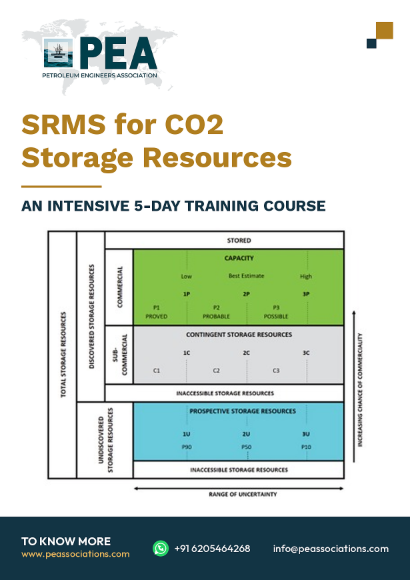
This training covers the framework and its application. The framework structure and its origin are established first, covering the relationship to petroleum resource classification and the reasons for the differences. Classification categories and their definitions follow, covering stored quantities, capacity, contingent and prospective storage resources and the boundaries between them. The project maturity axis is then developed, since storage classification depends on project status as much as on geological confidence. Capacity estimation consistent with the framework follows. Deterministic and probabilistic methods are then addressed. Commerciality criteria follow, covering what has to be in place for capacity to be classified as commercial. Aggregation rules are then developed. Reporting and disclosure requirements follow. The training closes with application to real projects.
Project maturity governs the classification, not geology alone. A site with excellent geology and a well-constrained capacity estimate is prospective storage resource until there is a project to use it: an identified source of carbon dioxide, a transport route, a permit path and a commercial basis. This mirrors the petroleum framework, where a discovered accumulation with no development project is contingent rather than reserves. It means that capacity figures quoted for basins and regions, however carefully estimated, are prospective resources and should not be compared with the classified capacity of a permitted project.
The commerciality test for storage is different from petroleum and often harder. A petroleum project is commercial if the hydrocarbon can be sold at a profit. A storage project has no product; its revenue comes from a payment for the storage service, from a carbon price, from a tax credit or from an obligation avoided, all of which depend on policy that may be less durable than a commodity market. Demonstrating commerciality therefore requires demonstrating a revenue mechanism and a committed source, and the absence of either keeps capacity in the contingent category.
Aggregating capacity across sites requires care, as it does for reserves. Adding the P90 estimates of ten storage sites gives a figure far more conservative than the P90 of the total, because the uncertainties are partly independent. Conversely, adding P10 values overstates the aggregate upside. The framework's aggregation rules follow the same logic as petroleum reserves aggregation, and the arithmetic matters when a national or corporate capacity figure is being assembled from site estimates.
Finally, the stored quantity is a separate category and it accumulates. Unlike petroleum, where production depletes the resource, storage injection consumes capacity and creates a stored inventory that must be accounted for and monitored indefinitely. The framework tracks both: the capacity remaining and the quantity stored. For a mature storage project these are both material numbers, and the stored quantity carries ongoing monitoring and liability obligations that the capacity figure does not.
By the end of this training, participants will be able to:
- Describe the SRMS framework structure and its relationship to petroleum classification
- Apply the classification categories and their definitions
- Classify storage resources by project maturity
- Estimate capacity consistently with the framework
- Apply deterministic and probabilistic estimation methods
- Apply commerciality criteria to storage projects
- Account for stored quantities separately from capacity
- Apply aggregation rules across sites and portfolios
- Meet reporting and disclosure requirements
- Classify and document capacity for a real storage project
The training works through classification exercises on storage projects at different maturity levels. Participants classify capacity estimates, test them against commerciality criteria and document the basis. Published capacity figures are examined and reclassified according to the framework, which usually changes the category substantially. Aggregation exercises are run across portfolios.
Organisations sending participants to this training will:
- Report storage capacity on a consistent classified basis
- Distinguish prospective from commercial capacity
- Apply commerciality criteria correctly
- Aggregate capacity across sites properly
- Meet disclosure requirements for storage resources
- Avoid overstating storage capacity
Participants will:
- Apply the SRMS framework competently
- Classify storage resources correctly
- Estimate capacity consistently
- Test commerciality criteria
- Aggregate across portfolios
- Document classification defensibly
- Geoscientists estimating storage capacity
- Reserves and resource classification staff
- Reservoir engineers on storage projects
- Commercial and planning staff
- Assurance and audit staff
- Project staff preparing storage disclosures
- Regulators and advisors reviewing capacity claims
Module 1 - Framework Structure
- Purpose of a classification framework
- Origins in petroleum resource classification
- Relationship to the petroleum resources management system
- Why storage needs its own framework
- Framework axes: maturity and uncertainty
- Terminology and definitions
- Guidelines and supporting documents
- Industry adoption status
- Regulatory recognition
- Comparison with other capacity methodologies
- Framework scope and limitations
Module 2 - Classification Categories
- Stored quantities
- Capacity definitions
- Commercial storage capacity
- Contingent storage resources
- Prospective storage resources
- Unrecoverable and inaccessible capacity
- Sub-classification within categories
- Boundaries between categories
- Reclassification triggers
- Movement between categories over project life
- Common misclassification errors
- Worked classification examples
Module 3 - Project Maturity
- Maturity as the classification driver
- Project definition requirements
- Source identification requirement
- Transport route requirement
- Permit status and its effect
- On injection and approved projects
- Justified for development
- Development pending and on hold
- Development unclarified
- Prospective sub-classes: play, lead, prospect
- Maturity against geological confidence
- Documenting maturity status
Module 4 - Capacity Estimation
- Capacity estimation consistent with classification
- Volumetric methods
- Pore volume and efficiency factors
- Pressure limited capacity
- Closure limited capacity
- Rate and schedule limited capacity
- Simulation based capacity estimation
- Capacity in depleted fields
- Capacity in saline aquifers
- Stacked reservoir capacity
- Shared aquifer and interference effects
- Capacity estimation documentation
Module 5 - Deterministic and Probabilistic Methods
- Deterministic estimation and scenarios
- Low, best and high estimates
- Probabilistic estimation methods
- Input distribution construction
- Monte Carlo simulation for capacity
- P90, P50 and P10 capacity
- Consistency between methods
- Uncertainty sources in capacity
- Sensitivity analysis
- Method selection by project maturity
- Reporting ranges
- Avoiding false precision
Module 6 - Commerciality
- Commerciality criteria for storage
- Revenue mechanisms for storage services
- Carbon price and policy dependence
- Tax credits and incentive schemes
- Committed source requirement
- Transport infrastructure availability
- Permit and regulatory approval
- Economic viability demonstration
- Reasonable timeframe criterion
- Liability and financial security
- Differences from petroleum commerciality
- Testing commerciality for a project
Module 7 - Aggregation
- Aggregation principles
- Arithmetic against probabilistic aggregation
- Independence and dependence between sites
- Portfolio aggregation effects
- National and regional capacity aggregation
- Shared aquifer aggregation problems
- Double counting risks
- Aggregating across maturity categories
- Reporting aggregated figures
- Common aggregation errors
- Worked aggregation examples
Module 8 - Reporting and Application
- Reporting requirements and audiences
- Disclosure to investors
- Reporting to regulators
- National inventory reporting
- Documentation standards
- Qualified person requirements
- Audit and assurance of capacity
- Annual revision and reconciliation
- Tracking stored quantities
- Monitoring obligations on stored volumes
- Applying the framework to a real project
- Reviewing published capacity claims
Upon successful completion of this training course, delegates will be awarded an official Certificate of Completion issued by the Petroleum Engineers Association (PEA), an ISO 9001:2015 certified training organization. The certificate carries 10 Credits and formally records the total learning hours completed.
Each certificate is signed by the Course Facilitator and the CEO of the Petroleum Engineers Association, and serves as verifiable proof of professional training that delegates can present to employers and professional bodies worldwide.
Frequently Asked Questions
All course bookings made through PEA are strictly non-refundable. By registering for a course, you acknowledge and accept that all fees are payable in full and are not subject to refund under any circumstances, including changes in personal or professional commitments or partial attendance.
PEA reserves the right to make reasonable adjustments to course content, trainers, or schedules where necessary, without entitling delegates to a refund. Comprehensive details of each course — including objectives, target audience, and content — are clearly outlined before enrolment, and it is the responsibility of the delegate to ensure the course's suitability prior to booking.
For any inquiries related to cancellations or bookings, please contact our support team, who will be happy to assist you.
