


An Interactive 5-Day Training Course
Sequence Stratigraphy of Mudstones, Source Rocks & Seals
Predicting Source and Seal Quality
Secure your spot now!
Duration
5 Days
Price
$ 3,500
Starting From
19 Apr 2027



Home Geology and Geoscience Sequence Stratigraphy of Mudstones, Source Rocks & Seals
Sequence Stratigraphy of Mudstones, Source Rocks & Seals
Have Questions ?
Sequence Stratigraphy of Mudstones, Source Rocks & Seals - GG-MUDSEQ-PEA27
| Code | Date | Time | Duration | Location | Currency | Early Bird Fee Per Person |
|---|---|---|---|---|---|---|
| GG-MUDSEQ-PEA27 | 19 - 23 Apr 2027 | 10 AM CST | 4 Hours Per Day |
Online |
USD |
3500 |
Need this for a group? We deliver the same course in-house — face-to-face at your location or online — tailored to your assets and team level. Contact info@peassociations.com
Boost your team's skills and your budget! Enjoy group discounts for collaborative learning. Send an inquiry to info@peassociations.com.
Sequence Stratigraphy of Mudstones, Source Rocks & Seals
Description
Mudstones have been treated as a uniform background lithology for most of the history of petroleum geology, and that treatment is no longer tenable. They contain the source rocks, they form the seals, and in unconventional plays they are the reservoir. Their properties vary substantially over short vertical distances, and that variation is systematic rather than random because it follows the same accommodation and supply controls that organise the coarse-grained record. A sequence stratigraphic framework applied to a mudstone succession predicts where the best source intervals, the best seals and the best unconventional targets are.
This training develops fine-grained stratigraphy from process to application. Mudstone sedimentology is established first, covering the processes that transport and deposit mud, including flocculation, fluid mud transport, bottom current reworking and the fact that mud is deposited by currents at far higher velocities than settling alone would allow. Mudstone description and classification follow, covering the components, fabrics and lamination types that can be recognised, and the core and thin section methods needed. Organic matter is then developed: production, preservation, the dilution relationship, and why organic richness is controlled by the interaction of all three. Condensed sections and maximum flooding surfaces are covered as the stratigraphic position where source rock quality is typically highest. Seal properties follow, covering capillary entry pressure, mineralogy and compaction controls, and the systematic variation of seal capacity through a sequence. The training closes with stratigraphic prediction of source and seal quality and with the application of the framework to unconventional reservoir targeting.
Organic richness is controlled by three variables and the interaction matters more than any one. Production supplies organic matter, preservation determines how much survives, and dilution by clastic or carbonate sediment determines its concentration in the rock. A highly productive, well preserved interval diluted by rapid clastic input may have a modest organic carbon content, while a moderately productive, moderately preserved interval with almost no clastic input may be very rich. This is why the best source intervals are typically in condensed sections, where dilution approaches zero, rather than where production was highest.
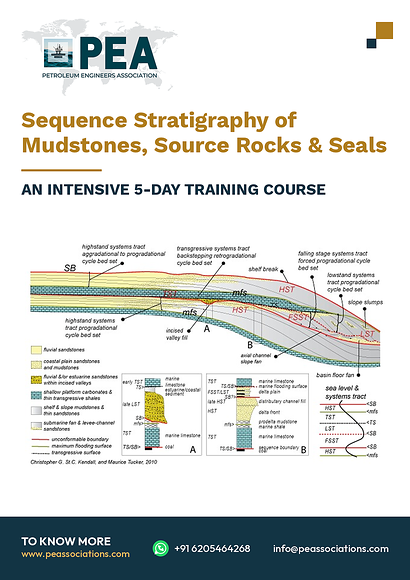
Maximum flooding surfaces concentrate source rock quality, and this is the single most useful predictive relationship in fine-grained stratigraphy. At maximum flooding, the shoreline is at its most landward, clastic input to the basin is at its minimum, and the sediment accumulating offshore is condensed and organic rich. The interval around the maximum flooding surface is therefore where the best source rock is expected, and where the thinnest and most organic rich interval in the succession will typically be found. Identifying that surface locates the source rock.
Seal capacity varies systematically through a sequence and is not a property of mudstone in general. The transgressive and early highstand mudstones deposited at maximum flooding are typically the finest grained, most clay rich and most laterally continuous, giving the highest capillary entry pressures and the best seals. Prograding highstand mudstones are siltier, coarser and more variable. A seal risk assessment that treats the whole shale interval as one unit misses a difference that may be an order of magnitude in retainable column height.
Finally, unconventional reservoir quality depends on the same stratigraphic controls, and it works against itself. The best source intervals are clay rich, which makes them ductile and difficult to stimulate. The most brittle intervals are silica or carbonate rich, which usually means more dilution and lower organic content. The commercial target is therefore a compromise, and finding it requires the organic and mineralogical variation through the succession to be mapped stratigraphically rather than treated as a bulk average over a thick interval.
By the end of this training, participants will be able to:
- Explain mudstone transport and depositional processes including current deposition of mud
- Describe and classify mudstones using appropriate component and fabric schemes
- Assess organic matter production, preservation and dilution controls
- Identify condensed sections and maximum flooding surfaces in fine-grained successions
- Build sequence stratigraphic frameworks in mudstone dominated successions
- Predict source rock quality distribution from the stratigraphic framework
- Assess seal capacity variation through a sequence
- Relate mudstone mineralogy to seal and completion properties
- Apply the framework to unconventional reservoir targeting
- Specify core and analytical programmes for fine-grained successions
Organisations sending participants to this training will:
- Predict source rock quality and distribution stratigraphically
- Assess seal risk by stratigraphic position rather than bulk interval
- Improve unconventional target selection and landing zone definition
- Extract more value from mudstone intervals already cored
- Improve basin modelling input through better source characterisation
- Build capability in the rocks that hold source, seal and unconventional reservoir
Participants will:
- Describe and interpret mudstones systematically
- Build sequence frameworks in fine-grained successions
- Predict source rock quality from stratigraphic position
- Assess seal capacity variation quantitatively
- Select unconventional targets on stratigraphic grounds
- Build capability in a long neglected part of the section
- Exploration geologists assessing source and seal
- Geochemists working on source rock characterisation
- Unconventional reservoir geoscientists
- Petrophysicists evaluating mudstone intervals
- Basin modellers requiring source rock input
- Stratigraphers working in fine-grained successions
- Geoscientists working on seal risk and trap integrity
Module 1 - Mudstone Sedimentology
- Mud composition and grain size definitions
- Clay mineralogy and its variation
- Flocculation and aggregate transport
- Current transport of mud and fluid muds
- Settling from suspension and its limits
- Hyperpycnal and hypopycnal mud transport
- Bottom current reworking of mud
- Mud deposition in deepwater settings
- Biogenic contributions: silica and carbonate
- Volcanic ash and its contribution
- Mudstone accumulation rates
Module 2 - Mudstone Description and Classification
- Mudstone classification schemes
- Components: clay, silt, organic, biogenic, authigenic
- Lamination types and their origin
- Silt laminae and their transport significance
- Bioturbation in mudstones
- Fabric and fissility
- Concretions, nodules and early cements
- Core description protocols for mudstones
- Thin section and scanning electron microscope methods
- X-ray diffraction and mineralogical quantification
- Elemental analysis and its stratigraphic use
- Establishing a mudstone facies scheme
Module 3 - Organic Matter and Source Rock Development
- Organic matter sources: marine, terrestrial, bacterial
- Primary productivity and its controls
- Preservation and the oxygenation control
- Anoxia development and persistence
- Dilution by clastic and carbonate input
- Interaction of production, preservation and dilution
- Organic carbon content and its measurement
- Kerogen type and hydrogen index
- Pyrolysis methods and their interpretation
- Organic matter distribution within a sequence
- Lateral variation in source quality
- Source rock thickness and its stratigraphic control
Module 4 - Condensed Sections and Key Surfaces
- Condensed section definition and formation
- Sediment starvation and its causes
- Maximum flooding surface identification in mudstones
- Log signature of condensed intervals
- Glauconite, phosphate and authigenic minerals
- Faunal abundance and diversity in condensed sections
- Hardgrounds and omission surfaces
- Sequence boundaries within fine-grained successions
- Transgressive surfaces in mudstone sections
- Correlating surfaces through mudstone dominated intervals
- Biostratigraphic and chemostratigraphic support
- Seismic expression of condensed intervals
Module 5 - Sequence Frameworks in Fine-Grained Successions
- Accommodation and supply in mud dominated settings
- Systems tract expression in mudstones
- Transgressive mudstone character
- Highstand mudstone character and silt content
- Lowstand mudstone and basin floor deposits
- Parasequence recognition in fine-grained sections
- Stacking patterns from log and geochemical data
- High frequency cyclicity in mudstones
- Orbital forcing records in fine-grained successions
- Framework construction from limited data
- Scale and resolution considerations
- Testing a fine-grained framework
Module 6 - Seal Properties and Their Variation
- Seal mechanisms and capillary entry pressure
- Pore throat size and its measurement
- Mercury injection data and column height conversion
- Mineralogy control on seal capacity
- Clay content and type effects
- Silt content and its degradation of seal quality
- Compaction and burial effects on seal capacity
- Overpressure and its relation to sealing
- Seal thickness and continuity requirements
- Seal capacity variation through a sequence
- Lateral seal continuity assessment
- Fracture susceptibility and seal failure
Module 7 - Prediction of Source and Seal Quality
- Predicting source rock position within a framework
- Predicting organic richness from stratigraphic position
- Lateral prediction of source quality
- Source rock mapping from seismic and well data
- Predicting seal position and quality
- Identifying the best seal interval within a shale section
- Seal risk assessment by stratigraphic position
- Source and seal input to basin modelling
- Source and seal input to prospect risking
- Regional source and seal distribution mapping
- Uncertainty in fine-grained prediction
Module 8 - Application to Unconventional Reservoirs
- Unconventional reservoir quality controls
- Organic content and porosity development
- Organic porosity and its maturity dependence
- Mineralogy and brittleness
- Clay content and completion difficulty
- The trade-off between organic richness and brittleness
- Stratigraphic variation in target quality
- Landing zone selection from the framework
- Stress variation and its stratigraphic control
- Barrier intervals and fracture containment
- Lateral prediction of target quality
- Core and log programmes for unconventional targets
Upon successful completion of this training course, delegates will be awarded an official Certificate of Completion issued by the Petroleum Engineers Association (PEA), an ISO 9001:2015 certified training organization. The certificate carries 10 Credits and formally records the total learning hours completed.
Each certificate is signed by the Course Facilitator and the CEO of the Petroleum Engineers Association, and serves as verifiable proof of professional training that delegates can present to employers and professional bodies worldwide.
Frequently Asked Questions
All course bookings made through PEA are strictly non-refundable. By registering for a course, you acknowledge and accept that all fees are payable in full and are not subject to refund under any circumstances, including changes in personal or professional commitments or partial attendance.
PEA reserves the right to make reasonable adjustments to course content, trainers, or schedules where necessary, without entitling delegates to a refund. Comprehensive details of each course — including objectives, target audience, and content — are clearly outlined before enrolment, and it is the responsibility of the delegate to ensure the course's suitability prior to booking.
For any inquiries related to cancellations or bookings, please contact our support team, who will be happy to assist you.
