


An Interactive 5-Day Training Course
Reefs, Buildups & Carbonate Platform Margins
Mapping and Producing Carbonate Buildups
Secure your spot now!
Duration
5 Days
Price
$ 3,500
Starting From
24 May 2027



Home Geology and Geoscience Reefs, Buildups & Carbonate Platform Margins
Reefs, Buildups & Carbonate Platform Margins
Have Questions ?
Reefs, Buildups & Carbonate Platform Margins - GG-REEF-PEA27
| Code | Date | Time | Duration | Location | Currency | Early Bird Fee Per Person |
|---|---|---|---|---|---|---|
| GG-REEF-PEA27 | 24 - 28 May 2027 | 10 AM CST | 4 Hours Per Day |
Online |
USD |
3500 |
Need this for a group? We deliver the same course in-house — face-to-face at your location or online — tailored to your assets and team level. Contact info@peassociations.com
Boost your team's skills and your budget! Enjoy group discounts for collaborative learning. Send an inquiry to info@peassociations.com.
Reefs, Buildups & Carbonate Platform Margins
Description
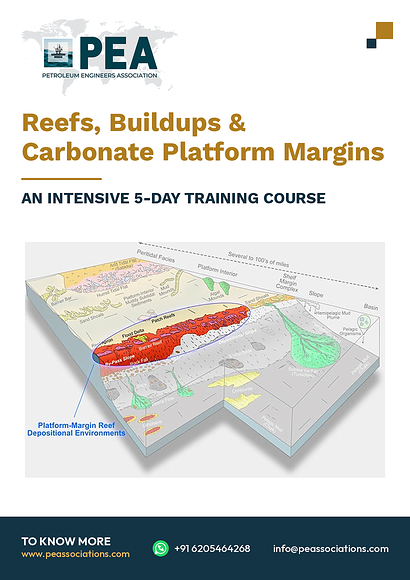
Reef and build-up reservoirs include some of the most productive fields in the world and some of the most difficult to develop. They have strong depositional relief, often with steep flanks and sharply defined edges, which makes them visible on seismic and attractive as exploration targets. Internally they are the most heterogeneous rocks in carbonate geology: a reef has a framework core, a flank of derived debris, a back-reef lagoon and a fore-reef slope, each with different reservoir properties, all within a structure that may be only a few kilometres across.
This training develops build-up reservoirs from biology to development. Framework builders are established first, covering the organisms that have built reefs through the Phanerozoic, their very different construction styles, and the consequences for reef fabric and porosity in rocks of different ages. Reef and build-up types follow, covering barrier, fringing, patch and pinnacle reefs, atolls, mud mounds and microbial build-ups, with their settings and dimensions. Internal zonation is then developed in detail: reef core and framework facies, reef crest, fore-reef talus and breccia, back-reef and lagoon, and the way these shift as the build-up grows. Platform margin architecture follows, covering rimmed margins, escarpment and accretionary margins, margin steepness and its controls, and the slope and toe of slope deposits derived from the margin. Build-up geometry and seismic recognition is treated as a separate skill. Reservoir quality is then developed, including the diagenetic overprint that commonly dominates. The training closes with appraisal and development, where the heterogeneity makes well placement and volume estimation unusually difficult.
Framework builders have changed completely through the Phanerozoic and the resulting rocks differ accordingly. Palaeozoic reefs built by stromatoporoids, tabulate corals and calcareous algae have different fabrics and primary porosity from Mesozoic rudist build-ups, which differ again from Cenozoic scleractinian coral reefs. Rudists in particular built structures that are not reefs in the modern sense, being more like shell banks with a different internal fabric and porosity distribution. Applying a modern coral reef model to a Cretaceous rudist build-up is a common and consequential error.
The flank is frequently a better reservoir than the core. Reef core framework is rigid and may be heavily cemented by early marine cement that fills the primary framework porosity, while the flank, composed of reef derived debris, retains interparticle porosity and may be dolomitised or leached. Many build-up fields produce principally from flank facies rather than from the framework. This inverts the intuitive targeting of the build-up crest and it has to be established from core rather than assumed either way.
Build-up geometry on seismic is both the main exploration advantage and a source of error. A build-up produces a mounded external form with onlap of surrounding sediment, often with velocity pull-up beneath it because of its high velocity, and sometimes with internal reflection free character. Each of these can also be produced by other features: a volcanic edifice, a salt or shale diapir, a channel margin or a processing artefact. Velocity pull-up in particular has been misread as structural closure. Confirming a build-up interpretation requires more than mounded geometry.
Finally, volume estimation in build-ups is dominated by geometry and net to gross uncertainty rather than by property uncertainty. The build-up has steep flanks whose position is imprecisely resolved, its base may be unclear, the proportion of the structure that is reservoir facies varies, and the diagenetic overprint can be laterally variable. The resulting in-place volume range is typically wide, and appraisal wells placed to resolve flank position and facies proportion reduce it more than wells placed to confirm the crest.
By the end of this training, participants will be able to:
- Identify framework building organisms and their construction styles through geological time
- Classify reef, mound and build-up types and their settings
- Interpret internal zonation including core, crest, flank and back-reef facies
- Characterise platform margin architecture and margin types
- Interpret slope and toe of slope deposits derived from margins
- Recognise build-ups on seismic and distinguish them from look-alikes
- Assess velocity effects including pull-up and their structural consequences
- Evaluate reservoir quality distribution within a build-up
- Assess diagenetic overprint and its control on producibility
- Plan appraisal and development of build-up reservoirs
Organisations sending participants to this training will:
- Identify build-ups on seismic with fewer false positives
- Avoid structural errors from velocity pull-up
- Target the producible facies within a build-up correctly
- Reduce volume uncertainty through better appraisal placement
- Improve development well placement in heterogeneous build-ups
- Build capability for a high value carbonate play type
Participants will:
- Interpret build-up facies and internal zonation
- Recognise build-ups and their look-alikes on seismic
- Assess reservoir quality distribution within a build-up
- Estimate volumes with appropriate geometric uncertainty
- Plan appraisal that reduces the uncertainties that matter
- Build specialist capability in build-up reservoirs
- Exploration geoscientists evaluating build-up plays
- Seismic interpreters mapping carbonate build-ups
- Reservoir geologists working on build-up fields
- Reservoir modellers building heterogeneous carbonate models
- Petrophysicists evaluating build-up reservoirs
- Reservoir engineers developing build-up fields
- Geoscientists requiring specialist carbonate capability
Module 1 - Framework Builders Through Time
- Reef building and its ecological requirements
- Archaeocyathids and early metazoan reefs
- Stromatoporoids and tabulate corals
- Palaeozoic reef construction styles
- Permian and Triassic reef systems
- Rudist bivalves and Cretaceous build-ups
- Scleractinian corals and Cenozoic reefs
- Calcareous algae and their role
- Microbial contributions to reef construction
- Reef gaps after mass extinctions
- Fabric and porosity consequences by builder type
- Why modern analogues mislead for ancient reefs
Module 2 - Build-up Types and Settings
- Reef classification schemes
- Fringing reefs and their setting
- Barrier reefs and platform margin reefs
- Patch reefs and their dimensions
- Pinnacle reefs and their geometry
- Atolls and their evolution
- Mud mounds and their origin
- Microbial and automicrite build-ups
- Bioclastic banks and shoals
- Build-up dimensions and aspect ratios
- Build-up distribution within a platform
- Settings favouring build-up development
Module 3 - Internal Zonation and Facies
- Reef core and framework facies
- Framework porosity and early cementation
- Reef crest and high energy facies
- Fore-reef talus and breccia
- Debris apron geometry and extent
- Back-reef and reef flat facies
- Lagoonal facies behind the build-up
- Facies transitions and their sharpness
- Vertical facies change during build-up growth
- Build-up growth phases: initiation, growth, drowning
- Backstepping and aggradation
- Zonation in different build-up types
Module 4 - Platform Margins and Slopes
- Platform margin types and their geometry
- Rimmed margins and their reef association
- Accretionary and prograding margins
- Escarpment and bypass margins
- Margin steepness and its controls
- Margin collapse and megabreccia
- Slope facies and their gradation
- Periplatform ooze and its character
- Calciturbidites and carbonate debris flows
- Toe of slope apron deposits
- Slope and apron reservoir potential
- Margin and slope relationship to build-up reservoirs
Module 5 - Seismic Recognition and Mapping
- Build-up seismic expression
- Mounded external form and onlap relationships
- Internal reflection character
- Velocity contrast and its effects
- Velocity pull-up and its magnitude
- Misinterpretation of pull-up as structure
- Look-alike features: volcanics, diapirs, channels
- Processing artefacts resembling build-ups
- Seismic attributes for build-up detection
- Build-up geometry mapping and its uncertainty
- Defining build-up flanks and base
- Confirming a build-up interpretation
Module 6 - Reservoir Quality in Build-ups
- Primary porosity in framework and flank facies
- Early marine cementation and its effects
- Framework porosity occlusion
- Flank facies porosity preservation
- Meteoric diagenesis during exposure
- Karst development on build-up tops
- Dolomitisation of build-ups
- Burial cementation and compaction
- Reservoir quality distribution within a build-up
- Why flanks often outperform cores
- Rock typing in build-up reservoirs
- Predicting producible facies distribution
Module 7 - Volume Estimation and Appraisal
- Gross rock volume in build-up geometry
- Flank position uncertainty and its effect
- Base of build-up definition
- Depth conversion over and around build-ups
- Net to gross estimation in heterogeneous build-ups
- Porosity and saturation distributions
- Volume uncertainty ranges in build-ups
- Which uncertainties dominate the range
- Appraisal well objectives and placement
- Flank wells against crestal wells
- Data acquisition priorities in appraisal
- Reducing uncertainty efficiently
Module 8 - Development of Build-up Reservoirs
- Development concepts for build-up fields
- Well placement in heterogeneous build-ups
- Horizontal wells and facies targeting
- Connectivity between build-up facies
- Aquifer support and its variability
- Gas cap and contact behaviour
- Water coning in high permeability zones
- Fracture contribution in build-ups
- Pressure maintenance options
- Surveillance in heterogeneous reservoirs
- Infill drilling and remaining oil
- Field cases from build-up developments
Upon successful completion of this training course, delegates will be awarded an official Certificate of Completion issued by the Petroleum Engineers Association (PEA), an ISO 9001:2015 certified training organization. The certificate carries 10 Credits and formally records the total learning hours completed.
Each certificate is signed by the Course Facilitator and the CEO of the Petroleum Engineers Association, and serves as verifiable proof of professional training that delegates can present to employers and professional bodies worldwide.
Frequently Asked Questions
All course bookings made through PEA are strictly non-refundable. By registering for a course, you acknowledge and accept that all fees are payable in full and are not subject to refund under any circumstances, including changes in personal or professional commitments or partial attendance.
PEA reserves the right to make reasonable adjustments to course content, trainers, or schedules where necessary, without entitling delegates to a refund. Comprehensive details of each course — including objectives, target audience, and content — are clearly outlined before enrolment, and it is the responsibility of the delegate to ensure the course's suitability prior to booking.
For any inquiries related to cancellations or bookings, please contact our support team, who will be happy to assist you.
