


An Interactive 5-Day Training Course
Pore Pressure Prediction from Seismic & Logs
Predicting Pore Pressure Before You Drill
Secure your spot now!
Duration
5 Days
Price
$ 3,500
Starting From
25 Jan 2027



Home Geology and Geoscience Pore Pressure Prediction from Seismic & Logs
Pore Pressure Prediction from Seismic & Logs
Have Questions ?
Pore Pressure Prediction from Seismic & Logs - GG-PPP-PEA27
| Code | Date | Time | Duration | Location | Currency | Early Bird Fee Per Person |
|---|---|---|---|---|---|---|
| GG-PPP-PEA27 | 25 - 29 Jan 2027 | 10 AM CST | 4 Hours Per Day |
Online |
USD |
3500 |
Need this for a group? We deliver the same course in-house — face-to-face at your location or online — tailored to your assets and team level. Contact info@peassociations.com
Boost your team's skills and your budget! Enjoy group discounts for collaborative learning. Send an inquiry to info@peassociations.com.
Pore Pressure Prediction from Seismic & Logs
This training covers pore pressure prediction from seismic and log data. It works through overpressure generation mechanisms, normal compaction trends, prediction methods and their assumptions, velocity based prediction from seismic, log based prediction, centroid and lateral transfer effects, mechanism dependence of method validity, real time pressure monitoring while drilling and the delivery of pressure predictions with their uncertainty.
Description
Pore pressure prediction determines the casing design, the mud weight programme and whether a well can be drilled safely. An underprediction risks an influx and a well control incident; an overprediction leads to unnecessary casing strings, lost circulation and in some cases the abandonment of a viable prospect. The prediction is made before the well is drilled from seismic velocities and from analogue log data, and its reliability depends almost entirely on whether the mechanism generating the overpressure is correctly identified.
This training covers the subject thoroughly. Overpressure generation mechanisms are established first, covering disequilibrium compaction, fluid expansion from diagenesis and hydrocarbon generation, lateral transfer, tectonic loading and hydraulic connection, with the diagnostic signature each leaves in the log and velocity data. Normal compaction trends follow, covering their construction, their lithology dependence and the consequences of getting them wrong. Prediction methods are then developed, covering Eaton, Bowers, Miller and effective stress approaches, with explicit attention to the assumption each makes and therefore the mechanism each is valid for. Velocity based prediction from seismic follows, covering velocity estimation quality, the resolution available and the uncertainty it carries. Log based prediction is then addressed. Centroid and lateral transfer effects follow. Real time monitoring while drilling is then developed. The training closes with uncertainty and delivery.
The prediction method has to match the overpressure mechanism or it will be wrong. Eaton and other porosity based methods assume that overpressure results from undercompaction, so that excess pressure corresponds to excess porosity and hence low velocity. Where overpressure is generated by fluid expansion after the rock has already compacted, the porosity is normal and the velocity reduction is small or absent, so a porosity based method will substantially underpredict the pressure. The Bowers unloading approach was developed specifically for this situation. Identifying the mechanism is therefore the first step, not an afterthought.
The normal compaction trend is a choice that controls the answer. Pressure prediction from porosity based methods works by measuring the departure of the observed velocity or resistivity from the trend expected for normally pressured rock of the same lithology at the same depth. If the trend is drawn too steeply, pressure is underpredicted; too shallowly and it is overpredicted. The trend must be built on shale data only, excluding sands and carbonates, and should be established from wells with known normal pressure in the same basin and lithology.
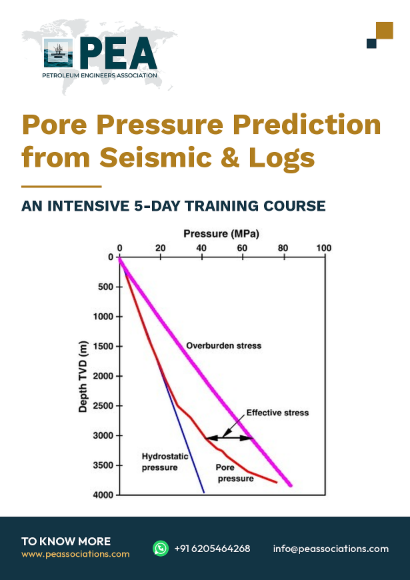
The centroid effect means a dipping reservoir has different pressure at its crest than its flank. Within a permeable body embedded in a sealing shale, the fluid pressure follows a fluid gradient while the surrounding shale pressure follows the much steeper lithostatic-related trend. The two coincide at one depth, the centroid, and diverge above and below it. At the crest, the reservoir pressure exceeds the shale pressure, giving a lower-than-expected fracture margin and a kick risk that a shale-based prediction will miss entirely. This is a common cause of well control incidents in structurally positioned targets.
Finally, the prediction must be updated while drilling. The pre-drill prediction is a model, and every metre drilled provides data to test it: drilling parameters, cuttings, gas levels, connection gas, resistivity and sonic from logging while drilling, and any direct pressure measurement. A monitoring process that compares the observed data against the prediction continuously, and revises the look-ahead accordingly, is far more valuable than the most carefully constructed static prediction used unchanged.
By the end of this training, participants will be able to:
- Identify overpressure generation mechanisms from log and velocity signatures
- Construct normal compaction trends on a defensible basis
- Select prediction methods appropriate to the generating mechanism
- Apply Eaton, Bowers and effective stress methods
- Predict pore pressure from seismic velocities
- Assess the resolution and uncertainty of velocity based prediction
- Predict pore pressure from log data in offset wells
- Account for centroid and lateral transfer effects
- Monitor and update pressure predictions while drilling
- Deliver pressure predictions with ranges and their basis
The training works on basin data sets with known drilling outcomes. Participants identify mechanisms from the data, construct compaction trends, and produce pre-drill predictions which are then compared against the measured pressures and the drilling events of the actual wells. Centroid calculations are run on dipping reservoirs. Real time data sequences are supplied for monitoring exercises against an initial prediction.
Organisations sending participants to this training will:
- Improve pre-drill pressure prediction accuracy
- Select methods appropriate to the overpressure mechanism
- Account for centroid effects in structurally positioned targets
- Reduce well control and lost circulation incidents
- Avoid unnecessary casing strings from overprediction
- Monitor and revise predictions effectively while drilling
Participants will:
- Diagnose overpressure mechanisms from data
- Build compaction trends correctly
- Apply the right prediction method
- Predict pressure from seismic and logs
- Recognise centroid risk
- Monitor pressure while drilling
- Petrophysicists and pore pressure specialists
- Drilling engineers and well planners
- Geoscientists supporting well planning
- Seismic interpreters producing velocity models
- Geomechanics staff
- Operations geologists monitoring while drilling
- Technical staff reviewing pressure predictions
Module 1 - Overpressure Mechanisms
- Hydrostatic and normal pressure
- Overpressure definition and magnitude
- Disequilibrium compaction
- Sedimentation rate and permeability controls
- Fluid expansion mechanisms
- Clay diagenesis and smectite to illite
- Hydrocarbon generation and gas cracking
- Aquathermal expansion and its limits
- Lateral transfer and hydraulic connection
- Tectonic loading and compression
- Osmotic and chemical mechanisms
- Diagnostic signatures of each mechanism
Module 2 - Normal Compaction Trends
- Compaction and porosity loss with depth
- Velocity and resistivity trends with depth
- Shale point selection
- Excluding sand and carbonate data
- Trend construction from normally pressured wells
- Lithology dependence of trends
- Basin specific trends
- Uplift and erosion effects on trends
- Trend sensitivity of predicted pressure
- Multiple trend testing
- Documenting the trend basis
Module 3 - Prediction Methods
- Equivalent depth method
- Eaton method and its exponent
- Eaton assumptions and validity
- Bowers method and virgin curve
- Bowers unloading and its application
- Miller method
- Effective stress based approaches
- Compaction and unloading distinction
- Method selection by mechanism
- Calibration of method parameters
- Method comparison on the same data
- Consequences of method mismatch
Module 4 - Seismic Velocity Based Prediction
- Velocity sources: stacking, tomography, inversion
- Velocity quality and its spatial variation
- Interval against instantaneous velocity
- Anisotropy effects on velocity
- Velocity resolution and prediction resolution
- Converting velocity to effective stress
- Velocity to pressure transforms and their calibration
- Rock physics basis for the transform
- Lithology effects on velocity
- Gas effects on velocity
- Pressure cube construction
- Uncertainty in velocity based prediction
Module 5 - Log Based Prediction
- Log data for pressure prediction
- Sonic based prediction
- Resistivity based prediction
- Density based approaches
- Shale selection from logs
- Offset well prediction and its transfer
- Logging while drilling data use
- Mud weight and pressure indicators
- Direct pressure measurement types
- Formation pressure test interpretation
- Kick and influx pressure data
- Calibration of predictions against measurements
Module 6 - Centroid and Lateral Effects
- Centroid concept and geometry
- Fluid gradient against shale pressure trend
- Crestal pressure elevation
- Centroid depth determination
- Centroid calculation for a dipping reservoir
- Fracture margin reduction at the crest
- Lateral transfer in connected systems
- Pressure transfer across faults
- Buoyancy effects in gas columns
- Reservoir connectivity and pressure distribution
- Implications for well control
- Implications for seal capacity
Module 7 - Real Time Monitoring
- Monitoring programme design
- Drilling parameter indicators
- Rate of penetration and d-exponent
- Cuttings and shale density
- Gas levels and connection gas
- Background and trip gas
- Logging while drilling resistivity and sonic
- Annular pressure while drilling
- Comparing observed against predicted
- Updating the look-ahead prediction
- Decision points and casing calls
- Communication with the rig team
Module 8 - Uncertainty and Delivery
- Uncertainty sources in prediction
- Mechanism uncertainty
- Trend and parameter uncertainty
- Velocity uncertainty contribution
- Multiple scenario prediction
- Most likely and extreme case profiles
- Pressure prediction deliverable content
- Presenting pressure with fracture gradient
- Mud weight window delivery
- Casing design implications
- Post-well review of predictions
- Building basin prediction capability
Upon successful completion of this training course, delegates will be awarded an official Certificate of Completion issued by the Petroleum Engineers Association (PEA), an ISO 9001:2015 certified training organization. The certificate carries 10 Credits and formally records the total learning hours completed.
Each certificate is signed by the Course Facilitator and the CEO of the Petroleum Engineers Association, and serves as verifiable proof of professional training that delegates can present to employers and professional bodies worldwide.
Frequently Asked Questions
All course bookings made through PEA are strictly non-refundable. By registering for a course, you acknowledge and accept that all fees are payable in full and are not subject to refund under any circumstances, including changes in personal or professional commitments or partial attendance.
PEA reserves the right to make reasonable adjustments to course content, trainers, or schedules where necessary, without entitling delegates to a refund. Comprehensive details of each course — including objectives, target audience, and content — are clearly outlined before enrolment, and it is the responsibility of the delegate to ensure the course's suitability prior to booking.
For any inquiries related to cancellations or bookings, please contact our support team, who will be happy to assist you.
