


An Interactive 5-Day Training Course
Fault Reactivation, Rupture Risk & Induced Seismicity
Managing Fault Reactivation and Induced Seismicity
Secure your spot now!
Duration
5 Days
Price
$ 4,000
Starting From
16 Aug 2027



Home Geology and Geoscience Fault Reactivation, Rupture Risk & Induced Seismicity
Fault Reactivation, Rupture Risk & Induced Seismicity
Have Questions ?
Fault Reactivation, Rupture Risk & Induced Seismicity - GG-FRUPT-PEA27
| Code | Date | Time | Duration | Location | Currency | Early Bird Fee Per Person |
|---|---|---|---|---|---|---|
| GG-FRUPT-PEA27 | 16 - 20 Aug 2027 | 10 AM CST | 4 Hours Per Day |
Online |
USD |
4000 |
Need this for a group? We deliver the same course in-house — face-to-face at your location or online — tailored to your assets and team level. Contact info@peassociations.com
Boost your team's skills and your budget! Enjoy group discounts for collaborative learning. Send an inquiry to info@peassociations.com.
Fault Reactivation, Rupture Risk & Induced Seismicity
This training covers fault reactivation and induced seismicity in subsurface operations. It works through stress state determination and fault stability analysis, the mechanisms by which injection and depletion change stress, slip tendency and critical pore pressure, seismic hazard assessment, monitoring and traffic light systems, operational controls, and the regulatory and stakeholder dimensions of induced seismicity management.
Description
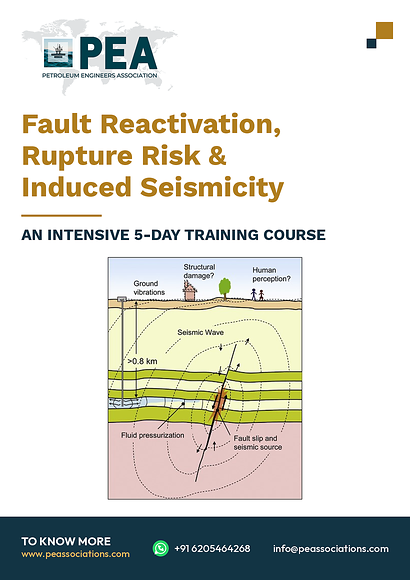
Subsurface operations change the stress acting on faults. Injection raises pore pressure, which reduces effective normal stress and brings faults closer to failure. Depletion lowers pore pressure in the reservoir while leaving the surrounding rock unchanged, which alters the stress path in ways that can destabilise faults both inside and outside the producing volume. Cooling from injected fluid adds thermal stress changes. Where a fault is already close to failure, any of these can cause slip, which releases seismic energy, can damage wells and caprock, and in populated areas becomes a public and regulatory matter.
This training covers the assessment and management of that risk. Stress state determination is established first, covering the measurement and estimation of stress magnitudes and orientation, the data available in a typical field and the uncertainty in each. Fault stability analysis follows, covering the resolution of stress onto fault planes, slip tendency, the critical pore pressure increment to failure, and the identification of critically stressed faults. The mechanisms of stress change are then developed in detail: pore pressure increase from injection, the depletion stress path and its arching effects, poroelastic stress transfer beyond the reservoir, and thermal stresses. Seismic hazard assessment follows, covering magnitude estimation from fault dimensions, ground motion and the relationship between operational parameters and observed seismicity. Monitoring is then addressed, covering seismic array design, detection thresholds and real-time interpretation. Traffic light systems and operational controls follow. The training closes with regulatory frameworks and stakeholder communication.
The critical pore pressure increment is the number that matters operationally. For a given fault plane in a given stress field, there is a pore pressure increase at which the shear stress on that plane exceeds its frictional strength and it slips. Calculating that increment for every mapped fault, given the stress state and its uncertainty, identifies which faults are close to failure and how much injection pressure margin exists. It converts a structural map into an operational constraint that injection planning can work with.
Depletion destabilises faults in a less obvious way than injection. Reducing pore pressure in a reservoir increases effective stress and compacts it, but because the surrounding rock does not deplete, stress arches around the depleting volume. The result is that stress changes are transmitted into the bounding faults and into the overburden, and the stress path can move a fault towards failure even though pressure there has fallen. Several documented cases of production induced seismicity, including shallow events above depleting gas fields, arise this way.
Maximum magnitude depends on fault size, which is why mapping matters. The energy released in a slip event scales with the rupture area, so a small fault can only produce a small event while a large mapped fault has the potential for a larger one. A risk assessment that identifies which faults are critically stressed and how large they are therefore produces a bounded expectation for magnitude. Faults below seismic resolution are a genuine uncertainty here, since they cannot be mapped but are limited in size by definition.
Finally, induced seismicity is managed operationally rather than eliminated. Traffic light systems link observed event magnitudes to defined operational responses, from continuing unchanged, through rate reduction, to suspension. They work when the monitoring can detect events well below the threshold of concern, when the response actions are agreed and rehearsed in advance, and when the decision authority is clear. Designing that system before injection starts is substantially easier than designing it after the first felt event.
By the end of this training, participants will be able to:
- Determine in situ stress magnitudes and orientation from available field data
- Resolve stress onto fault planes and calculate slip and dilation tendency
- Calculate critical pore pressure increments for mapped faults
- Identify critically stressed faults and assess their reactivation risk
- Assess stress changes caused by injection, depletion and thermal effects
- Evaluate poroelastic stress transfer beyond the reservoir volume
- Estimate maximum credible magnitude from fault dimensions
- Design microseismic and seismic monitoring programmes
- Design and operate traffic light systems and operational controls
- Address regulatory requirements and communicate risk to stakeholders
The training works through stress and fault stability calculations on real field data, with participants determining stress states from available measurements, assessing fault stability and calculating critical pressure increments across a mapped fault population. Depletion and injection stress paths are modelled and their fault stability consequences compared. Monitoring array performance is assessed against detection requirements. Documented induced seismicity cases are examined for the mechanism, the warning signs available beforehand and the operational response.
Organisations sending participants to this training will:
- Assess induced seismicity risk before operations begin
- Set injection pressure and rate limits on a technical basis
- Design monitoring that detects events early enough to respond
- Meet regulatory requirements for seismicity management
- Reduce the risk of well and caprock damage from fault slip
- Build capability required for injection and storage projects
Participants will:
- Determine stress states and assess fault stability
- Calculate reactivation thresholds for specific faults
- Assess depletion and injection stress effects
- Design monitoring and traffic light systems
- Support regulatory submissions on seismicity
- Build capability in a discipline required across injection projects
- Geomechanics specialists and structural geologists
- Reservoir engineers planning injection operations
- Carbon storage and water disposal project staff
- Geothermal project geoscientists and engineers
- Unconventional completion and stimulation engineers
- HSE and regulatory affairs staff
- Technical staff responsible for subsurface risk assessment
Module 1 - Stress State Determination
- In situ stress components and regimes
- Vertical stress from density integration
- Minimum horizontal stress from leak-off and minifrac
- Maximum horizontal stress estimation methods
- Breakout and tensile fracture analysis
- Stress orientation from image logs
- Regional stress maps and their use
- Stress uncertainty and its quantification
- Pore pressure determination
- Stress variation with depth and lithology
- Building a geomechanical model
Module 2 - Fault Stability Analysis
- Resolving stress onto a fault plane
- Normal and shear stress calculation
- Mohr-Coulomb failure on fault planes
- Friction coefficient and cohesion on faults
- Slip tendency definition and mapping
- Dilation tendency and fracture opening
- Critical pore pressure increment calculation
- Fracture stability diagrams
- Critically stressed fault identification
- Fault orientation and stability relationships
- Mapping stability across a fault population
- Uncertainty in stability assessment
Module 3 - Stress Change from Injection
- Pore pressure increase and effective stress reduction
- Pressure front propagation from injection wells
- Pressure diffusion and its timescale
- Hydraulic connection to faults
- Direct pressurisation of fault zones
- Injection rate and pressure relationships
- Fracture pressure constraints
- Thermal stress from cold fluid injection
- Thermal front propagation
- Combined pressure and thermal effects
- Injection induced seismicity mechanisms
- Documented injection induced cases
Module 4 - Stress Change from Depletion
- Depletion and effective stress increase
- Reservoir compaction and its stress effect
- Stress path during depletion
- Stress arching around the depleting volume
- Poroelastic stress transfer to surroundings
- Overburden stress changes
- Fault stability inside and outside the reservoir
- Differential compaction across faults
- Shallow seismicity above depleting fields
- Subsidence and surface deformation
- Documented depletion induced cases
- Modelling depletion stress paths
Module 5 - Seismic Hazard Assessment
- Magnitude definitions and scales
- Rupture area and magnitude relationships
- Maximum credible magnitude from fault dimensions
- Unmapped fault uncertainty
- Seismogenic depth considerations
- Ground motion prediction
- Felt thresholds and damage thresholds
- Site specific hazard considerations
- Probabilistic hazard assessment approaches
- Distinguishing induced from natural seismicity
- Baseline seismicity characterisation
- Risk assessment framework
Module 6 - Monitoring
- Monitoring objectives and requirements
- Surface seismic array design
- Borehole geophone arrays
- Detection threshold and magnitude of completeness
- Array geometry and location accuracy
- Event detection and location processing
- Magnitude determination
- Focal mechanism analysis
- Real-time monitoring and alerting
- Baseline monitoring before operations
- Data management and reporting
- Integrating seismic with pressure and injection data
Module 7 - Operational Control
- Traffic light system design
- Threshold magnitude selection
- Response actions at each level
- Rate and pressure reduction protocols
- Suspension and restart criteria
- Decision authority and escalation
- Pre-agreed response planning
- Injection design to reduce risk
- Well placement relative to critical faults
- Pressure management strategies
- Rehearsing the response
- Reviewing and updating the system
Module 8 - Regulation and Stakeholders
- Regulatory frameworks for induced seismicity
- Jurisdictional differences in approach
- Permitting requirements and submissions
- Required assessments before operations
- Reporting obligations
- Liability and insurance considerations
- Public concern and its drivers
- Communication of risk to communities
- Transparency and data sharing
- Managing a felt event and its aftermath
- Industry guidance and good practice
- Case studies of regulatory and public outcomes
Upon successful completion of this training course, delegates will be awarded an official Certificate of Completion issued by the Petroleum Engineers Association (PEA), an ISO 9001:2015 certified training organization. The certificate carries 10 Credits and formally records the total learning hours completed.
Each certificate is signed by the Course Facilitator and the CEO of the Petroleum Engineers Association, and serves as verifiable proof of professional training that delegates can present to employers and professional bodies worldwide.
Frequently Asked Questions
All course bookings made through PEA are strictly non-refundable. By registering for a course, you acknowledge and accept that all fees are payable in full and are not subject to refund under any circumstances, including changes in personal or professional commitments or partial attendance.
PEA reserves the right to make reasonable adjustments to course content, trainers, or schedules where necessary, without entitling delegates to a refund. Comprehensive details of each course — including objectives, target audience, and content — are clearly outlined before enrolment, and it is the responsibility of the delegate to ensure the course's suitability prior to booking.
For any inquiries related to cancellations or bookings, please contact our support team, who will be happy to assist you.
