


An Interactive 5-Day Training Course
Salt Tectonics & Salt Basin Exploration
How Moving Salt Builds Traps
Secure your spot now!
Duration
5 Days
Price
$ 3,500
Starting From
28 Jun 2027



Home Geology and Geoscience Salt Tectonics & Salt Basin Exploration
Salt Tectonics & Salt Basin Exploration
Have Questions ?
Salt Tectonics & Salt Basin Exploration - GG-SALT-PEA27
| Code | Date | Time | Duration | Location | Currency | Early Bird Fee Per Person |
|---|---|---|---|---|---|---|
| GG-SALT-PEA27 | 28 Jun - 02 Jul 2027 | 10 AM CST | 4 Hours Per Day |
Online |
USD |
3500 |
Need this for a group? We deliver the same course in-house — face-to-face at your location or online — tailored to your assets and team level. Contact info@peassociations.com
Boost your team's skills and your budget! Enjoy group discounts for collaborative learning. Send an inquiry to info@peassociations.com.
Salt Tectonics & Salt Basin Exploration
This training covers salt tectonics and its application to exploration. It works through salt mechanical behaviour and the drivers of flow, diapirism mechanisms and canopy development, minibasin subsidence and salt weld formation, structural styles across salt provinces, seismic imaging and velocity modelling in salt, restoration of salt structures, and the trap configurations and exploration workflows of salt basins.
Description
Salt deforms by viscous flow at geological strain rates, which makes salt provinces structurally unlike anything else. Structures grow continuously through sedimentation rather than in discrete tectonic events, the overburden deforms in response to salt withdrawal beneath it, and the resulting geometries, diapirs, walls, canopies, minibasins, turtle structures and welds, have no counterpart in conventional structural geology. Salt provinces are also disproportionately prospective, holding major reserves in the Gulf of Mexico, the South Atlantic, the North Sea, the Precaspian and the Middle East.
This training develops salt tectonics and applies it to exploration. Salt mechanics are established first: rheology, flow laws, density relationships, and the drivers of movement including differential loading, gravity gliding and spreading, and tectonic shortening and extension. Diapirism follows, covering reactive, active and passive mechanisms, the conditions for each, diapir geometry and the stratigraphic record of growth. Allochthonous salt is then developed, covering sheet advance mechanisms, canopy coalescence, roof sequences and the complexity of multi-level salt. Minibasins and welds follow, covering subsidence mechanisms, minibasin stratigraphy and its record of salt evolution, weld types and their sealing significance. Structural styles across the major salt provinces are then compared. Seismic imaging and velocity model building in salt are developed as a distinct technical problem. Restoration of salt structures follows. The training closes with trap configurations, the petroleum systems of salt basins and exploration workflow.
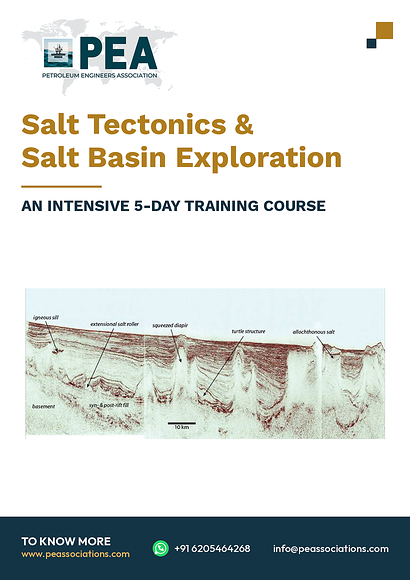
Minibasin stratigraphy records salt movement and is the most useful evidence available. As salt withdraws from beneath a depocentre, the overlying sediment subsides, creating accommodation that fills with sediment thicker than that deposited on adjacent salt highs. Thickness variation, onlap relationships, growth packages and halokinetic sequences at the minibasin margins therefore record when salt moved, how fast and in what direction. Reading that record reconstructs the salt history, which constrains trap formation timing and its relationship to charge.
Salt welds are structurally significant and poorly resolvable. A weld is the surface left where salt has been almost entirely withdrawn, bringing the overburden into contact with the sub-salt section. Welds are commonly at or below seismic resolution, so whether residual salt remains is often unknown. That matters because a weld with salt remaining is a seal and a weld without may be a migration pathway. Welds also accommodate significant displacement, acting as detachments, so they are structural surfaces as well as potential seals.
Allochthonous salt makes imaging and interpretation substantially harder. A salt sheet emplaced at shallow level above younger sediments inverts the normal stratigraphic order, and where multiple sheets have coalesced into canopies, the section may contain several salt bodies at different levels with sediment between them. Interpreting the base of each, building a velocity model that honours them and imaging beneath them is a major technical undertaking, and the resulting subsalt image carries depth uncertainty that must be stated honestly in prospect evaluation.
Finally, traps in salt provinces form and evolve continuously, which makes timing central. A structure adjacent to a growing diapir changes shape throughout its history, closure may have formed early or late, and a trap that exists today may not have existed when charge occurred. Equally, salt movement may have breached a trap that previously held. Restoration of the salt structure through time is therefore not an academic exercise but a direct input to charge risk.
By the end of this training, participants will be able to:
- Explain salt rheology and the drivers of salt flow
- Interpret diapirism mechanisms and recognise their stratigraphic record
- Characterise allochthonous salt, sheets and canopies
- Interpret minibasin stratigraphy as a record of salt movement
- Identify salt welds and assess their sealing and structural significance
- Compare structural styles across the major salt provinces
- Assess seismic imaging limitations and velocity model issues in salt
- Restore salt structures and reconstruct their evolution through time
- Identify trap configurations in salt provinces and their charge requirements
- Apply salt tectonic understanding to exploration evaluation and risking
The training is worked on seismic data from salt provinces, with participants interpreting salt geometry, mapping minibasin growth packages and reconstructing salt movement history. Restorations are constructed and tested for area and volume consistency. Velocity model and imaging issues are examined directly on data where subsalt interpretation differs between processing vintages. Traps are evaluated with explicit timing analysis relating structural evolution to charge history.
Organisations sending participants to this training will:
- Interpret salt provinces with correct structural reasoning
- Assess subsalt depth and structural uncertainty honestly
- Reconstruct trap timing relative to charge
- Identify weld related seal and migration risks
- Improve prospect evaluation in high value salt basins
- Build capability for some of the most prospective basins worldwide
Participants will:
- Interpret salt structures and their evolution
- Read minibasin stratigraphy as a salt movement record
- Restore salt structures through time
- Assess subsalt imaging limitations
- Evaluate salt basin traps and their timing
- Build specialist capability in salt tectonics
- Exploration geoscientists working in salt basins
- Structural geologists and seismic interpreters
- Geophysicists working on subsalt imaging and velocity modelling
- Basin analysts in salt influenced basins
- New ventures staff evaluating salt province acreage
- Well planners drilling through salt
- Geoscientists requiring specialist salt capability
Module 1 - Salt Mechanics and Flow
- Salt rheology and viscous flow laws
- Strain rate dependence and temperature effects
- Salt density and its depth relationship
- Buoyancy and its limited role
- Differential loading as the principal driver
- Gravity gliding on a basal slope
- Gravity spreading under differential load
- Tectonic shortening and extension effects
- Salt strength compared with overburden
- Flow rates and their estimation
- Physical and numerical modelling of salt flow
Module 2 - Diapirism
- Diapir initiation conditions
- Reactive diapirism under extension
- Active diapirism and roof uplift
- Passive diapirism and downbuilding
- Diapir geometry: stocks, walls, ridges
- Diapir growth rate and sediment accumulation balance
- Halokinetic sequences at diapir flanks
- Hook and wedge halokinetic geometries
- Composite halokinetic sequences
- Diapir roof deformation and crestal faulting
- Diapir fall and deflation
- Recognising diapir growth history from stratigraphy
Module 3 - Allochthonous Salt and Canopies
- Salt sheet emplacement mechanisms
- Extrusive and intrusive advance
- Sheet geometry and thickness
- Roof sequences above advancing sheets
- Canopy formation by sheet coalescence
- Multi-level salt systems
- Stratigraphic inversion by allochthonous salt
- Salt stocks feeding canopies
- Subsalt and suprasalt stratigraphy
- Interpreting base of salt
- Complexity of multi-level interpretation
- Gulf of Mexico canopy systems
Module 4 - Minibasins and Welds
- Minibasin subsidence mechanisms
- Minibasin geometry and dimensions
- Minibasin stratigraphic fill
- Growth packages and thickness variation
- Onlap and truncation at minibasin margins
- Reading salt movement from minibasin fill
- Minibasin interaction and salt expulsion
- Turtle structure formation
- Weld types: primary, secondary, tertiary
- Weld recognition and seismic resolution
- Welds as seals and as migration pathways
- Welds as detachment surfaces
Module 5 - Salt Provinces and Structural Styles
- Passive margin salt systems
- Linked extension and contraction domains
- Updip extension and downdip compression
- Toe thrust and fold belts
- Gulf of Mexico structural style
- South Atlantic margins and pre-salt setting
- North Sea Zechstein salt structures
- Precaspian salt province
- Zagros and Middle East salt structures
- Intracratonic and rift salt basins
- Shortened salt provinces and salt nappes
- Comparing styles and their controls
Module 6 - Seismic Imaging and Velocity Modelling
- Salt acoustic properties and velocity contrast
- Imaging challenges: raypath bending and multiples
- Top and base of salt picking
- Salt geometry uncertainty
- Velocity model building workflows
- Salt flooding and scenario testing
- Depth migration approaches
- Full waveform inversion applications
- Wide azimuth and long offset acquisition
- Subsalt illumination and shadow zones
- Comparing processing vintages and their differences
- Stating subsalt structural uncertainty
Module 7 - Restoration of Salt Structures
- Restoration objectives in salt provinces
- Area and volume balance with a mobile layer
- Decompaction and its application
- Sequential restoration through time
- Restoring diapir growth history
- Restoring allochthonous salt advance
- Minibasin subsidence restoration
- Salt volume accounting
- Restoration software and workflows
- Testing restorations for consistency
- Reconstructing trap formation timing
- Using restoration to constrain charge risk
Module 8 - Exploration in Salt Basins
- Trap types in salt provinces
- Subsalt and presalt traps
- Flank and truncation traps
- Turtle and minibasin traps
- Traps against welds
- Suprasalt and roof traps
- Source rock distribution in salt basins
- Thermal effects of salt on maturation
- Migration pathways around and through salt
- Charge access to subsalt traps
- Timing of trap formation relative to charge
- Prospect risking in salt provinces
- Exploration workflow in a salt basin
Upon successful completion of this training course, delegates will be awarded an official Certificate of Completion issued by the Petroleum Engineers Association (PEA), an ISO 9001:2015 certified training organization. The certificate carries 10 Credits and formally records the total learning hours completed.
Each certificate is signed by the Course Facilitator and the CEO of the Petroleum Engineers Association, and serves as verifiable proof of professional training that delegates can present to employers and professional bodies worldwide.
Frequently Asked Questions
All course bookings made through PEA are strictly non-refundable. By registering for a course, you acknowledge and accept that all fees are payable in full and are not subject to refund under any circumstances, including changes in personal or professional commitments or partial attendance.
PEA reserves the right to make reasonable adjustments to course content, trainers, or schedules where necessary, without entitling delegates to a refund. Comprehensive details of each course — including objectives, target audience, and content — are clearly outlined before enrolment, and it is the responsibility of the delegate to ensure the course's suitability prior to booking.
For any inquiries related to cancellations or bookings, please contact our support team, who will be happy to assist you.
