


An Interactive 5-Day Training Course
Play-Based Exploration
Assess the Play Before the Prospect
Secure your spot now!
Duration
5 Days
Price
$ 3,500
Starting From
23 Aug 2027



Home Geology and Geoscience Play-Based Exploration
Play-Based Exploration
Have Questions ?
Play-Based Exploration - GG-PBE-PEA27
| Code | Date | Time | Duration | Location | Currency | Early Bird Fee Per Person |
|---|---|---|---|---|---|---|
| GG-PBE-PEA27 | 23 - 27 Aug 2027 | 10 AM CST | 4 Hours Per Day |
Online |
USD |
3500 |
Need this for a group? We deliver the same course in-house — face-to-face at your location or online — tailored to your assets and team level. Contact info@peassociations.com
Boost your team's skills and your budget! Enjoy group discounts for collaborative learning. Send an inquiry to info@peassociations.com.
Play-Based Exploration
This training covers play-based exploration as a working method. It works through play definition and segmentation, play element mapping, common risk segment and composite risk mapping, play chance of success, yet-to-find resource estimation, play ranking and portfolio allocation, the relationship between play and prospect risk, and the use of play analysis to direct exploration effort and acreage decisions.
Description
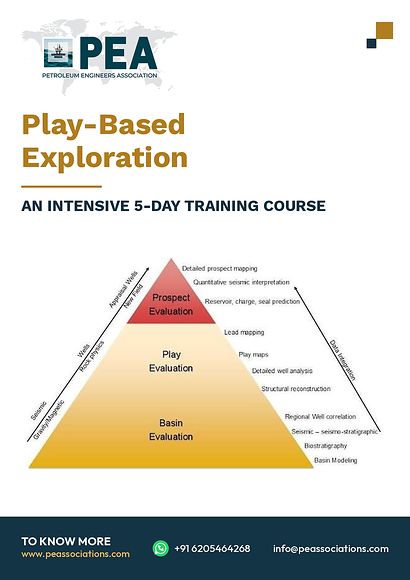
Play-based exploration evaluates the geological concept before evaluating individual structures. A play is a set of prospects sharing the same source, reservoir, seal and trap configuration, so they succeed or fail together for the same geological reasons. Assessing the play first establishes where in a basin the combination of elements is likely to work, how many accumulations might exist and of what size, and which prospects within it are worth maturing. Working the other way round, mapping prospects first and assessing the geology afterwards, produces portfolios in which many prospects share an unexamined common risk.
This training develops the method and its application. Play definition is established first, covering what constitutes a play, the distinction between plays and prospects, play segmentation and the naming and documentation conventions that keep a portfolio coherent. Play element mapping follows: source presence and maturity, reservoir presence and quality, seal presence and effectiveness, and trap availability, each mapped as a surface across the basin with its own confidence. Common risk segment mapping is then developed, converting each element map into a risk surface, and composite risk mapping combines them to show where the play is most likely to work. Play chance of success and yet-to-find resource estimation follow, covering field size distributions, creaming curves and the estimation of undiscovered volume. Play ranking and portfolio allocation are then addressed. The training closes with the relationship between play and prospect risk and the use of play analysis in acreage and drilling decisions.
Shared risk is the reason play analysis exists. If ten prospects in a portfolio all depend on the same source rock being mature, they do not represent ten independent chances; they represent one geological question with ten expressions. Treating them as independent overstates the portfolio's chance of at least one success substantially, and a single well that proves the source immature invalidates all of them together. Separating play level risk, which is shared, from prospect level risk, which is specific, is what makes a portfolio assessment honest.
Common risk segment maps turn judgement into geography. Instead of assigning a single reservoir probability to a play, the method maps where reservoir is proven, where it is likely, where it is possible and where it is absent, as a surface with those confidence zones drawn explicitly. Doing the same for each element and combining the surfaces produces a composite map showing where all elements are most likely to coincide. That map directs where to look, and it makes the reasoning visible and challengeable rather than buried in a number.
Yet-to-find estimation is a portfolio tool, not a precision instrument. Field size distributions in a mature play are typically lognormal, and discoveries are made roughly in descending size order, so a creaming curve of cumulative discovered volume against wells drilled flattens as the play matures. Projecting that curve, with the field size distribution, gives an estimate of what remains and of the size of fields still to be found. It is approximate, but it answers whether a play is worth continuing to drill, which is a decision that otherwise gets made on sentiment.
Finally, play analysis directs acreage decisions better than prospect inventories do. A licence round decision made on the prospects currently visible on existing data rewards whoever has the best data rather than the best geology. A decision made on play analysis asks whether the elements are likely to be present in the acreage, which is answerable from regional understanding before detailed seismic exists, and which is where the competitive advantage in frontier exploration actually lies.
By the end of this training, participants will be able to:
- Define plays and segment them appropriately for assessment
- Map play elements including source, reservoir, seal and trap across a basin
- Construct common risk segment maps for each element
- Combine element maps into composite risk surfaces
- Assess play chance of success and distinguish it from prospect risk
- Estimate field size distributions and yet-to-find resource
- Construct and interpret creaming curves
- Rank plays and allocate exploration effort between them
- Separate shared play risk from independent prospect risk in a portfolio
- Apply play analysis to acreage, drilling and portfolio decisions
The training is worked as a play assessment on a real basin. Participants define and segment plays, map each element as a confidence surface, build composite risk maps and use them to identify where exploration effort should go. Field size distributions and creaming curves are constructed from the basin's discovery history and used to estimate remaining potential. A portfolio of prospects is then assessed with play risk separated from prospect risk, and the difference in portfolio outcome is quantified.
Organisations sending participants to this training will:
- Assess portfolio chance of success honestly by separating shared risk
- Direct exploration effort using composite risk mapping
- Estimate remaining potential in mature and frontier plays
- Make acreage decisions on geological rather than data availability grounds
- Avoid portfolios concentrated on a single unexamined risk
- Improve consistency of play and prospect assessment
Participants will:
- Define and assess plays systematically
- Build element and composite risk maps
- Estimate yet-to-find resource for a play
- Separate play and prospect risk correctly
- Direct exploration effort on play grounds
- Build capability that improves portfolio decisions
- Exploration geoscientists and team leaders
- New ventures and frontier evaluation staff
- Portfolio and resource assessment staff
- Acreage and licence round evaluation teams
- Exploration managers allocating effort and budget
- Prospect evaluation staff
- Geoscientists requiring play assessment capability
Module 1 - Play Concepts
- Play definition and its elements
- Play against prospect distinction
- Play segmentation and its basis
- Proven, emerging and conceptual plays
- Play naming and documentation conventions
- Play inventory for a basin
- Analogue plays and their evidence
- Play maturity and its stages
- Why play analysis precedes prospect work
- Common failures in play definition
Module 2 - Mapping Play Elements
- Source presence mapping
- Maturity mapping and kitchen definition
- Charge access mapping
- Reservoir presence mapping
- Reservoir quality mapping
- Seal presence and effectiveness mapping
- Trap availability mapping
- Preservation and timing mapping
- Data density and its effect on confidence
- Evidence standards for each confidence level
- Documenting the basis of each map
- Updating element maps with new data
Module 3 - Common Risk Segment Mapping
- Common risk segment concept
- Converting element maps to risk surfaces
- Confidence categories and their definitions
- Proven, likely, possible and absent zones
- Assigning probabilities to zones
- Element map combination methods
- Composite common risk segment maps
- Interpreting composite maps
- Identifying the limiting element by area
- Sweet spot identification
- Using composite maps to direct effort
- Challenging and revising risk maps
Module 4 - Play Chance of Success
- Play level risk and its meaning
- Elements assessed at play level
- Elements assessed at prospect level
- Avoiding double counting of risk
- Play chance of success calculation
- Conditional prospect risk given play success
- Shared and independent risk in a portfolio
- Portfolio chance of at least one success
- Effect of shared risk on portfolio outcomes
- Sequential drilling and risk updating
- Bayesian updating after wells
- Communicating play and prospect risk separately
Module 5 - Field Size Distributions
- Field size distributions and their shape
- Lognormal and Pareto distributions
- Fitting distributions to discovered fields
- Truncation at the economic limit
- Discovery process and size bias
- Largest fields found first
- Estimating the parent distribution
- Number of fields in a play
- Distribution parameters and their uncertainty
- Analogue play distributions
- Using distributions in prospect volume estimation
Module 6 - Yet-to-Find Estimation
- Yet-to-find concept and its definition
- Creaming curve construction
- Cumulative discovery against wells drilled
- Curve flattening and play maturity
- Projecting the creaming curve
- Discovery process modelling
- Volumetric yet-to-find methods
- Geochemical mass balance methods
- Analogue basin yield methods
- Reconciling different estimation methods
- Expressing yet-to-find as a range
- Using yet-to-find in decision making
Module 7 - Play Ranking and Portfolio Allocation
- Play ranking criteria
- Chance of success against resource potential
- Cost and cycle time considerations
- Access and commercial factors
- Risked resource and expected value
- Portfolio balance across plays
- Exploration effort allocation
- High risk high reward against incremental plays
- Sequencing exploration across plays
- Testing a play with the right well
- Play test well design
- Reallocating after play test results
Module 8 - Application to Decisions
- Acreage evaluation using play analysis
- Licence round bidding on play grounds
- Farm-in and farm-out assessment
- Work programme commitment decisions
- Relinquishment decisions
- Data acquisition prioritisation
- Drilling sequence decisions
- Value of information in play testing
- Updating play assessments after drilling
- Capturing learning from play failures
- Communicating play assessments to management
- Case studies of play based exploration outcomes
Upon successful completion of this training course, delegates will be awarded an official Certificate of Completion issued by the Petroleum Engineers Association (PEA), an ISO 9001:2015 certified training organization. The certificate carries 10 Credits and formally records the total learning hours completed.
Each certificate is signed by the Course Facilitator and the CEO of the Petroleum Engineers Association, and serves as verifiable proof of professional training that delegates can present to employers and professional bodies worldwide.
Frequently Asked Questions
All course bookings made through PEA are strictly non-refundable. By registering for a course, you acknowledge and accept that all fees are payable in full and are not subject to refund under any circumstances, including changes in personal or professional commitments or partial attendance.
PEA reserves the right to make reasonable adjustments to course content, trainers, or schedules where necessary, without entitling delegates to a refund. Comprehensive details of each course — including objectives, target audience, and content — are clearly outlined before enrolment, and it is the responsibility of the delegate to ensure the course's suitability prior to booking.
For any inquiries related to cancellations or bookings, please contact our support team, who will be happy to assist you.
