


An Interactive 5-Day Training Course
Geomechanics for Gas & Hydrogen Storage
Geomechanics of Cyclic Gas Storage
Secure your spot now!
Duration
5 Days
Price
$ 4,000
Starting From
07 Jun 2027



Home Geology and Geoscience Geomechanics for Gas & Hydrogen Storage
Geomechanics for Gas & Hydrogen Storage
Have Questions ?
Geomechanics for Gas & Hydrogen Storage - GG-GSGEOM-PEA27
| Code | Date | Time | Duration | Location | Currency | Early Bird Fee Per Person |
|---|---|---|---|---|---|---|
| GG-GSGEOM-PEA27 | 07 - 11 Jun 2027 | 10 AM CST | 4 Hours Per Day |
Online |
USD |
4000 |
Need this for a group? We deliver the same course in-house — face-to-face at your location or online — tailored to your assets and team level. Contact info@peassociations.com
Boost your team's skills and your budget! Enjoy group discounts for collaborative learning. Send an inquiry to info@peassociations.com.
Geomechanics for Gas & Hydrogen Storage
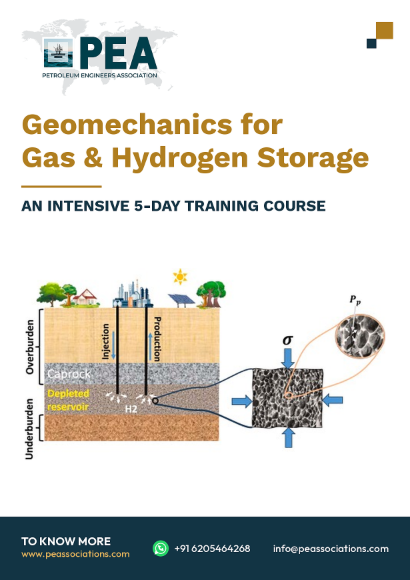
This training covers geomechanics for underground gas and hydrogen storage. It works through cyclic loading and its effects, stress characterisation for storage sites, operating pressure envelope determination, caprock integrity under cycling, fault stability under cyclic pressure, salt cavern mechanics and convergence, well integrity under cyclic duty, fatigue and degradation mechanisms, induced seismicity in storage operations and monitoring for geomechanical integrity.
Description
Storage differs geomechanically from production in one essential respect: the pressure cycles repeatedly rather than declining once. A seasonal gas store cycles annually; a hydrogen store balancing renewable generation may cycle weekly. Each cycle loads and unloads the reservoir, the caprock, the faults and the wells, and the relevant failure mechanisms become fatigue, progressive degradation and cumulative deformation rather than single-event failure. Design standards developed for production do not address this directly.
This training covers the geomechanics of cyclic storage. Cyclic loading and its effects are established first, covering the mechanical response of rock and cement to repeated loading. Stress characterisation for storage sites follows. Operating pressure envelope determination is then developed, covering both the maximum and minimum pressure limits and their bases, since a storage facility is constrained at both ends. Caprock integrity under cycling follows. Fault stability under cyclic pressure is then addressed. Salt cavern mechanics and convergence are developed, since caverns are a principal storage type with their own mechanics. Well integrity under cyclic duty follows. Fatigue and degradation mechanisms are then addressed. Induced seismicity in storage operations follows. The training closes with monitoring.
A storage facility has a minimum pressure limit as well as a maximum. The maximum is set by caprock integrity and fault stability, as in any injection operation. The minimum matters too: drawing a porous reservoir down below a certain pressure risks compaction, fines mobilisation, water influx into the gas-filled pore space and, in a salt cavern, excessive convergence from salt creep. The operating envelope is therefore bounded at both ends, and the working gas capacity is the volume between the two bounds, which makes the geomechanical analysis directly determinative of the facility's commercial capacity.
Cement fatigue is the main well integrity concern under cycling. Each pressure cycle expands and contracts the casing, which loads the cement sheath in the annulus, and repeated loading can debond the cement from the casing or from the formation, or crack it. The result is a micro-annulus providing a leakage path, which is the most likely failure mode in a cyclically loaded storage well. Design responses include cement systems selected for flexibility, reduced cycle amplitude at the well, and integrity monitoring that can detect a developing micro-annulus.
Salt caverns converge continuously and the rate depends on how they are operated. Salt creeps under deviatoric stress, so a cavern slowly reduces in volume, at a rate that increases strongly with temperature and with the difference between the overburden stress and the cavern pressure. Operating at low pressure for extended periods accelerates convergence; operating at high pressure risks fracturing the salt or the interbeds. Managing a cavern means managing the time spent at each pressure, not just respecting the limits, and the cumulative volume loss over decades can be material.
Finally, cyclic loading can either strengthen or weaken rock and both occur. Repeated loading below the failure threshold can compact a porous rock and increase its strength, a form of shakedown. Loading closer to the threshold progressively damages the rock through microcracking, reducing its strength until failure occurs at a stress that a single cycle would have survived. Which behaviour dominates depends on the amplitude relative to the strength, which means the cycle amplitude is a design variable and the laboratory programme should test at the amplitudes the facility will actually impose.
By the end of this training, participants will be able to:
- Assess the mechanical effects of cyclic pressure loading
- Characterise stress at gas and hydrogen storage sites
- Determine maximum and minimum operating pressure limits
- Relate the operating envelope to working gas capacity
- Assess caprock integrity under repeated cycling
- Assess fault stability under cyclic pressure
- Apply salt cavern mechanics including creep and convergence
- Assess well integrity and cement fatigue under cyclic duty
- Assess induced seismicity risk in storage operations
- Specify monitoring for geomechanical integrity
The training works on storage facility data including operating histories, integrity records and cavern survey data. Participants determine operating envelopes and relate them to working gas capacity, assess cement fatigue risk against cycling duty, and analyse cavern convergence histories. Integrity failures from operating facilities are analysed for their mechanisms.
Organisations sending participants to this training will:
- Determine operating envelopes on a geomechanical basis
- Link working gas capacity to integrity limits
- Design wells for cyclic rather than single-event duty
- Manage cavern convergence through operating practice
- Assess cyclic fatigue risk explicitly
- Reduce integrity failures in storage operations
Participants will:
- Assess cyclic loading effects
- Determine operating pressure envelopes
- Assess caprock and fault stability under cycling
- Apply salt cavern mechanics
- Assess well integrity under cyclic duty
- Specify geomechanical monitoring
- Geomechanics staff on storage projects
- Reservoir engineers in storage operations
- Well integrity engineers on storage wells
- Salt cavern operations staff
- Project staff developing storage facilities
- Geoscientists characterising storage sites
- Regulators and advisors reviewing storage integrity
Module 1 - Cyclic Loading Effects
- Cyclic against monotonic loading
- Elastic and inelastic response
- Hysteresis loops in stress strain behaviour
- Cumulative strain accumulation
- Shakedown and strengthening
- Progressive damage and weakening
- Amplitude dependence of behaviour
- Frequency and rate effects
- Number of cycles to failure
- Laboratory cyclic testing
- Specifying cyclic test programmes
- Design implications of cyclic duty
Module 2 - Stress Characterisation
- Stress data requirements for storage
- Vertical stress determination
- Minimum horizontal stress measurement
- Maximum horizontal stress constraint
- Stress orientation determination
- Stress in the caprock
- Stress in and around salt
- Property and strength data requirements
- Core testing requirements
- Stress model construction
- Uncertainty in storage stress models
- Data acquisition in storage wells
Module 3 - Operating Pressure Envelope
- Maximum pressure limits and their bases
- Caprock tensile limit
- Fault reactivation limit
- Discovery pressure as a reference
- Overpressuring above original pressure
- Minimum pressure limits
- Compaction at low pressure
- Fines mobilisation and sand production
- Water influx at low pressure
- Cavern convergence at low pressure
- Envelope width and working gas capacity
- Documenting and respecting the envelope
Module 4 - Caprock Integrity Under Cycling
- Caprock loading during cycles
- Tensile failure threshold
- Shear failure in the caprock
- Cyclic fatigue of caprock
- Progressive microcracking
- Permeability change under cycling
- Capillary sealing under cyclic loading
- Caprock deformation and strain
- Heterogeneity and weak layers
- Pre-existing fractures in the caprock
- Laboratory evidence on cyclic caprock behaviour
- Demonstrating long term integrity
Module 5 - Fault Stability Under Cycling
- Fault inventory for storage sites
- Slip tendency under maximum pressure
- Cyclic pressure on faults
- Repeated approach to the failure envelope
- Fault healing between cycles
- Progressive weakening of faults
- Permeability change on cycled faults
- Aseismic creep on faults
- Seismic slip and its triggering
- Fault stability margins for storage
- Monitoring fault related seismicity
- Operational limits from fault stability
Module 6 - Salt Cavern Mechanics
- Salt rheology and creep laws
- Temperature dependence of creep
- Deviatoric stress and creep rate
- Cavern convergence rates
- Volume loss over cavern life
- Minimum pressure and convergence
- Maximum pressure and salt fracturing
- Interbeds and insoluble layers
- Cavern roof and wall stability
- Cavern spacing and pillar stability
- Cavern integrity testing
- Sonar surveys and volume monitoring
Module 7 - Well Integrity Under Cyclic Duty
- Casing loads during pressure cycles
- Thermal loads during cycling
- Cement sheath loading
- Cement debonding mechanisms
- Micro-annulus formation
- Cement cracking under cycling
- Flexible and resilient cement systems
- Casing material and connection selection
- Hydrogen compatibility of materials
- Hydrogen embrittlement considerations
- Completion design for cyclic duty
- Annular pressure monitoring
Module 8 - Seismicity and Monitoring
- Induced seismicity in storage operations
- Observed seismicity at storage facilities
- Triggering by pressure increase
- Cyclic triggering mechanisms
- Hazard assessment for storage sites
- Monitoring network design
- Microseismic monitoring
- Surface deformation monitoring
- Cavern volume and convergence monitoring
- Well integrity monitoring and logging
- Integrity management systems
- Response to integrity indications
Upon successful completion of this training course, delegates will be awarded an official Certificate of Completion issued by the Petroleum Engineers Association (PEA), an ISO 9001:2015 certified training organization. The certificate carries 10 Credits and formally records the total learning hours completed.
Each certificate is signed by the Course Facilitator and the CEO of the Petroleum Engineers Association, and serves as verifiable proof of professional training that delegates can present to employers and professional bodies worldwide.
Frequently Asked Questions
All course bookings made through PEA are strictly non-refundable. By registering for a course, you acknowledge and accept that all fees are payable in full and are not subject to refund under any circumstances, including changes in personal or professional commitments or partial attendance.
PEA reserves the right to make reasonable adjustments to course content, trainers, or schedules where necessary, without entitling delegates to a refund. Comprehensive details of each course — including objectives, target audience, and content — are clearly outlined before enrolment, and it is the responsibility of the delegate to ensure the course's suitability prior to booking.
For any inquiries related to cancellations or bookings, please contact our support team, who will be happy to assist you.
