


An Interactive 5-Day Training Course
Climate Science & the Carbon Cycle for Energy Professionals
Climate Science for Energy Professionals
Secure your spot now!
Duration
5 Days
Price
$ 3,000
Starting From
28 Jun 2027



Home Geology and Geoscience Climate Science & the Carbon Cycle for Energy Professionals
Climate Science & the Carbon Cycle for Energy Professionals
Have Questions ?
Climate Science & the Carbon Cycle for Energy Professionals - GG-CLIM-PEA27
| Code | Date | Time | Duration | Location | Currency | Early Bird Fee Per Person |
|---|---|---|---|---|---|---|
| GG-CLIM-PEA27 | 28 Jun - 02 Jul 2027 | 10 AM CST | 4 Hours Per Day |
Online |
USD |
3000 |
Need this for a group? We deliver the same course in-house — face-to-face at your location or online — tailored to your assets and team level. Contact info@peassociations.com
Boost your team's skills and your budget! Enjoy group discounts for collaborative learning. Send an inquiry to info@peassociations.com.
Climate Science & the Carbon Cycle for Energy Professionals
This training covers climate science and the carbon cycle for energy professionals. It works through the radiative balance and greenhouse effect, the carbon cycle and its reservoirs, the geological record of climate, emissions and atmospheric concentration, climate sensitivity and feedbacks, climate models and their projections, carbon budgets and net zero, removal and sequestration options and the interpretation of climate information in energy decisions.
Description
Energy professionals work in an industry whose future is being shaped by climate policy, and most have never studied the underlying science. The result is a workforce making and implementing decisions about emissions, carbon storage, fuel transitions and asset life without a working understanding of the radiative physics, the carbon cycle, the evidence base or the quantitative relationships between emissions and warming. This training provides that understanding, at the level of a geoscientist or engineer who needs to reason about it rather than research it.
The course covers the science systematically. The radiative balance and greenhouse effect are established first, covering the physics of the energy balance and the role of each greenhouse gas. The carbon cycle and its reservoirs follow, covering the fluxes between atmosphere, ocean, biosphere and geosphere and their timescales. The geological record of climate is then developed, which is the part most accessible to geoscientists and the strongest evidence for the behaviour of the system. Emissions and atmospheric concentration follow. Climate sensitivity and feedbacks are then addressed, covering the central quantitative question and why its uncertainty persists. Climate models and their projections follow. Carbon budgets and net zero are then developed. Removal and sequestration options are addressed. The training closes with the interpretation of climate information in energy decisions.
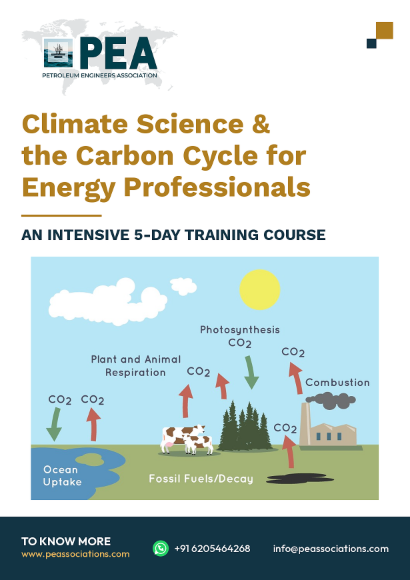
The carbon cycle operates on many timescales and that is why the problem is durable. Carbon dioxide emitted today partitions over decades into the ocean surface and the biosphere, over centuries into the deep ocean, and over tens to hundreds of thousands of years into carbonate sediments and silicate weathering products. Roughly a fifth to a quarter of a pulse of emissions remains in the atmosphere after a thousand years. This is why cumulative emissions, rather than the current emission rate, determine the eventual warming, and why reducing emissions stabilises rather than reverses the concentration.
Climate sensitivity is the central number and its uncertainty is mostly clouds. Doubling the carbon dioxide concentration produces a direct radiative forcing that is well established; the resulting temperature change depends on the feedbacks, principally water vapour, which amplifies strongly, ice and snow albedo, which amplifies, and clouds, which may do either and are the main source of the remaining uncertainty. The constrained range for the equilibrium response has narrowed over decades of work but remains wide enough to matter for policy, and anyone quoting a single value is simplifying.
The geological record is where geoscientists have most to contribute and most to learn. Past intervals of high carbon dioxide and high temperature, the glacial-interglacial cycles with their tight coupling of carbon dioxide and temperature, and rapid carbon release events such as the Palaeocene-Eocene Thermal Maximum provide the only direct evidence of how the system behaves outside the observed range. The proxies are imperfect and the records are incomplete, and they nonetheless constrain sensitivity, demonstrate the recovery timescales of the carbon cycle and show that the system has been forced before.
Finally, carbon budgets are an arithmetic consequence of the cumulative relationship. Because warming scales approximately with cumulative emissions, a temperature limit implies a total quantity of carbon that may be emitted, and the remaining budget is that total less what has already been emitted. The figures are uncertain, principally through climate sensitivity and the response of natural sinks, and the arithmetic is nonetheless straightforward: a remaining budget divided by current annual emissions gives the time available at present rates. That calculation is what underlies the policy positions the industry is responding to.
By the end of this training, participants will be able to:
- Explain the radiative balance and the greenhouse effect
- Compare greenhouse gases by forcing and lifetime
- Describe the carbon cycle, its reservoirs and its timescales
- Interpret the geological record of climate and its proxies
- Relate emissions to atmospheric concentration
- Explain climate sensitivity, feedbacks and the sources of uncertainty
- Describe climate models, their structure and their projections
- Apply carbon budget arithmetic and net zero definitions
- Compare carbon removal and sequestration options
- Interpret climate information encountered in energy decisions
The training works through the science with quantitative exercises. Participants calculate radiative forcing and carbon budget arithmetic, interpret proxy records of past climate, and examine model projections and their uncertainty ranges. Published claims about climate and energy are assessed against the underlying science to distinguish what is well established from what is contested.
Organisations sending participants to this training will:
- Build an informed understanding of the science behind climate policy
- Assess climate related claims and projections critically
- Apply carbon budget and net zero concepts correctly
- Compare removal and sequestration options technically
- Improve the quality of internal climate related discussion
- Support credible climate reporting and strategy
Participants will:
- Understand the physical basis of climate change
- Work quantitatively with carbon cycle concepts
- Interpret the geological climate record
- Assess climate projections and their uncertainty
- Apply carbon budget arithmetic
- Discuss climate science accurately
- Geoscientists and engineers in the energy industry
- Staff working on energy transition projects
- Strategy and planning staff
- Sustainability and reporting staff
- Commercial and communications staff
- Managers responsible for climate related decisions
- Technical staff wanting the underlying science
Module 1 - Radiative Balance
- Solar input and planetary energy balance
- Albedo and reflected radiation
- Blackbody emission and effective temperature
- Atmospheric absorption of infrared radiation
- Greenhouse effect mechanism
- Greenhouse gases and their absorption bands
- Water vapour as a greenhouse gas
- Carbon dioxide, methane and nitrous oxide
- Radiative forcing definition and units
- Forcing by gas and by source
- Aerosols and their forcing
- Global warming potential and its limitations
Module 2 - The Carbon Cycle
- Carbon reservoirs and their sizes
- Atmospheric carbon inventory
- Ocean carbon and its chemistry
- Terrestrial biosphere carbon
- Soil carbon
- Geological carbon reservoirs
- Fluxes between reservoirs
- Ocean uptake and its mechanisms
- Ocean acidification
- Land sink and its variability
- Silicate weathering and carbonate burial
- Timescales of each process
Module 3 - The Geological Record
- Proxies for past temperature
- Oxygen isotopes in carbonates and ice
- Proxies for past carbon dioxide
- Boron isotopes and stomatal indices
- Ice core records
- Glacial-interglacial cycles
- Milankovitch forcing
- Carbon dioxide and temperature coupling in ice cores
- Warm intervals in the Cenozoic
- The Palaeocene-Eocene Thermal Maximum
- Rapid carbon release events
- What the record constrains
Module 4 - Emissions and Concentration
- Emissions by source and sector
- Fossil fuel emissions
- Land use change emissions
- Cement and process emissions
- Methane emissions and their sources
- Atmospheric concentration measurement
- Keeling curve and monitoring networks
- Airborne fraction
- Isotopic evidence for the source of the increase
- Emissions accounting conventions
- Scope one, two and three emissions
- Measurement and verification of emissions
Module 5 - Sensitivity and Feedbacks
- Climate sensitivity definitions
- Equilibrium and transient sensitivity
- Direct forcing from carbon dioxide doubling
- Water vapour feedback
- Lapse rate feedback
- Ice and snow albedo feedback
- Cloud feedbacks and their uncertainty
- Carbon cycle feedbacks
- Permafrost and methane feedbacks
- Constraints on sensitivity from observations
- Constraints from the geological record
- Why the uncertainty persists
Module 6 - Models and Projections
- Model structure and components
- Atmosphere, ocean, land and ice components
- Resolution and parameterisation
- Model evaluation against observations
- Hindcast performance
- Model intercomparison projects
- Emissions and concentration scenarios
- Shared socioeconomic pathways
- Projection ranges and their interpretation
- Regional against global projections
- Extreme event attribution
- What models do and do not predict well
Module 7 - Carbon Budgets and Net Zero
- Cumulative emissions and warming relationship
- Transient climate response to emissions
- Carbon budget calculation
- Remaining budget estimates and their uncertainty
- Budget by temperature limit
- Net zero definition
- Residual emissions and offsetting
- Overshoot pathways
- Methane and short lived gases in net zero
- National and corporate target frameworks
- Pathway arithmetic and its implications
- Critiquing a net zero claim
Module 8 - Removal, Sequestration and Energy Decisions
- Carbon dioxide removal options
- Afforestation and land based removal
- Bioenergy with carbon capture
- Direct air capture
- Enhanced weathering
- Ocean based removal options
- Geological storage as the sink
- Permanence and accounting of removals
- Cost and scale of removal options
- Interpreting climate information in asset decisions
- Scenario use in planning
- Distinguishing established from contested claims
Upon successful completion of this training course, delegates will be awarded an official Certificate of Completion issued by the Petroleum Engineers Association (PEA), an ISO 9001:2015 certified training organization. The certificate carries 10 Credits and formally records the total learning hours completed.
Each certificate is signed by the Course Facilitator and the CEO of the Petroleum Engineers Association, and serves as verifiable proof of professional training that delegates can present to employers and professional bodies worldwide.
Frequently Asked Questions
All course bookings made through PEA are strictly non-refundable. By registering for a course, you acknowledge and accept that all fees are payable in full and are not subject to refund under any circumstances, including changes in personal or professional commitments or partial attendance.
PEA reserves the right to make reasonable adjustments to course content, trainers, or schedules where necessary, without entitling delegates to a refund. Comprehensive details of each course — including objectives, target audience, and content — are clearly outlined before enrolment, and it is the responsibility of the delegate to ensure the course's suitability prior to booking.
For any inquiries related to cancellations or bookings, please contact our support team, who will be happy to assist you.
