


An Interactive 5-Day Training Course
Hydrocarbon Habitat in Rift Basins
Where Rift Basins Hold Oil
Secure your spot now!
Duration
5 Days
Price
$ 3,500
Starting From
11 Oct 2027



Home Geology and Geoscience Hydrocarbon Habitat in Rift Basins
Hydrocarbon Habitat in Rift Basins
Have Questions ?
Hydrocarbon Habitat in Rift Basins - GG-RIFTB-PEA27
| Code | Date | Time | Duration | Location | Currency | Early Bird Fee Per Person |
|---|---|---|---|---|---|---|
| GG-RIFTB-PEA27 | 11 - 15 Oct 2027 | 10 AM CST | 4 Hours Per Day |
Online |
USD |
3500 |
Need this for a group? We deliver the same course in-house — face-to-face at your location or online — tailored to your assets and team level. Contact info@peassociations.com
Boost your team's skills and your budget! Enjoy group discounts for collaborative learning. Send an inquiry to info@peassociations.com.
Hydrocarbon Habitat in Rift Basins
This training covers the hydrocarbon habitat of rift basins. It works through rift evolution and its stratigraphic phases, syn-rift lacustrine and marine source rocks, reservoir distribution by rift phase and structural position, seal distribution, trap types and charge access, the thermal history of rifts, play distribution within a rift, and the exploration of rift basins at different maturity stages.
Description
Rift basins hold a very large share of world reserves and they are internally organised in a way that makes their habitat predictable. The rift history creates a characteristic stratigraphic sequence, pre-rift, syn-rift and post-rift, each with its own reservoir and seal characteristics. Source rocks concentrate in the syn-rift lacustrine or restricted marine section. Traps form during and after rifting in positions controlled by the fault architecture. Charge moves from hangingwall kitchens into footwall and crestal structures. Knowing this organisation tells you where to look in any rift basin.
This training develops the habitat systematically. Rift evolution is established first, covering initiation, propagation, climax and the post-rift transition, with the stratigraphic expression of each. Source rocks follow, covering lacustrine source development in continental rifts, restricted marine sources in rifts connected to the sea, the conditions producing exceptional richness, and the lateral and vertical distribution within a rift. Reservoirs are then developed by phase and position: pre-rift reservoirs in tilted blocks, syn-rift footwall fans and axial systems, relay zone fairways, and post-rift regional reservoirs. Seals follow, including the post-rift regional seal that makes many rift plays work. Trap types and charge access are then addressed, covering the geometry of footwall, crestal, rollover and stratigraphic traps and their migration access from hangingwall kitchens. Thermal history is developed as a distinct topic, since rift heat flow evolution controls maturation timing. The training closes with play distribution and exploration strategy at different basin maturities.
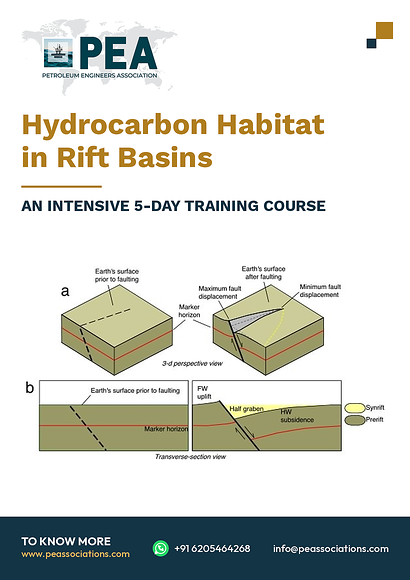
The hangingwall is the kitchen and the footwall is the trap. In a half graben, the deepest burial is against the border fault in the hangingwall, which is where source rock reaches maturity. The footwall is uplifted and shallow, which is where traps form by erosion and tilting. Migration therefore runs from the deep hangingwall, up the dip of the fault block or across the fault, into footwall crest and tilted block traps. This simple geometry organises the charge in most rift basins and it is the first thing to establish in a new one.
Lacustrine source rocks in rifts can be exceptional. A deep, stratified, long-lived rift lake with limited clastic dilution produces source rocks with organic carbon contents several times those of typical marine shales and with Type I kerogen of very high generative potential. The resulting oils are waxy and low in sulphur. Whether a given rift developed such a lake depends on climate, on whether the rift remained closed, and on the balance between accommodation and water supply, which is predictable from the setting.
The post-rift seal is what makes many rift plays work. Syn-rift reservoirs are often sealed by the regional mudstone deposited during post-rift thermal subsidence, which blankets the whole basin including the eroded footwall crests. Where that seal is present and continuous, traps that would otherwise be breached at the crest are sealed; where it is absent or thin, they are not. Mapping the post-rift seal is therefore as important as mapping the structure.
Finally, rift basins mature in a predictable exploration sequence. The large footwall and tilted block structures are found first because they are obvious. What remains is subtler: hangingwall traps, intra-rift highs, relay zone stratigraphic traps, pre-rift and basement plays, and deeper syn-rift objectives. A mature rift basin with its structural inventory drilled usually retains substantial potential in these, and knowing the habitat is what makes them findable.
By the end of this training, participants will be able to:
- Describe rift evolution and the stratigraphic expression of each phase
- Assess lacustrine and restricted marine source rock development in rifts
- Predict source rock distribution and quality within a rift basin
- Identify reservoir types by rift phase and structural position
- Assess the role of relay zones in reservoir distribution
- Evaluate syn-rift and post-rift seal distribution and effectiveness
- Identify trap types and assess charge access from hangingwall kitchens
- Interpret rift thermal history and its effect on maturation timing
- Map play distribution within a rift basin
- Develop exploration strategy for rift basins at different maturity stages
The training works on seismic, well and regional data from rift basins at different maturity stages. Participants map the rift architecture, identify kitchens and migration pathways, and assess the distribution of reservoir and seal by phase and position. Thermal histories are constructed and maturation timing compared against trap formation. Remaining potential is assessed in a mature rift basin, and the resulting play inventory compared against what has actually been found subsequently.
Organisations sending participants to this training will:
- Evaluate rift basins using a consistent habitat framework
- Identify remaining potential in mature rift provinces
- Predict source rock quality and distribution from rift setting
- Assess charge access systematically from basin architecture
- Map post-rift seal as a primary play element
- Build capability for a basin type holding major reserves
Participants will:
- Understand how a rift basin is organised
- Predict source, reservoir and seal by position
- Assess charge access from basin architecture
- Identify under-explored plays in mature rifts
- Build exploration strategy for rift basins
- Build regional capability in a major basin type
- Exploration geoscientists working in rift basins
- New ventures staff evaluating rift acreage
- Basin analysts and regional geologists
- Geochemists working on lacustrine source systems
- Reservoir geologists on rift basin fields
- Prospect evaluation staff in rift provinces
- Geoscientists entering rift basin operations
Module 1 - Rift Evolution and Architecture
- Rift initiation and its controls
- Fault nucleation and segment linkage
- Half graben and border fault geometry
- Rift polarity and accommodation zones
- Rift climax and maximum subsidence
- Post-rift thermal subsidence
- Break-up and margin development
- Failed rifts and their preservation
- Multi-phase rifting
- Pre-existing fabric control
- Rift architecture and its mapping
Module 2 - Rift Stratigraphy
- Pre-rift section and its character
- Syn-rift fill and its geometry
- Growth strata and expansion
- Rift climax deposits
- Late syn-rift and transition
- Break-up unconformity
- Post-rift sag deposits
- Lateral stratigraphic variation along faults
- Stratigraphy from footwall to hangingwall
- Correlating within syn-rift sections
- Seismic expression of rift stratigraphy
Module 3 - Source Rocks in Rifts
- Lacustrine source rock development
- Lake type and its source implications
- Stratification and anoxia in rift lakes
- Organic richness in lacustrine sources
- Type I kerogen and generative potential
- Restricted marine source development
- Marine incursion and its effect
- Source rock distribution within a rift
- Lateral variation in source quality
- Source thickness and its structural control
- Lacustrine oil properties and recognition
- Predicting source presence in undrilled rifts
Module 4 - Reservoirs by Phase and Position
- Pre-rift reservoirs in tilted blocks
- Basement and weathered basement reservoirs
- Footwall derived fan deltas and aprons
- Axial fluvial and deltaic systems
- Relay zone sediment entry and fairways
- Lacustrine turbidite reservoirs
- Shoreline and deltaic reservoirs in rift lakes
- Carbonate build-ups on intra-rift highs
- Post-rift regional reservoirs
- Reservoir quality by position and phase
- Predicting reservoir away from control
- Reservoir distribution mapping
Module 5 - Seals and Traps
- Syn-rift intraformational seals
- Lacustrine mudstone seals
- Post-rift regional seal development
- Seal continuity over footwall crests
- Evaporite seals in some rift settings
- Tilted fault block traps
- Footwall crest traps
- Hangingwall and rollover traps
- Intra-rift high traps
- Stratigraphic traps in relay zones
- Post-rift drape and onlap traps
- Fault seal in rift settings
Module 6 - Thermal History and Maturation
- Heat flow during rifting
- Syn-rift heat flow elevation
- Post-rift thermal decay
- Stretching factor and heat flow magnitude
- Burial history by structural position
- Hangingwall against footwall maturation
- Generation timing in rift basins
- Early generation in hot rifts
- Maturation in multi-phase rifts
- Calibrating thermal models in rifts
- Generation timing against trap formation
Module 7 - Charge and Migration
- Hangingwall kitchen geometry
- Drainage area definition in half grabens
- Migration up the dip slope
- Migration across the border fault
- Fault controlled vertical migration
- Carrier beds in rift sections
- Charge access to footwall traps
- Charge access to intra-rift highs
- Charge to post-rift traps
- Migration losses in rift settings
- Charge focusing and its structural control
- Assessing charge for a specific trap
Module 8 - Plays and Exploration Strategy
- Play inventory in a rift basin
- Proven and under-explored plays
- Exploration maturity stages in rifts
- What gets found first and why
- Remaining potential in mature rifts
- Deeper syn-rift objectives
- Pre-rift and basement plays
- Stratigraphic plays in rift settings
- Hangingwall and sub-fault plays
- Exploration strategy by basin maturity
- Rift basin analogues and their use
- Case studies from productive rift provinces
Upon successful completion of this training course, delegates will be awarded an official Certificate of Completion issued by the Petroleum Engineers Association (PEA), an ISO 9001:2015 certified training organization. The certificate carries 10 Credits and formally records the total learning hours completed.
Each certificate is signed by the Course Facilitator and the CEO of the Petroleum Engineers Association, and serves as verifiable proof of professional training that delegates can present to employers and professional bodies worldwide.
Frequently Asked Questions
All course bookings made through PEA are strictly non-refundable. By registering for a course, you acknowledge and accept that all fees are payable in full and are not subject to refund under any circumstances, including changes in personal or professional commitments or partial attendance.
PEA reserves the right to make reasonable adjustments to course content, trainers, or schedules where necessary, without entitling delegates to a refund. Comprehensive details of each course — including objectives, target audience, and content — are clearly outlined before enrolment, and it is the responsibility of the delegate to ensure the course's suitability prior to booking.
For any inquiries related to cancellations or bookings, please contact our support team, who will be happy to assist you.
