


An Interactive 5-Day Training Course
Seal & Reservoir Pressure Analysis for Prospect Risk
Pressure Evidence for Seal Risk
Secure your spot now!
Duration
5 Days
Price
$ 3,500
Starting From
20 Sep 2027



Home Geology and Geoscience Seal & Reservoir Pressure Analysis for Prospect Risk
Seal & Reservoir Pressure Analysis for Prospect Risk
Have Questions ?
Seal & Reservoir Pressure Analysis for Prospect Risk - GG-SEALP-PEA27
| Code | Date | Time | Duration | Location | Currency | Early Bird Fee Per Person |
|---|---|---|---|---|---|---|
| GG-SEALP-PEA27 | 20 - 24 Sep 2027 | 10 AM CST | 4 Hours Per Day |
Online |
USD |
3500 |
Need this for a group? We deliver the same course in-house — face-to-face at your location or online — tailored to your assets and team level. Contact info@peassociations.com
Boost your team's skills and your budget! Enjoy group discounts for collaborative learning. Send an inquiry to info@peassociations.com.
Seal & Reservoir Pressure Analysis for Prospect Risk
This training covers the use of pressure data in seal and prospect risk assessment. It works through pressure measurement and quality control, hydrostatic and overpressure regimes, pressure gradients and fluid contact determination, across-fault and across-seal pressure differences, hydrodynamic effects, seal capacity inferred from pressure, column height prediction and the application of pressure evidence to prospect and development risking.
Description
Pressure data is the most direct subsurface evidence available about seals, compartments and fluid contacts, and it is routinely under-used. A set of formation pressure measurements tells you the fluid type in each interval, the depth of each contact, whether two sands are in communication, whether a fault seals, whether a seal is holding a pressure difference and whether the trap is at its capacity. These are the questions prospect risking asks, and in many basins the pressure data to answer them already exists in the offset wells.
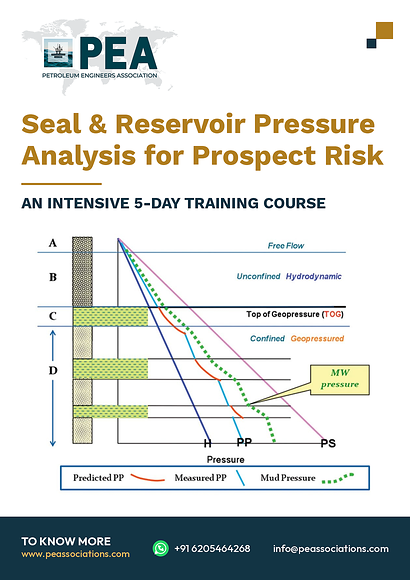
This training develops pressure analysis for subsurface risk. Measurement is established first, covering formation testers, drill stem tests, mud weights and kicks, and the quality control required before any interpretation. Pressure regimes follow: hydrostatic, overpressured and underpressured, generation mechanisms, and the regional distribution of overpressure. Gradient analysis is then developed, covering fluid gradient determination, contact identification from gradient intersections, and the recognition of multiple compartments from offset gradients. Across-fault and across-seal pressure differences are treated in detail as the direct evidence for sealing behaviour. Hydrodynamics follows, covering flowing aquifers, tilted contacts and their effect on trapping. Seal capacity inference from pressure is then developed, including the use of observed columns to calibrate seal algorithms. The training closes with the application of pressure evidence to prospect risk, to development compartmentalisation and to well planning.
A pressure difference across a seal is proof that the seal works. If two reservoir intervals separated by a shale show different pressure gradients at the same depth, that shale is supporting the difference, and it has been doing so over geological time. No capillary measurement, algorithm or analogue carries the same weight as that observation. The practical consequence is that a seal risk assessment should begin with the pressure data from offset wells, and only move to laboratory and empirical methods where the pressure evidence is absent.
Gradient intersections locate contacts without a well ever drilling them. Plotting formation pressures against depth gives a line whose slope is the fluid density, so gas, oil and water each plot on a different gradient. Where two gradients intersect, that depth is the contact between those fluids, and this works even where the contact itself was not penetrated. A prospect's expected column can be constrained this way from offset wells, and a free water level determined in a producing field independently of saturation logs.
A trap at spill behaves differently from a trap below capacity. If the pressure data indicates a column equal to the structural closure, the trap is full and has probably been filling and spilling, which means updip and adjacent structures may be charged too. If the column is well below closure, either the charge was limited or the seal is at its capacity. These are different exploration situations with different implications for the surrounding acreage, and the pressure data distinguishes them.
Finally, overpressure is both a seal indicator and a drilling hazard, and the same analysis serves both. An overpressured interval requires a seal capable of holding that excess pressure, which is direct evidence about seal quality. It also requires a mud weight to drill safely, and the pressure prediction feeding the well plan is built from the same data and reasoning. Carrying out the analysis once for both purposes is both cheaper and more consistent than doing it twice.
By the end of this training, participants will be able to:
- Quality control formation pressure data and identify unreliable measurements
- Identify pressure regimes and interpret overpressure generation mechanisms
- Construct pressure depth plots and determine fluid gradients
- Locate fluid contacts from gradient intersections
- Identify compartments from offset pressure gradients
- Interpret across-fault and across-seal pressure differences as sealing evidence
- Assess hydrodynamic effects and tilted contacts
- Infer seal capacity and column limits from pressure evidence
- Calibrate seal algorithms against observed columns and pressures
- Apply pressure evidence to prospect risk, compartmentalisation and well planning
The training is worked on real formation pressure data sets from exploration and producing fields. Participants quality control the data, construct gradient plots, identify contacts and compartments, and assess fault and seal behaviour from pressure differences. Observed columns are compared against structural closure to identify full and under-filled traps. Seal algorithms are calibrated against the pressure derived columns. Prospects are then risked with and without the pressure evidence and the difference examined.
Organisations sending participants to this training will:
- Use pressure data as primary seal evidence rather than ignoring it
- Locate contacts and compartments without additional drilling
- Calibrate seal methods against local pressure observations
- Improve prospect risking where offset pressure data exists
- Identify compartmentalisation earlier in field development
- Link seal analysis and pore pressure prediction in one workflow
Participants will:
- Interpret pressure data confidently and critically
- Determine contacts and compartments from gradients
- Use pressure differences as seal evidence
- Calibrate seal predictions against observation
- Apply pressure analysis across exploration and development
- Extract more value from data already held
- Exploration geoscientists risking prospects
- Reservoir geologists assessing compartmentalisation
- Petrophysicists working with formation pressure data
- Reservoir engineers interpreting pressure surveys
- Pore pressure specialists and well planners
- Geoscientists working on fault and top seal assessment
- Technical staff reviewing trap and seal evaluations
Module 1 - Pressure Measurement and Quality
- Formation tester principles and tool types
- Pretest and drawdown measurement
- Supercharging and its recognition
- Tight tests and failed measurements
- Mud filtrate and contamination effects
- Drill stem test pressure data
- Production and shut-in pressure data
- Mud weight and kick pressure evidence
- Depth reference and datum corrections
- Quality control criteria for pressure points
- Building a reliable pressure data set
Module 2 - Pressure Regimes
- Hydrostatic pressure and its gradient
- Overpressure definition and magnitude
- Disequilibrium compaction mechanism
- Fluid expansion and gas generation mechanisms
- Diagenetic and tectonic overpressure
- Underpressure and its causes
- Pressure compartments and seals
- Regional overpressure distribution
- Pressure transition zones
- Depletion and its pressure signature
- Mapping pressure regimes across a basin
Module 3 - Gradient Analysis and Contacts
- Pressure depth plot construction
- Fluid gradient determination from data
- Gas, oil and water gradient values
- Gradient intersection and contact depth
- Free water level against oil water contact
- Gas oil contact determination
- Contacts not penetrated by the well
- Multiple gradients and compartments
- Offset gradients and their interpretation
- Column height determination from pressure
- Uncertainty in gradient and contact estimates
Module 4 - Pressure Evidence for Sealing
- Across-seal pressure differences
- Vertical seal evidence from stacked reservoirs
- Across-fault pressure differences
- Fault seal confirmation from pressure
- Pressure difference magnitude and seal capacity
- Production induced against geological pressure differences
- Interference and communication evidence
- Compartment identification in fields
- Pressure evidence against saturation evidence
- Reconciling conflicting evidence
- Documenting pressure based seal conclusions
Module 5 - Hydrodynamics
- Aquifer flow and potentiometric surfaces
- Hydrodynamic trapping concept
- Tilted contacts and their recognition
- Tilt magnitude and flow velocity
- Hydrodynamic effects on trap capacity
- Updip and downdip flow directions
- Flushing and its effect on accumulations
- Distinguishing hydrodynamic from tectonic tilt
- Water chemistry and flow evidence
- Hydrodynamic effects on prospect risking
- Basins where hydrodynamics matter
Module 6 - Seal Capacity from Pressure
- Inferring seal capacity from held columns
- Observed column against structural closure
- Traps at spill and traps below capacity
- Implications of a full trap for nearby structures
- Implications of an under-filled trap
- Calibrating shale gouge algorithms against pressure
- Calibrating capillary methods against observed columns
- Gas against oil column differences
- Building a basin specific calibration
- Applying the calibration to undrilled prospects
- Uncertainty in the calibrated prediction
Module 7 - Application to Prospect Risk
- Pressure evidence in trap risking
- Pressure evidence in seal risking
- Predicting column height for a prospect
- Predicting fluid type from gradient context
- Charge evidence from regional pressure patterns
- Overpressure as a charge indicator
- Assessing segment communication pre-drill
- Volume implications of predicted columns
- Reducing prospect uncertainty with pressure data
- Prospects where pressure data is absent
- Documenting the pressure basis of a risk assessment
Module 8 - Development and Well Planning Applications
- Compartmentalisation assessment in development
- Pressure surveillance programme design
- Depletion mapping across a field
- Identifying unswept compartments
- Infill target identification from pressure
- Injection support and communication assessment
- Pore pressure prediction for well planning
- Depleted zone drilling risks
- Mud weight window from pressure analysis
- Shallow overpressure and well control
- Integrating pressure work across disciplines
Upon successful completion of this training course, delegates will be awarded an official Certificate of Completion issued by the Petroleum Engineers Association (PEA), an ISO 9001:2015 certified training organization. The certificate carries 10 Credits and formally records the total learning hours completed.
Each certificate is signed by the Course Facilitator and the CEO of the Petroleum Engineers Association, and serves as verifiable proof of professional training that delegates can present to employers and professional bodies worldwide.
Frequently Asked Questions
All course bookings made through PEA are strictly non-refundable. By registering for a course, you acknowledge and accept that all fees are payable in full and are not subject to refund under any circumstances, including changes in personal or professional commitments or partial attendance.
PEA reserves the right to make reasonable adjustments to course content, trainers, or schedules where necessary, without entitling delegates to a refund. Comprehensive details of each course — including objectives, target audience, and content — are clearly outlined before enrolment, and it is the responsibility of the delegate to ensure the course's suitability prior to booking.
For any inquiries related to cancellations or bookings, please contact our support team, who will be happy to assist you.
