


An Interactive 5-Day Training Course
Tight Gas & Low Permeability Reservoir Geology
Geology of Tight Gas Reservoirs
Secure your spot now!
Duration
5 Days
Price
$ 3,500
Starting From
22 Mar 2027



Home Geology and Geoscience Tight Gas & Low Permeability Reservoir Geology
Tight Gas & Low Permeability Reservoir Geology
Have Questions ?
Tight Gas & Low Permeability Reservoir Geology - GG-TIGHT-PEA27
| Code | Date | Time | Duration | Location | Currency | Early Bird Fee Per Person |
|---|---|---|---|---|---|---|
| GG-TIGHT-PEA27 | 22 - 26 Mar 2027 | 10 AM CST | 4 Hours Per Day |
Online |
USD |
3500 |
Need this for a group? We deliver the same course in-house — face-to-face at your location or online — tailored to your assets and team level. Contact info@peassociations.com
Boost your team's skills and your budget! Enjoy group discounts for collaborative learning. Send an inquiry to info@peassociations.com.
Tight Gas & Low Permeability Reservoir Geology
This training covers the geology of tight gas and low permeability reservoirs. It works through tight reservoir definition and settings, diagenetic causes of permeability loss, pore systems and threshold pressures, basin-centred and conventional tight accumulations, saturation and capillary effects, natural fractures and their contribution, sweet spot identification, stimulation requirements from a geological view and the assessment of tight gas resources.
Description
Tight gas reservoirs occupy the ground between conventional and unconventional: the rock is a genuine reservoir of clastic or carbonate origin, with recognisable depositional architecture, but its permeability has been reduced by diagenesis to the point where it cannot produce without stimulation. The geology that matters is therefore the diagenetic history as much as the depositional one, and the practical questions are where the least damaged rock is, what caused the damage, and where natural fractures add permeability.
This training covers these reservoirs specifically. Tight reservoir definition and settings are established first, covering the permeability ranges involved and the basin settings where tight gas accumulates. Diagenetic causes of permeability loss follow in detail, covering quartz cementation, carbonate cement, clay authigenesis and compaction, and the prediction of each. Pore systems and threshold pressures are then developed, covering the capillary behaviour of tight rock and its consequences. Basin-centred and conventional tight accumulations are then addressed, covering the differences in trap, contacts and saturation distribution. Saturation and capillary effects follow. Natural fractures and their contribution are then developed. Sweet spot identification follows. Stimulation requirements from a geological view are addressed. The training closes with resource assessment.
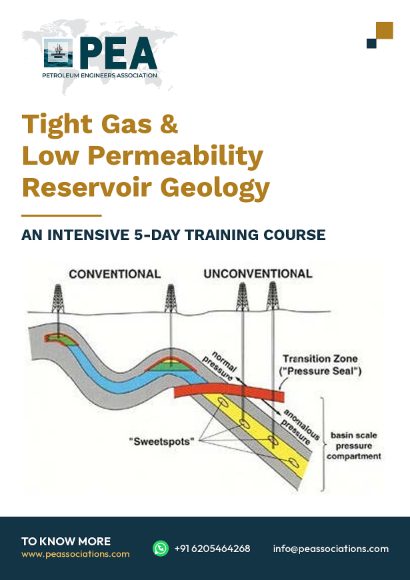
Tight gas reservoirs often have no conventional contact and the saturation distribution is capillary controlled. In a basin-centred accumulation, gas has been generated in place or has migrated into rock so tight that it could not displace all the water, and the result is a continuous gas-bearing interval with high water saturation and no identifiable free water level. Water saturations of forty to sixty per cent are common and the water is immobile. Applying a conventional contact-based interpretation to such a reservoir produces an in-place volume limited to a structural closure that does not control the accumulation.
Relative permeability behaviour explains why high water saturation still produces dry gas. In tight rock with small pore throats, the water occupies the finest pores and the grain surfaces as an immobile phase, while the gas moves through the larger connected throats. The water relative permeability is effectively zero at these saturations, so the well produces gas with little or no water, which contradicts what a conventional saturation interpretation would predict. Recognising this prevents tight gas intervals being written off as water-bearing.
The permeability that matters is often not the matrix permeability. In many tight gas reservoirs the matrix permeability measured on core is in the microdarcy range, which would give uneconomic rates, yet wells produce at commercial rates. The difference comes from natural fractures, from microfractures that open under production drawdown, or from thin better-quality streaks that the core sampling missed. Identifying which of these is supplying the production determines whether the well behaviour can be reproduced elsewhere in the field.
Finally, sweet spots in tight gas are mostly diagenetic. The depositional facies sets the starting permeability, but the variation in the final permeability across a field is commonly dominated by the degree of cementation, which varies with thermal history, with proximity to carbonate-cemented zones, with the presence of grain coatings and with the original composition. Mapping the diagenetic variation, which requires petrography rather than only logs, is therefore the route to finding the better rock, and it is a different exercise from mapping the facies.
By the end of this training, participants will be able to:
- Define tight reservoirs and recognise their basin settings
- Identify the diagenetic processes responsible for permeability loss
- Predict reservoir quality from diagenetic and thermal history
- Interpret pore systems and threshold pressures in tight rock
- Distinguish basin-centred from conventional tight accumulations
- Interpret high water saturation intervals correctly
- Apply relative permeability behaviour to tight gas producibility
- Assess the contribution of natural fractures to permeability
- Identify and map sweet spots on a diagenetic basis
- Assess tight gas resources and their recovery
The training works on tight gas field data sets including core, petrographic and production data. Participants interpret diagenetic histories and relate them to measured permeability, evaluate high saturation intervals and predict their producibility, and map reservoir quality variation. Production results are supplied for comparison against the predictions made.
Organisations sending participants to this training will:
- Avoid writing off productive high saturation intervals
- Predict tight reservoir quality from diagenetic history
- Map sweet spots on the correct basis
- Assess fracture contribution to production
- Improve tight gas resource estimates
- Target wells at the better rock
Participants will:
- Interpret diagenetic controls on permeability
- Evaluate tight reservoirs petrophysically
- Recognise basin-centred accumulations
- Assess producibility in low permeability rock
- Map diagenetic sweet spots
- Estimate tight gas resources
- Geoscientists working tight gas plays
- Petrophysicists evaluating low permeability reservoirs
- Exploration geologists assessing tight gas potential
- Reservoir engineers in tight gas developments
- Completion engineers requiring geological context
- Development geologists targeting tight reservoirs
- Technical staff assessing tight gas resources
Module 1 - Tight Reservoirs and Their Settings
- Permeability ranges and definitions
- Tight gas against shale gas distinction
- Tight oil considerations
- Basin settings for tight gas
- Foreland and intracratonic basins
- Deep basin accumulations
- Depositional settings of tight reservoirs
- Fluvial and deltaic tight sandstones
- Deepwater tight sandstones
- Tight carbonate reservoirs
- Thickness and continuity characteristics
- Global tight gas examples
Module 2 - Diagenetic Permeability Loss
- Mechanical compaction contribution
- Quartz cementation and temperature
- Quartz cement volumes in tight sandstones
- Carbonate cement and its distribution
- Clay authigenesis and pore throat occlusion
- Illite fibres and permeability damage
- Chlorite and its dual role
- Dissolution and secondary porosity
- Grain coating preservation effects
- Thermal history and cement prediction
- Petrographic quantification of cement
- Predicting permeability from petrography
Module 3 - Pore Systems and Capillarity
- Pore throat sizes in tight rock
- Capillary pressure curves in tight reservoirs
- Threshold entry pressure
- Mercury injection in tight samples
- Pore throat distribution and permeability
- Microporosity contribution
- Microfracture contribution
- Irreducible water saturation
- Transition zone thickness
- Capillary sealing by tight rock
- Pore system imaging methods
- Rock typing in tight reservoirs
Module 4 - Accumulation Types
- Conventional traps in tight reservoirs
- Basin-centred gas accumulation concept
- Continuous accumulations
- Gas generation in place
- Migration into tight rock
- Absence of free water level
- Downdip water-free gas
- Pressure regimes in basin-centred systems
- Overpressure and its role
- Sweet spots within continuous accumulations
- Trap and seal in tight systems
- Resource implications of accumulation type
Module 5 - Saturation and Producibility
- High water saturation intervals
- Capillary controlled saturation
- Saturation evaluation from logs
- Resistivity interpretation in tight rock
- Saturation exponent in tight reservoirs
- Core based saturation measurement
- Immobile water and relative permeability
- Water relative permeability at high saturation
- Dry gas production from wet rock
- Critical water saturation concepts
- Avoiding misinterpretation as water-bearing
- Producibility assessment methods
Module 6 - Natural Fractures
- Fracture occurrence in tight reservoirs
- Regional and local fracture sets
- Fracture characterisation from image logs
- Fracture observation in core
- Microfractures and their contribution
- Stress dependence of fracture permeability
- Fracture opening under drawdown
- Fracture corridors
- Structural controls on fracturing
- Mechanical stratigraphy effects
- Separating fracture from matrix contribution
- Targeting fractured intervals
Module 7 - Sweet Spots and Mapping
- Sweet spot definition in tight gas
- Depositional against diagenetic controls
- Petrographic mapping of cement variation
- Thermal history variation across a field
- Facies control on diagenesis
- Reservoir quality mapping workflows
- Log based quality indicators
- Seismic contribution to quality mapping
- Fracture intensity mapping
- Pressure and saturation mapping
- Combining criteria for ranking
- Well targeting from the maps
Module 8 - Stimulation and Resource Assessment
- Stimulation requirement in tight reservoirs
- Geological inputs to fracture design
- Stress profiles and containment
- Barrier identification for fracture height
- Natural fracture interaction with stimulation
- Damage mechanisms and their geology
- Clay sensitivity and fluid selection
- Horizontal against vertical well selection
- Resource assessment methods
- Recovery factors in tight gas
- Decline behaviour and reserves
- Economic thresholds and screening
Upon successful completion of this training course, delegates will be awarded an official Certificate of Completion issued by the Petroleum Engineers Association (PEA), an ISO 9001:2015 certified training organization. The certificate carries 10 Credits and formally records the total learning hours completed.
Each certificate is signed by the Course Facilitator and the CEO of the Petroleum Engineers Association, and serves as verifiable proof of professional training that delegates can present to employers and professional bodies worldwide.
Frequently Asked Questions
All course bookings made through PEA are strictly non-refundable. By registering for a course, you acknowledge and accept that all fees are payable in full and are not subject to refund under any circumstances, including changes in personal or professional commitments or partial attendance.
PEA reserves the right to make reasonable adjustments to course content, trainers, or schedules where necessary, without entitling delegates to a refund. Comprehensive details of each course — including objectives, target audience, and content — are clearly outlined before enrolment, and it is the responsibility of the delegate to ensure the course's suitability prior to booking.
For any inquiries related to cancellations or bookings, please contact our support team, who will be happy to assist you.
