


An Interactive 5-Day Training Course
Geological Time, Correlation & Biostratigraphy
Dating and Correlating the Subsurface
Secure your spot now!
Duration
5 Days
Price
$ 3,000
Starting From
18 Jan 2027



Home Geology and Geoscience Geological Time, Correlation & Biostratigraphy
Geological Time, Correlation & Biostratigraphy
Have Questions ?
Geological Time, Correlation & Biostratigraphy - GG-BIO-PEA27
| Code | Date | Time | Duration | Location | Currency | Early Bird Fee Per Person |
|---|---|---|---|---|---|---|
| GG-BIO-PEA27 | 18 - 22 Jan 2027 | 10 AM CST | 4 Hours Per Day |
Online |
USD |
3000 |
Need this for a group? We deliver the same course in-house — face-to-face at your location or online — tailored to your assets and team level. Contact info@peassociations.com.
Boost your team's skills and your budget! Enjoy group discounts for collaborative learning. Send an inquiry to info@peassociations.com.
Geological Time, Correlation & Biostratigraphy
Description
Correlation decides the shape of a reservoir. Deciding that a sand in one well is the same body as a sand in another, or that it is a different body at a different stratigraphic level, determines whether the model contains one continuous unit or two separate ones, and that determines connectivity, drainage, well spacing and recovery. Correlation is an interpretation made from incomplete evidence, alternative correlations almost always exist, and the consequences of choosing wrongly can persist through the life of a development.
This training covers correlation and the evidence that supports it. Geological time, the stratigraphic column and the formal nomenclature are established first, together with the fundamental distinction between lithostratigraphic units, which are bodies of rock, and chronostratigraphic units, which are intervals of time. Biostratigraphy is then developed in detail: the principal microfossil and palynomorph groups used in petroleum work, zonation schemes, range charts, first and last occurrence data, reworking and caving, and the practical interpretation of a biostratigraphic report. Sequence stratigraphy follows, covering systems tracts, key surfaces and their correlative value. Chemostratigraphy, magnetostratigraphy and absolute dating methods are covered as supporting tools. The training closes with well correlation practice, correlation in different depositional settings, and the reservoir consequences of correlation error.
Rock units and time units are not the same thing, and conflating them is the most common correlation error. A shoreface sandstone deposited as sea level rose is younger at its landward end than at its seaward end, sometimes by a considerable margin. Correlating that sand as a single time-equivalent layer places rock of different ages in the same model layer, which produces a flow unit that does not exist. Biostratigraphy and sequence stratigraphy both exist partly to detect exactly this situation.
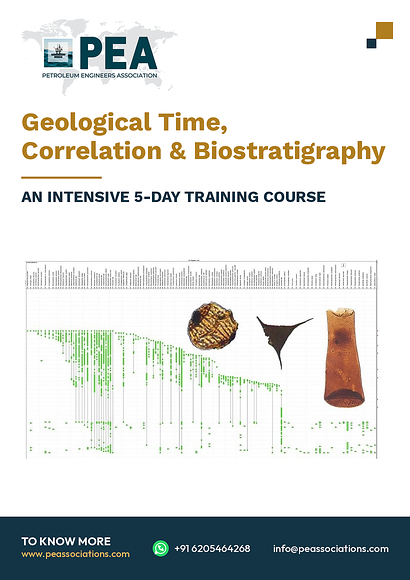
Biostratigraphic data is reported as first and last occurrences, and understanding what those represent is essential to using them. In a well drilled downward, the first occurrence encountered going down is the last occurrence of the species in time, and that top is generally the more reliable datum because the organism's extinction is a real event. Bases are less reliable because they can be missed by sampling. Caving contaminates samples with material from above, and reworking introduces older fossils into younger rock, and both are routine rather than exceptional.
Sequence stratigraphy provides correlation surfaces with genuine chronostratigraphic meaning. Maximum flooding surfaces and sequence boundaries form across a basin in a geologically short time, which makes them far better correlation datums than the top or base of a sand body. Correlating on these surfaces rather than on lithological picks produces models whose layering has time significance, which is what the flow simulation actually needs.
Finally, correlation uncertainty should be carried forward rather than resolved by assertion. Where two correlations fit the available data, both should be modelled and their different consequences for connectivity and volume examined. A development planned on one correlation when the other is equally supportable carries a risk that nobody has quantified, and it usually becomes apparent only when wells fail to find what was mapped.
By the end of this training, participants will be able to:
- Apply the geological time scale and formal stratigraphic nomenclature correctly
- Distinguish lithostratigraphic, biostratigraphic and chronostratigraphic units and use each appropriately
- Identify the principal fossil groups used in petroleum biostratigraphy and their applications
- Interpret biostratigraphic reports including range charts, zonations and occurrence data
- Recognise reworking, caving and sampling artefacts in biostratigraphic data
- Apply sequence stratigraphic concepts and identify key surfaces and systems tracts
- Use chemostratigraphy, magnetostratigraphy and absolute dating as correlation tools
- Correlate wells using integrated log, core, biostratigraphic and seismic evidence
- Construct alternative correlations and assess their relative support
- Assess the reservoir and development consequences of correlation uncertainty
Organisations sending participants to this training will:
- Improve correlation quality and the realism of reservoir layering
- Reduce connectivity and volume errors arising from incorrect correlation
- Extract more value from biostratigraphic data already acquired
- Specify biostratigraphic and dating programmes that answer the questions asked
- Improve communication between stratigraphers, modellers and engineers
- Carry correlation uncertainty into development decisions rather than concealing it
Participants will:
- Correlate wells using integrated evidence rather than log shape alone
- Interpret biostratigraphic reports confidently and recognise their artefacts
- Apply sequence stratigraphic surfaces as correlation datums
- Construct and compare alternative correlations
- Explain the reservoir consequences of a correlation choice
- Build a capability that underpins every static model
- Petroleum geologists and reservoir geologists
- Reservoir modellers building stratigraphic frameworks
- Exploration geoscientists working on regional correlation
- Operations geologists working on wellsite stratigraphy
- Petrophysicists correlating between wells
- Reservoir engineers requiring understanding of model layering
- Graduate geoscientists entering the oil and gas industry
Module 1 - Geological Time and Stratigraphic Principles
- Geological time scale and its divisions
- Relative and absolute time
- Principle of superposition and original horizontality
- Principle of faunal succession
- Principle of cross-cutting relationships
- Lithostratigraphy: formations, members and their definition
- Chronostratigraphy and geochronology
- Biostratigraphy as a time-correlation tool
- Diachronous surfaces and their recognition
- Unconformities, hiatuses and missing time
- Stratigraphic codes and formal nomenclature
Module 2 - Biostratigraphic Fossil Groups
- Microfossils and their advantages in petroleum work
- Foraminifera: planktonic and benthic, and their applications
- Calcareous nannofossils and their resolution
- Palynomorphs: spores, pollen and dinoflagellate cysts
- Diatoms, radiolaria and other siliceous microfossils
- Ostracods and their environmental significance
- Macrofossils and their limited subsurface use
- Group selection against age, environment and lithology
- Sample types: cuttings, sidewall cores, conventional core
- Sample preparation and processing
- Preservation, abundance and diversity
Module 3 - Biostratigraphic Methods and Interpretation
- Biozone types: range, interval, assemblage, acme
- Standard and local zonation schemes
- First and last occurrence data and their reliability
- Range charts and their construction
- Tops and bases: which is more reliable and why
- Caving and its recognition in cuttings data
- Reworking and its identification
- Barren intervals and their causes
- Resolution achievable and its variation
- Graphic correlation and quantitative methods
- Reading a biostratigraphic report critically
- Specifying a biostratigraphic programme
Module 4 - Palaeoenvironmental Interpretation
- Fossil assemblages as environmental indicators
- Water depth indicators and bathymetric zonation
- Salinity, oxygenation and temperature indicators
- Marine, marginal marine and non-marine assemblages
- Palaeoecology and its interpretation limits
- Integrating biofacies with sedimentary facies
- Palynofacies and organic matter assessment
- Kerogen type and maturity from palynology
- Environmental interpretation in support of correlation
- Reconciling biostratigraphic and sedimentological environment interpretations
Module 5 - Sequence Stratigraphy
- Sequence stratigraphic concepts and their basis
- Accommodation, eustasy, subsidence and sediment supply
- Base level and its controls
- Sequence boundaries and their recognition
- Maximum flooding surfaces and transgressive surfaces
- Systems tracts: lowstand, transgressive, highstand, falling stage
- Parasequences and parasequence stacking patterns
- Sequence hierarchy and order
- Sequence stratigraphy in different depositional settings
- Sequence surfaces as chronostratigraphic correlation datums
- Recognition on logs, core and seismic
- Common misapplications of sequence stratigraphy
Module 6 - Other Correlation and Dating Tools
- Chemostratigraphy: elemental and isotopic methods
- Chemostratigraphic zonation and its construction
- Applications where biostratigraphy fails
- Magnetostratigraphy and polarity reversal correlation
- Strontium isotope stratigraphy
- Carbon and oxygen isotope excursions as datums
- Radiometric dating methods and their applicability
- Absolute age constraints and the time scale
- Wireline log correlation and marker beds
- Seismic correlation and its resolution limits
- Integrating multiple correlation tools
Module 7 - Well Correlation Practice
- Correlation workflow and its sequence
- Datum selection and its consequences
- Flattening on different surfaces and what each shows
- Log signature correlation and its risks
- Correlating in fluvial and alluvial successions
- Correlating in deltaic and shoreface successions
- Correlating in deep water successions
- Correlating in carbonate successions
- Correlating across faults
- Correlation across a field and across a basin
- Constructing and testing alternative correlations
- Documenting correlation decisions and their basis
Module 8 - Reservoir Consequences and Application
- Correlation as the basis of model layering
- Effect of correlation on connectivity and compartmentalisation
- Effect on in-place volume estimation
- Effect on well spacing and drainage assessment
- Correlation and flow unit definition
- Time-significant against rock-significant layering in models
- Revising correlation as new wells are drilled
- Production and pressure data as correlation evidence
- Recognising correlation error from field performance
- Carrying correlation uncertainty into development decisions
- Field cases where correlation determined the outcome
Upon successful completion of this training course, delegates will be awarded an official Certificate of Completion issued by the Petroleum Engineers Association (PEA), an ISO 9001:2015 certified training organization. The certificate carries 10 Credits and formally records the total learning hours completed.
Each certificate is signed by the Course Facilitator and the CEO of the Petroleum Engineers Association, and serves as verifiable proof of professional training that delegates can present to employers and professional bodies worldwide.
Frequently Asked Questions
All course bookings made through PEA are strictly non-refundable. By registering for a course, you acknowledge and accept that all fees are payable in full and are not subject to refund under any circumstances, including changes in personal or professional commitments or partial attendance.
PEA reserves the right to make reasonable adjustments to course content, trainers, or schedules where necessary, without entitling delegates to a refund. Comprehensive details of each course — including objectives, target audience, and content — are clearly outlined before enrolment, and it is the responsibility of the delegate to ensure the course's suitability prior to booking.
For any inquiries related to cancellations or bookings, please contact our support team, who will be happy to assist you.
