


An Interactive 5-Day Training Course
Source Rock Evaluation & Maturity Modelling
Quantifying Source Rock Quality and Maturity
Secure your spot now!
Duration
5 Days
Price
$ 3,500
Starting From
18 Oct 2027



Home Geology and Geoscience Source Rock Evaluation & Maturity Modelling
Source Rock Evaluation & Maturity Modelling
Have Questions ?
Source Rock Evaluation & Maturity Modelling - GG-SRC-PEA27
| Code | Date | Time | Duration | Location | Currency | Early Bird Fee Per Person |
|---|---|---|---|---|---|---|
| GG-SRC-PEA27 | 18 - 22 Oct 2027 | 10 AM CST | 4 Hours Per Day |
Online |
USD |
3500 |
Need this for a group? We deliver the same course in-house — face-to-face at your location or online — tailored to your assets and team level. Contact info@peassociations.com
Boost your team's skills and your budget! Enjoy group discounts for collaborative learning. Send an inquiry to info@peassociations.com.
Source Rock Evaluation & Maturity Modelling
This training covers source rock evaluation and maturity modelling in depth. It works through source rock sampling and screening, quantitative source characterisation, original against present organic richness, maturity indicator measurement and calibration, kinetics determination, burial and thermal history construction, model calibration, generation and expulsion modelling, and the uncertainty in maturity and generation predictions.
Description
Source rock evaluation and maturity modelling together answer the charge question quantitatively: how much was generated, when, and of what. These are the inputs that distinguish a prospect with a demonstrated charge from one with a hopeful one, and they are among the few exploration parameters that can be substantially improved by analysis rather than by drilling. The work requires correct sampling, appropriate measurement, careful calibration and an honest treatment of the uncertainty in each step.
This training develops both subjects to working level. Source rock sampling is established first, covering sample selection, the particular problems of cuttings, contamination and caving, and the programme design that produces usable data. Screening and quantitative characterisation follow, covering total organic carbon, pyrolysis, the derivation of generative potential, net source thickness and the mapping of source quality. Original organic richness is then addressed, since a mature source rock has already lost part of its carbon and its present measurements understate its original potential. Maturity indicators are developed in detail: vitrinite reflectance measurement and its pitfalls, Tmax, biomarker ratios, and the reconciliation of indicators that disagree. Kinetics follow, covering measured and default kinetics and their effect on predicted timing. Burial and thermal history construction is then developed, covering decompaction, erosion estimation, heat flow history and the calibration process. Generation and expulsion modelling complete the technical content. The training closes with uncertainty and sensitivity analysis.
A mature source rock understates its own original potential. Generation removes carbon from the kerogen and expels it, so a source rock measured at two per cent organic carbon in the oil window may have been four or five per cent when deposited, and its measured hydrogen index will be far below the original. Modelling generated volumes from present-day measurements without restoring the original richness underestimates the charge, sometimes substantially. Restoration methods exist and should be applied wherever the source is mature.
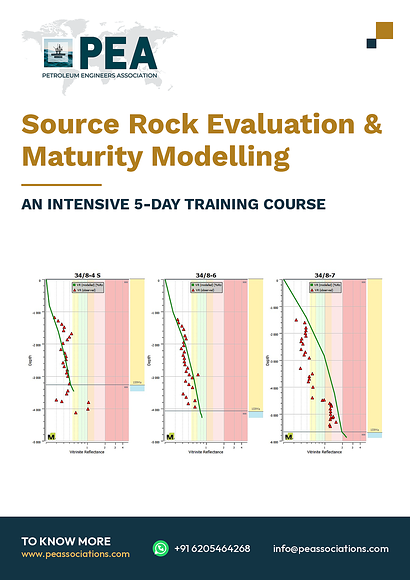
Vitrinite reflectance is the standard maturity indicator and it is frequently misread. Problems include caved vitrinite from shallower levels giving spuriously low values, reworked vitrinite from older rocks giving high values, suppression in hydrogen rich and marine settings giving values below the true maturity, and the simple absence of vitrinite in pre-Devonian and some marine rocks. A profile with scatter should be interpreted by identifying the correct population rather than by fitting a line through everything measured.
Kinetics determine the timing and the timing determines whether the charge mattered. Default kinetics for a kerogen type give generation at a given temperature range; measured kinetics for the specific source can differ enough to shift generation by tens of millions of years in a slowly subsiding basin. Where the question is whether generation preceded trap formation, that difference can decide the prospect. Measuring kinetics on the actual source rock is comparatively cheap relative to the decision it informs.
Finally, the model is only as good as its calibration and its calibration is only as good as the data. A thermal model with no maturity measurements is an assumption dressed as a calculation. One calibrated against a few reliable vitrinite values, a corrected bottom hole temperature and a defensible erosion estimate is a constrained result with stated uncertainty. The difference in what can be concluded from the two is large, and the cost difference is small.
By the end of this training, participants will be able to:
- Design source rock sampling programmes and avoid common sample problems
- Characterise source rocks quantitatively from screening and pyrolysis data
- Restore original organic richness and generative potential
- Map source quality, thickness and distribution
- Measure and interpret maturity indicators and reconcile disagreement
- Recognise vitrinite reflectance artefacts including suppression and caving
- Apply measured and default kinetics and assess their effect on timing
- Construct burial and thermal histories with erosion estimation
- Calibrate thermal models against maturity and temperature data
- Model generation and expulsion and quantify the prediction uncertainty
The training works on real source rock and well data sets. Participants screen and characterise source intervals, restore original richness, build maturity profiles and identify artefacts in scattered data. Thermal histories are constructed and calibrated, with erosion estimated from multiple methods. Generation is modelled with default and measured kinetics and the timing difference quantified. Sensitivity analysis identifies which inputs the conclusions actually depend on.
Organisations sending participants to this training will:
- Quantify charge rather than assuming it
- Avoid understating generated volumes from mature sources
- Identify and correct maturity indicator artefacts
- Calibrate thermal models properly and improve timing predictions
- Specify kinetics measurement where timing is decisive
- Improve charge risking across the exploration portfolio
Participants will:
- Characterise source rocks quantitatively
- Restore original richness and potential
- Interpret maturity data critically
- Build and calibrate thermal histories
- Model generation with appropriate kinetics
- State charge predictions with their uncertainty
- Geochemists and basin modellers
- Exploration geoscientists assessing charge
- New ventures staff evaluating frontier basins
- Unconventional resource geoscientists
- Operations geologists specifying source sampling
- Technical staff reviewing charge assessments
- Geoscientists requiring quantitative charge capability
Module 1 - Sampling and Sample Problems
- Sample selection for source evaluation
- Cuttings sampling and its limitations
- Caving and its effect on results
- Core and sidewall core sampling
- Outcrop sampling and weathering effects
- Oil based mud contamination
- Additive and lubricant contamination
- Sample storage and oxidation
- Sample preparation procedures
- Sampling density and interval
- Specifying a sampling programme
- Recognising compromised data
Module 2 - Quantitative Source Characterisation
- Total organic carbon measurement and precision
- Pyrolysis parameters in detail
- Generative potential calculation
- Hydrogen index and kerogen typing
- Source rock quality classification
- Net source rock thickness definition
- Source rock density and mass calculation
- Organic facies concept
- Lateral variation in source quality
- Source rock mapping methods
- Log based source rock identification
- Delta log R and related techniques
Module 3 - Original Richness Restoration
- Carbon loss during generation
- Present against original organic carbon
- Present against original hydrogen index
- Transformation ratio determination
- Restoration methods and their basis
- Immature equivalent identification
- Restoring across a maturity gradient
- Effect on generated volume estimates
- Magnitude of the correction
- Uncertainty in restoration
- When restoration matters most
Module 4 - Maturity Indicators
- Vitrinite reflectance measurement method
- Sample preparation for reflectance
- Population identification in scattered data
- Caved vitrinite recognition
- Reworked vitrinite recognition
- Vitrinite suppression and its causes
- Absence of vitrinite and alternatives
- Tmax and its reliability
- Biomarker maturity ratios
- Spore colour and thermal alteration index
- Fluid inclusion and apatite fission track constraints
- Reconciling conflicting indicators
Module 5 - Kinetics
- Kerogen cracking kinetics
- Activation energy distributions
- Arrhenius relationship and its application
- Default kinetics by kerogen type
- Measured kinetics on specific samples
- Kinetics measurement methods
- Effect of kinetics on generation temperature
- Effect of kinetics on generation timing
- Compositional kinetics
- Oil to gas cracking kinetics
- When measured kinetics are worth acquiring
- Kinetic uncertainty and its propagation
Module 6 - Burial and Thermal History
- Burial history construction
- Decompaction methods and parameters
- Erosion and hiatus estimation
- Estimating erosion from compaction trends
- Estimating erosion from maturity profiles
- Thermochronology constraints on exhumation
- Heat flow and its history by basin type
- Radiogenic heat contribution
- Thermal conductivity assignment
- Surface temperature history
- Palaeobathymetry and its effect
- Building the thermal model
Module 7 - Model Calibration
- Calibration data types
- Corrected bottom hole temperatures
- Temperature data quality and correction
- Vitrinite reflectance calibration
- Tmax and biomarker calibration
- Fission track calibration
- Fitting the model to calibration data
- Parameters adjusted during calibration
- Non-uniqueness in calibration
- Heat flow against erosion trade-off
- Assessing calibration quality
- Models that cannot be calibrated
Module 8 - Generation, Expulsion and Uncertainty
- Transformation ratio through time
- Generation timing determination
- Generated volume calculation
- Expulsion thresholds and efficiency
- Expelled volume estimation
- Compositional prediction of products
- Secondary cracking modelling
- Sensitivity analysis on model inputs
- Which inputs drive the conclusion
- Scenario modelling for uncertain histories
- Expressing generation results with uncertainty
- Communicating charge conclusions
Upon successful completion of this training course, delegates will be awarded an official Certificate of Completion issued by the Petroleum Engineers Association (PEA), an ISO 9001:2015 certified training organization. The certificate carries 10 Credits and formally records the total learning hours completed.
Each certificate is signed by the Course Facilitator and the CEO of the Petroleum Engineers Association, and serves as verifiable proof of professional training that delegates can present to employers and professional bodies worldwide.
Frequently Asked Questions
All course bookings made through PEA are strictly non-refundable. By registering for a course, you acknowledge and accept that all fees are payable in full and are not subject to refund under any circumstances, including changes in personal or professional commitments or partial attendance.
PEA reserves the right to make reasonable adjustments to course content, trainers, or schedules where necessary, without entitling delegates to a refund. Comprehensive details of each course — including objectives, target audience, and content — are clearly outlined before enrolment, and it is the responsibility of the delegate to ensure the course's suitability prior to booking.
For any inquiries related to cancellations or bookings, please contact our support team, who will be happy to assist you.
