


An Interactive 5-Day Training Course
Casing While Drilling & Drilling with Liner
Drilling and Casing Together
Secure your spot now!
Duration
5 Days
Price
$ 3,500
Starting From
04 Oct 2027



Casing While Drilling & Drilling with Liner
Have Questions ?
Casing While Drilling & Drilling with Liner - DC-CWDL-PEA27
| Code | Date | Time | Duration | Location | Currency | Early Bird Fee Per Person |
|---|---|---|---|---|---|---|
| DC-CWDL-PEA27 | 04 - 08 Oct 2027 | 10 AM CST | 4 Hours / Day |
Online |
USD |
3500 |
Need this for a group? We deliver the same course in-house — face-to-face at your location or online — tailored to your assets and team level. Contact info@peassociations.com
Boost your team's skills and your budget! Enjoy group discounts for collaborative learning. Send an inquiry to info@peassociations.com.
Casing While Drilling & Drilling with Liner
This course covers casing while drilling and drilling with liner. Participants study the concepts and their benefits, system types and equipment, drillable and retrievable bottomhole assemblies, the plastering effect and wellbore strengthening, hydraulics and hole cleaning, directional options, cementing, candidate selection, operational practice and economics.
Description
Casing while drilling uses the casing string itself as the drillstring, so the hole is cased as it is drilled. It removes tripping, reduces exposure time, strengthens the wellbore through the plastering effect and can eliminate the problems that occur between drilling and running casing, which is when many wells get into trouble.
This course covers the methods and their application. It starts with the concepts and the benefits claimed for them, then covers system types: non-retrievable drillable shoes, retrievable bottomhole assemblies run on wireline, and drilling with liner systems. It covers the plastering effect and its role in wellbore strengthening and loss reduction, hydraulics and hole cleaning with the reduced annular clearance, and the directional options available. It then covers cementing after casing while drilling, candidate selection and the conditions where the method works best, operational practice and the problems that occur, and the economic assessment against conventional drilling.
The main benefit is eliminating the gap between drilling and casing. In troublesome sections, the hole deteriorates while the drillstring is tripped out and the casing is run, and a significant proportion of stuck casing and failed casing runs happen in that window. Casing while drilling removes it entirely, because the casing is already there.
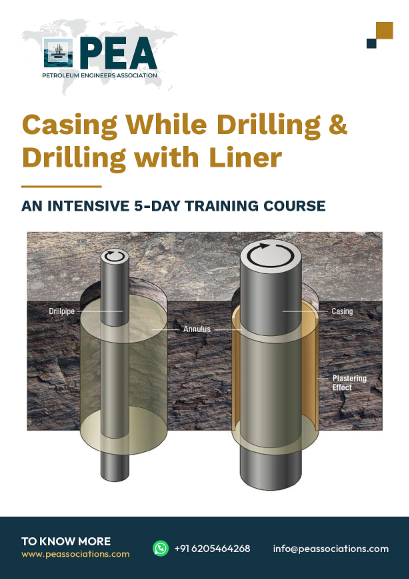
The plastering effect is the second benefit. The casing rotating in a tight annulus smears cuttings and mud solids into the borehole wall, forming a dense layer that reduces losses and can raise the effective fracture gradient. This is why the method is used in depleted and loss-prone sections where conventional drilling struggles.
The constraints are real. The annulus is small, so hydraulics are limited and equivalent circulating density is higher; directional capability is restricted compared with conventional drilling; and if the bottomhole assembly is drillable, the string cannot be tripped to change it. Candidate selection is therefore narrower than the benefits alone would suggest.
By the end of this training, participants will be able to:
- Explain casing while drilling and drilling with liner concepts and benefits.
- Compare system types and select between drillable and retrievable assemblies.
- Specify equipment, including shoes, drill locks and wireline retrievable systems.
- Explain the plastering effect and its role in wellbore strengthening.
- Calculate hydraulics and assess hole cleaning with reduced annular clearance.
- Manage equivalent circulating density in casing while drilling.
- Apply directional options and understand their limits.
- Plan cementing after casing while drilling.
- Select candidate sections and assess suitability.
- Evaluate operational practice, problems and economics against conventional drilling.
The course is instructor-led. Systems and equipment are covered with drawings and specifications, hydraulics with calculations comparing conventional and casing while drilling cases, and operations with field records from applied projects. Participants assess candidate sections and evaluate the economic case. Participants are encouraged to bring their own problem sections for discussion.
Organisations sending participants to this training will:
- Reduce losses and stuck casing in trouble-prone sections.
- Eliminate the exposure window between drilling and casing.
- Apply wellbore strengthening through the plastering effect.
- Select candidates where the method genuinely adds value.
- Reduce days and cost in suitable sections.
Participants will:
- Understand casing while drilling systems and their benefits.
- Be able to assess hydraulics and hole cleaning constraints.
- Be able to select systems and candidate sections.
- Understand cementing and operational practice.
- Be able to evaluate the economics against conventional drilling.
- Drilling and well engineers
- Rig site supervisors and company representatives
- Well planners working trouble-prone sections
- Service company engineers supporting these systems
- Drilling fluids engineers
- Technical staff evaluating drilling technology
Module 1: Concepts and Benefits
- Casing while drilling and drilling with liner
- Claimed benefits and evidence
- Applications and history
- Comparison with conventional drilling
- Where the method fits
Module 2: System Types
- Non-retrievable drillable systems
- Retrievable wireline systems
- Drilling with liner systems
- Selection criteria
- Equipment availability by size
Module 3: Equipment
- Drillable bits and shoes
- Drill locks and latching systems
- Casing drive systems and top drive adapters
- Casing connections for drilling loads
- Wear and handling considerations
Module 4: The Plastering Effect
- Mechanism and evidence
- Effect on losses and wellbore strength
- Conditions where it works
- Measurement and verification
- Application in depleted zones
Module 5: Hydraulics and Hole Cleaning
- Annular clearance and pressure losses
- Equivalent circulating density
- Flow rate limits
- Hole cleaning with casing
- Managing within the pressure window
Module 6: Directional Options
- Directional capability and limits
- Steerable casing while drilling systems
- Trajectory control expectations
- Applications where directional capability is needed
Module 7: Cementing
- Cementing after casing while drilling
- Float equipment and plug systems
- Displacement considerations
- Cement evaluation
- Common cementing problems
Module 8: Candidate Selection
- Section characteristics that suit the method
- Loss-prone and depleted sections
- Formation and hole size constraints
- Risk assessment
- Contingency if the method fails
Module 9: Operations and Economics
- Operational practice and crew requirements
- Common problems and their handling
- Rate of penetration expectations
- Cost comparison with conventional drilling
- Field experience and lessons learned
Upon successful completion of this training course, delegates will be awarded an official Certificate of Completion issued by the Petroleum Engineers Association (PEA), an ISO 9001:2015 certified training organization. The certificate carries 10 Credits and formally records the total learning hours completed.
Each certificate is signed by the Course Facilitator and the CEO of the Petroleum Engineers Association, and serves as verifiable proof of professional training that delegates can present to employers and professional bodies worldwide.
Frequently Asked Questions
All course bookings made through PEA are strictly non-refundable. By registering for a course, you acknowledge and accept that all fees are payable in full and are not subject to refund under any circumstances, including changes in personal or professional commitments or partial attendance.
PEA reserves the right to make reasonable adjustments to course content, trainers, or schedules where necessary, without entitling delegates to a refund. Comprehensive details of each course — including objectives, target audience, and content — are clearly outlined before enrolment, and it is the responsibility of the delegate to ensure the course's suitability prior to booking.
For any inquiries related to cancellations or bookings, please contact our support team, who will be happy to assist you.
