


An Interactive 5-Day Training Course
Riserless Drilling & Dual Gradient Systems
Drilling Without a Riser
Secure your spot now!
Duration
5 Days
Price
$ 3,500
Starting From
06 Sep 2027



Riserless Drilling & Dual Gradient Systems
Have Questions ?
Riserless Drilling & Dual Gradient Systems - DC-RDG-PEA27
| Code | Date | Time | Duration | Location | Currency | Early Bird Fee Per Person |
|---|---|---|---|---|---|---|
| DC-RDG-PEA27 | 06 - 10 Sep 2027 | 10 AM CST | 4 Hours / Day |
Online |
USD |
3500 |
Need this for a group? We deliver the same course in-house — face-to-face at your location or online — tailored to your assets and team level. Contact info@peassociations.com
Boost your team's skills and your budget! Enjoy group discounts for collaborative learning. Send an inquiry to info@peassociations.com.
Riserless Drilling & Dual Gradient Systems
This course covers riserless and dual gradient drilling. Participants study riserless top hole operations, pump and dump systems, riserless mud recovery, dual gradient concepts and equipment, subsea pumping systems, hydraulics and pressure profiles, well control considerations, environmental requirements, operational practice and application assessment.
Description
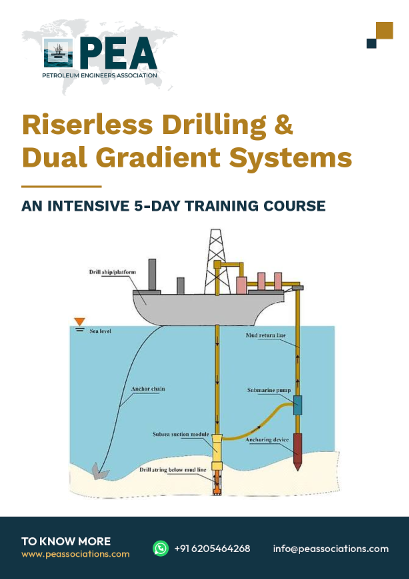
Riserless and dual gradient methods change the pressure profile in a well by removing or replacing the riser mud column. Riserless drilling returns fluid to the seabed and is standard practice for deepwater top hole; riserless mud recovery captures and returns the fluid to the rig; dual gradient systems use a subsea pump to replace the riser column with seawater, widening the drilling window in deep water.
This course covers the methods and their application. It starts with riserless top hole operations, pump and dump systems, fluid selection and environmental constraints, then covers riserless mud recovery systems, their equipment, operation and benefits. It covers dual gradient concepts, the pressure profile they produce and the equipment required, including subsea mud pumps, return lines and control systems. It then covers hydraulics and pressure management in these systems, well control considerations and procedures, environmental and regulatory requirements, operational practice and the assessment of where these methods add enough value to justify their cost and complexity.
In deep water the riser mud column is the problem. It adds hydrostatic pressure from the seabed to the rig floor, raising bottomhole pressure and narrowing the margin against fracture. Dual gradient drilling removes that column by pumping returns from the seabed, so the pressure profile below the mudline behaves as if the rig were on the seabed.
Riserless drilling does the same thing for the top hole by returning fluid to the seabed. It is routine, cheap in equipment terms and environmentally constrained, since only water-based fluids can be discharged and in many locations only within defined limits. Riserless mud recovery extends the method by returning the fluid to the rig, which allows better fluids to be used and reduces discharge.
Dual gradient systems have not become standard because of complexity and cost. Subsea pumps, return lines, control systems and the procedures that surround them add equipment on the seabed, new failure modes and new well control considerations. Where the window is narrow enough that conventional drilling needs several extra casing strings, the trade-off can favour them.
By the end of this training, participants will be able to:
- Plan riserless top hole drilling operations and fluid programmes.
- Specify pump and dump systems and their environmental limits.
- Describe riserless mud recovery systems and their operation.
- Explain dual gradient concepts and the pressure profiles they produce.
- Specify subsea pumping equipment, return lines and control systems.
- Calculate hydraulics and pressure profiles for riserless and dual gradient systems.
- Apply well control principles and procedures in these systems.
- Assess environmental and regulatory requirements for discharge and operations.
- Apply operational practice, including connections, tripping and transitions.
- Assess where these methods add enough value to justify their cost.
The course is instructor-led. Pressure profiles and hydraulics are developed with calculations comparing conventional, riserless and dual gradient cases. Equipment and operations are covered with schematics, procedures and field experience from projects that applied these methods. Participants are encouraged to bring their own wells for discussion.
Organisations sending participants to this training will:
- Reduce casing strings in narrow margin deepwater wells.
- Improve top hole operations and reduce discharge.
- Assess dual gradient technology on realistic cost and value grounds.
- Meet environmental requirements for riserless operations.
- Build competence in alternative deepwater drilling methods.
Participants will:
- Understand riserless and dual gradient methods and their effects.
- Be able to plan riserless top hole operations.
- Be able to calculate pressure profiles for these systems.
- Understand well control in riserless and dual gradient drilling.
- Be able to assess application and value.
- Drilling and well engineers in deepwater operations
- Rig site supervisors on floating units
- Drilling fluids engineers
- Subsea engineers
- Technical authorities for deepwater drilling
- Project engineers assessing new drilling technology
Module 1: Riserless Top Hole Drilling
- Why the top hole is drilled riserless
- Returns to seabed
- Hole cleaning without returns
- Conductor and surface casing installation
- Operational sequence
Module 2: Pump and Dump Systems
- Fluid selection for discharge
- Volume and logistics requirements
- Mixing and supply
- Environmental limits and monitoring
- Cost considerations
Module 3: Riserless Mud Recovery
- System concept and equipment
- Subsea pump module and return line
- Fluid recovery and reconditioning
- Benefits over pump and dump
- Operational experience and limitations
Module 4: Dual Gradient Concepts
- The riser column pressure problem
- Dual gradient pressure profiles
- Window widening and casing reduction
- Variants of dual gradient
- History and current application
Module 5: Equipment
- Subsea mud pumps
- Return lines and risers
- Suction modules and level control
- Surface equipment and interfaces
- Control systems and automation
Module 6: Hydraulics and Pressure Management
- Pressure profile calculation
- Equivalent circulating density in dual gradient systems
- Connection pressure management
- Transients and pump control
- Comparison with managed pressure drilling
Module 7: Well Control
- Kick detection in riserless and dual gradient systems
- U-tube effects and their management
- Shut-in and kill procedures
- Transition to conventional well control
- Procedures and drills
Module 8: Environment and Regulation
- Discharge regulations and limits
- Monitoring and reporting
- Fluid selection for environmental compliance
- Approvals for new technology
- Jurisdictional differences
Module 9: Operations and Application Assessment
- Operational practice and crew requirements
- Equipment reliability and contingency
- Candidate well screening
- Cost and value comparison
- Field experience and lessons learned
Upon successful completion of this training course, delegates will be awarded an official Certificate of Completion issued by the Petroleum Engineers Association (PEA), an ISO 9001:2015 certified training organization. The certificate carries 10 Credits and formally records the total learning hours completed.
Each certificate is signed by the Course Facilitator and the CEO of the Petroleum Engineers Association, and serves as verifiable proof of professional training that delegates can present to employers and professional bodies worldwide.
Frequently Asked Questions
All course bookings made through PEA are strictly non-refundable. By registering for a course, you acknowledge and accept that all fees are payable in full and are not subject to refund under any circumstances, including changes in personal or professional commitments or partial attendance.
PEA reserves the right to make reasonable adjustments to course content, trainers, or schedules where necessary, without entitling delegates to a refund. Comprehensive details of each course — including objectives, target audience, and content — are clearly outlined before enrolment, and it is the responsibility of the delegate to ensure the course's suitability prior to booking.
For any inquiries related to cancellations or bookings, please contact our support team, who will be happy to assist you.
