


An Interactive 5-Day Training Course
HP/HT Drilling Engineering
Drilling at Extreme Conditions
Secure your spot now!
Duration
5 Days
Price
$ 4,000
Starting From
30 Aug 2027



HP/HT Drilling Engineering
Have Questions ?
HP/HT Drilling Engineering - DC-HPHT-PEA27
| Code | Date | Time | Duration | Location | Currency | Early Bird Fee Per Person |
|---|---|---|---|---|---|---|
| DC-HPHT-PEA27 | 30 Aug - 03 Sep 2027 | 10 AM CST | 4 Hours / Day |
Online |
USD |
4000 |
Need this for a group? We deliver the same course in-house — face-to-face at your location or online — tailored to your assets and team level. Contact info@peassociations.com
Boost your team's skills and your budget! Enjoy group discounts for collaborative learning. Send an inquiry to info@peassociations.com.
HP/HT Drilling Engineering
This course covers high pressure and high temperature drilling engineering. Participants study HP/HT definitions and challenges, pore pressure and narrow margins, drilling fluids at extreme conditions, casing and wellhead design, equipment ratings and elastomers, well control at HP/HT, kick tolerance, annular pressure build-up, operating practice and risk management.
Description
High pressure and high temperature wells sit at the limits of equipment, materials and prediction methods. Margins between pore pressure and fracture gradient are narrow, kick tolerance is small, mud properties change substantially downhole, elastomers and electronics degrade, and the consequences of a well control event are more severe than in conventional wells.
This course covers the engineering and the operating discipline. It starts with HP/HT definitions and classifications and the specific challenges each level brings, then covers pore pressure prediction and narrow margin management at extreme conditions. It covers drilling fluid behaviour at high temperature and pressure, including rheology, density changes, sag and thermal stability, and the hydraulics consequences. It then covers casing, wellhead and equipment design and ratings, elastomer and material selection, and well control at HP/HT including kick tolerance, gas behaviour and kill design. The course closes with annular pressure build-up, operating practice, monitoring requirements and the risk management framework HP/HT wells require.
At HP/HT conditions, small errors become large ones quickly. Kick tolerance may be only a few barrels, meaning a kick must be detected and shut in almost immediately; mud density changes with temperature and pressure by enough to matter for pressure control; and equipment operating close to its rated pressure has little margin for the surge of a shut-in.
Mud behaviour is harder to predict. Downhole rheology differs substantially from surface measurements, equivalent circulating density calculations that ignore compressibility and thermal expansion can be significantly wrong, and barite sag risk is high in hot deviated wells. Fluid design and hydraulics modelling therefore need temperature and pressure dependent data rather than surface values.
Materials and elastomers set hard limits. Seals degrade, electronics fail, and casing strength falls with temperature, which narrows the design margins at the same time as the loads increase. HP/HT wells are therefore slower, more carefully monitored and more procedurally controlled than conventional wells, and the planning reflects that.
By the end of this training, participants will be able to:
- Define HP/HT classifications and the challenges at each level.
- Predict pore pressure and manage narrow margins at extreme conditions.
- Assess drilling fluid behaviour at high temperature and pressure.
- Calculate hydraulics and equivalent circulating density with temperature and pressure effects.
- Manage barite sag and fluid stability in HP/HT wells.
- Design casing, wellheads and equipment for HP/HT service.
- Select materials and elastomers within temperature and pressure limits.
- Calculate kick tolerance and apply well control at HP/HT conditions.
- Assess and mitigate annular pressure build-up.
- Apply HP/HT operating practice, monitoring and risk management.
The course is instructor-led. HP/HT effects are developed through calculations comparing conventional and extreme conditions, and participants work through a well design case including margins, fluid design, casing and well control planning. Field cases cover HP/HT wells and incidents. Participants are encouraged to bring their own wells for discussion.
Organisations sending participants to this training will:
- Design and drill HP/HT wells with adequate margin and control.
- Reduce well control risk in low kick tolerance conditions.
- Improve fluid and hydraulics prediction at extreme conditions.
- Select materials and equipment correctly for HP/HT service.
- Apply the operating discipline these wells require.
Participants will:
- Understand what changes at HP/HT conditions and why.
- Be able to design fluids, casing and equipment for HP/HT wells.
- Be able to calculate kick tolerance and plan well control.
- Understand annular pressure build-up and its mitigation.
- Be able to apply HP/HT operating and monitoring practice.
- Drilling and well engineers on HP/HT projects
- Rig site supervisors and company representatives
- Drilling fluids engineers
- Well control specialists
- Materials and integrity engineers
- Technical authorities for HP/HT operations
Module 1: HP/HT Definitions and Challenges
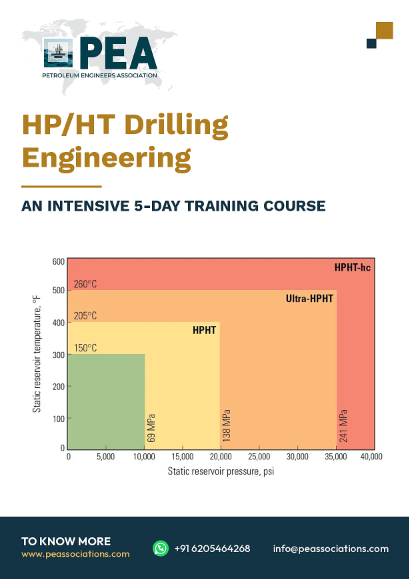
- Pressure and temperature classifications
- Where conventional practice breaks down
- Equipment and material limits
- Overview of HP/HT developments and experience
Module 2: Pore Pressure and Margins
- Pressure prediction at extreme conditions
- Narrow margin assessment
- Kick tolerance calculation
- Casing point selection
- Managed pressure techniques in HP/HT wells
Module 3: Drilling Fluids at Extreme Conditions
- Density changes with temperature and pressure
- Rheology at downhole conditions
- Thermal stability of additives
- Barite sag risk and prevention
- Fluid selection for HP/HT wells
Module 4: Hydraulics at HP/HT
- Compressibility and thermal expansion effects
- Equivalent circulating density calculation
- Pressure loss prediction
- Surge and swab at extreme conditions
- Hydraulics modelling requirements
Module 5: Casing and Wellhead Design
- Strength derating with temperature
- Load cases for HP/HT wells
- Connection selection
- Wellhead and equipment ratings
- Design factors and margins
Module 6: Materials and Elastomers
- Material selection for high temperature and sour service
- Elastomer temperature limits
- Seal selection
- Electronics and tool temperature limits
- Qualification requirements
Module 7: Well Control at HP/HT
- Low kick tolerance implications
- Detection and shut-in speed
- Gas behaviour at high pressure and temperature
- Kill design and pressure limits
- Equipment rating margins during a kill
Module 8: Annular Pressure Build-Up
- Mechanism at high temperature
- Calculation methods
- Mitigation options
- Monitoring and operating limits
- Design integration
Module 9: Operating Practice and Risk Management
- Procedures and operating discipline
- Monitoring and data requirements
- Crew competence and drills
- Risk assessment and contingency
- Lessons from HP/HT incidents
Upon successful completion of this training course, delegates will be awarded an official Certificate of Completion issued by the Petroleum Engineers Association (PEA), an ISO 9001:2015 certified training organization. The certificate carries 10 Credits and formally records the total learning hours completed.
Each certificate is signed by the Course Facilitator and the CEO of the Petroleum Engineers Association, and serves as verifiable proof of professional training that delegates can present to employers and professional bodies worldwide.
Frequently Asked Questions
All course bookings made through PEA are strictly non-refundable. By registering for a course, you acknowledge and accept that all fees are payable in full and are not subject to refund under any circumstances, including changes in personal or professional commitments or partial attendance.
PEA reserves the right to make reasonable adjustments to course content, trainers, or schedules where necessary, without entitling delegates to a refund. Comprehensive details of each course — including objectives, target audience, and content — are clearly outlined before enrolment, and it is the responsibility of the delegate to ensure the course's suitability prior to booking.
For any inquiries related to cancellations or bookings, please contact our support team, who will be happy to assist you.
