


An Interactive 5-Day Training Course
Subsea Wellhead & Tubing Hanger Systems
Subsea Wellheads and Hangers
Secure your spot now!
Duration
5 Days
Price
$ 4,000
Starting From
30 Aug 2027



Subsea Wellhead & Tubing Hanger Systems
Have Questions ?
Subsea Wellhead & Tubing Hanger Systems - DC-SWC-PEA27
| Code | Date | Time | Duration | Location | Currency | Early Bird Fee Per Person |
|---|---|---|---|---|---|---|
| DC-SWC-PEA27 | 30 Aug - 03 Sep 2027 | 10 AM CST | 4 Hours / Day |
Online |
USD |
4000 |
Need this for a group? We deliver the same course in-house — face-to-face at your location or online — tailored to your assets and team level. Contact info@peassociations.com
Boost your team's skills and your budget! Enjoy group discounts for collaborative learning. Send an inquiry to info@peassociations.com.
Subsea Wellhead & Tubing Hanger Systems
This course covers subsea wellhead and tubing hanger systems. Participants study wellhead housings and casing hangers, seal assemblies and lock-down, load capacity and fatigue, running tools and installation, tubing hanger systems and orientation, control line penetrators, testing and verification, integrity monitoring and intervention on subsea wellheads.
Description
A subsea wellhead carries every casing string, seals each annulus, supports the blowout preventer stack and later the Christmas tree, and must do all of it on the seabed for the life of the well. It is a barrier element, a structural member and the interface between the well and everything above it.
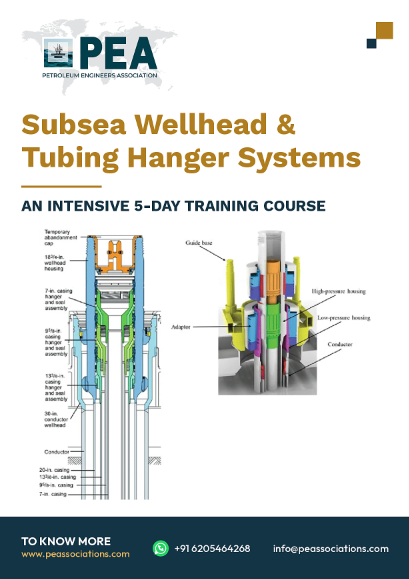
This course covers the system in detail. It starts with wellhead housings, casing hangers and the installation sequence as each string is run, then covers seal assemblies, lock-down mechanisms and the sealing technologies used. It covers load capacity, bending and fatigue from riser and BOP loads, and the analysis behind wellhead fatigue life. It then covers running tools and installation operations, tubing hanger systems including orientation, control line penetrators and downhole line connections, and the testing and verification of each seal. The course closes with integrity monitoring of subsea wellheads, common problems and failures, and intervention and repair options when something goes wrong on the seabed.
Wellhead fatigue has become a central concern in deepwater operations. The riser and blowout preventer stack apply bending loads at the wellhead through vessel motion and current, concentrated at the conductor and the high pressure housing. Over long drilling campaigns these loads accumulate damage at a rate that has to be tracked, because a fatigued wellhead cannot be replaced.
Seals are the other critical element. Each casing hanger seal isolates an annulus, and every one of them is installed blind at the seabed, tested by pressure and then expected to hold for decades. Installation practice, cleanliness, correct tool operation and verified testing are what make them reliable.
The tubing hanger adds orientation and control lines. It must land in a defined orientation so that control line and downhole gauge connections align, and the penetrators must seal and remain electrically and hydraulically sound. Problems here are expensive to fix because access requires a vessel and often a pulled tree.
By the end of this training, participants will be able to:
- Describe subsea wellhead housings and casing hangers and their installation sequence.
- Explain seal assembly types, setting and lock-down mechanisms.
- Assess wellhead load capacity, bending and fatigue.
- Apply wellhead fatigue analysis and tracking.
- Specify running tools and plan installation operations.
- Describe tubing hanger systems and orientation methods.
- Specify control line penetrators and downhole line connections.
- Plan testing and verification of wellhead and hanger seals.
- Monitor subsea wellhead integrity during drilling and production.
- Plan intervention and repair for wellhead and hanger problems.
The course is instructor-led. Equipment is covered with cutaway drawings, tool specifications and installation procedures, and fatigue with worked analysis examples. Field cases cover seal failures, orientation problems and wellhead fatigue issues and how they were managed. Participants are encouraged to bring their own equipment and problems for discussion.
Organisations sending participants to this training will:
- Improve subsea wellhead installation quality and seal reliability.
- Manage wellhead fatigue over long drilling campaigns.
- Reduce intervention caused by wellhead and hanger problems.
- Improve testing and verification practice.
- Strengthen subsea integrity monitoring.
Participants will:
- Understand subsea wellhead and hanger systems in detail.
- Be able to plan installation and testing operations.
- Understand wellhead fatigue and its tracking.
- Understand tubing hanger orientation and control line systems.
- Be able to diagnose and respond to wellhead problems.
- Drilling and completion engineers on subsea wells
- Subsea engineers
- Well integrity engineers
- Rig site supervisors on floating operations
- Subsea equipment service personnel
- Technical authorities for subsea well equipment
Module 1: Wellhead Systems Overview
- Subsea wellhead functions
- System components and standards
- High pressure and low pressure housings
- Installation sequence through well construction
- Interfaces with BOP and tree
Module 2: Casing Hangers
- Hanger types and load transfer
- Landing and locking
- Annulus access
- Hanger running and retrieval
- Load capacity and limits
Module 3: Seal Assemblies
- Metal-to-metal and elastomer seals
- Setting and energising mechanisms
- Lock-down and anti-rotation
- Seal testing
- Common seal problems
Module 4: Loads and Fatigue
- Riser and BOP induced bending
- Conductor and housing stress
- Fatigue mechanisms and hot spots
- Fatigue analysis and tracking
- Managing campaign length and loads
Module 5: Running Tools and Installation
- Running tool types and operation
- Installation procedures
- Orientation and alignment
- Common installation problems
- Tool retrieval and verification
Module 6: Tubing Hanger Systems
- Tubing hanger types
- Orientation requirements and methods
- Landing and locking
- Annulus access through the hanger
- Horizontal and vertical tree arrangements
Module 7: Control Lines and Penetrators
- Hydraulic and electrical penetrators
- Downhole gauge and valve lines
- Make-up and sealing
- Testing of penetrators
- Failure modes and consequences
Module 8: Testing and Verification
- Pressure testing of seals
- Inflow testing
- Verification requirements and records
- Testing during drilling and completion
- Acceptance criteria
Module 9: Integrity, Problems and Intervention
- Subsea wellhead integrity monitoring
- Annulus pressure monitoring subsea
- Common failures and their causes
- Intervention options on the seabed
- Repair, replacement and contingency planning
Upon successful completion of this training course, delegates will be awarded an official Certificate of Completion issued by the Petroleum Engineers Association (PEA), an ISO 9001:2015 certified training organization. The certificate carries 10 Credits and formally records the total learning hours completed.
Each certificate is signed by the Course Facilitator and the CEO of the Petroleum Engineers Association, and serves as verifiable proof of professional training that delegates can present to employers and professional bodies worldwide.
Frequently Asked Questions
All course bookings made through PEA are strictly non-refundable. By registering for a course, you acknowledge and accept that all fees are payable in full and are not subject to refund under any circumstances, including changes in personal or professional commitments or partial attendance.
PEA reserves the right to make reasonable adjustments to course content, trainers, or schedules where necessary, without entitling delegates to a refund. Comprehensive details of each course — including objectives, target audience, and content — are clearly outlined before enrolment, and it is the responsibility of the delegate to ensure the course's suitability prior to booking.
For any inquiries related to cancellations or bookings, please contact our support team, who will be happy to assist you.
