
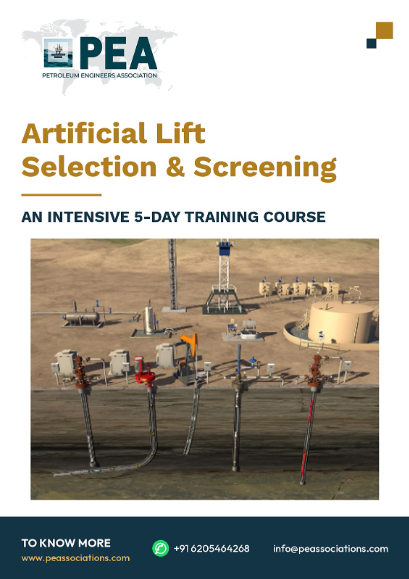
An Interactive 5-Day Training Course
Artificial Lift Selection & Screening
Choosing the Right Lift Method
Secure your spot now!
Duration
5 Days
Price
$ 3,000
Starting From
12 Apr 2027



Artificial Lift Selection & Screening
Have Questions ?
Artificial Lift Selection & Screening - PE-ALS-PEA27
| Code | Date | Time | Duration | Location | Currency | Early Bird Fee Per Person |
|---|---|---|---|---|---|---|
| PE-ALS-PEA27 | 12 - 16 Apr 2027 | 10 AM CST | 4 Hours Per Day |
Online |
USD |
3000 |
Need this for a group? We deliver the same course in-house — face-to-face at your location or online — tailored to your assets and team level. Contact info@peassociations.com.
Boost your team's skills and your budget! Enjoy group discounts for collaborative learning. Send an inquiry to info@peassociations.com.
Artificial Lift Selection & Screening
Description
Choosing the wrong artificial lift method is expensive and hard to reverse. Casing size, completion design, power supply, gas availability and facility layout all constrain what can be run, and a decision made for early-life rates may be wrong once water cut rises and reservoir pressure falls. This course sets out a structured approach to artificial lift selection and screening.
The course reviews each lift method in turn, covering how it works, the rate, depth, temperature, deviation, sand, gas and viscosity limits it operates within, and the surface equipment and power it needs. It then covers screening methods, including exclusion criteria, expert screening matrices and lifecycle cost comparison, and how to handle changing conditions over field life, conversions between lift methods and lift selection for unconventional, offshore and heavy oil wells.
Artificial lift is needed in the great majority of oil wells and in many gas wells. The method chosen determines what rates can be achieved, how often the well needs intervention, how much energy it consumes and how easily production can be changed. Over the life of a field, the difference between a good and a poor lift selection is measured in lost production, workover cost and operating expense.
Selection is a constrained problem. Casing and tubing size limit pump and gas lift equipment. Deviation limits rod pumping. High gas–liquid ratio and free gas at the pump intake limit ESP and rod pump performance. Sand, scale, high temperature, viscous crude and corrosive fluids each rule some options out or shorten run life. Gas lift needs a reliable compressed gas supply; electric pumps need reliable power. The best method is the one that meets the required rate over the well's life within these constraints at the lowest cost.
Common mistakes include selecting for initial conditions only, standardising on one method across a field because the organisation already has the experience and spares for it, ignoring the power and surface facilities required, and comparing methods on capital cost alone rather than on lifecycle cost per barrel. Good screening makes these trade-offs explicit before money is committed.
By the end of this training, participants will be able to:
- Describe the operating principles of the main artificial lift methods.
- Define the operating envelope and limits of each method in terms of rate, depth, deviation, temperature, gas, sand and fluid viscosity.
- Identify well, reservoir, surface and power constraints that affect lift selection.
- Apply exclusion criteria and screening matrices to shortlist candidate lift methods.
- Evaluate how changing water cut, gas–oil ratio and reservoir pressure affect the selection over field life.
- Compare shortlisted methods on lifecycle cost, run life and operating flexibility.
- Plan conversions between artificial lift methods.
- Select and justify an artificial lift method for onshore, offshore, heavy oil and unconventional applications.
The course is instructor-led. Each lift method is reviewed with the same structure so that direct comparison is possible, and the screening process is built up step by step from exclusion criteria to lifecycle cost comparison. Worked examples and field cases show how selections have been made, and where they have gone wrong and why. Participants are encouraged to bring their own well conditions for discussion.
Organisations sending participants to this training will:
- Get artificial lift selections that hold up over the life of the well, not just at start-up.
- Reduce workovers and lift changes caused by unsuitable equipment.
- Improve capital and operating cost forecasts for lift systems.
- Apply a consistent, documented screening process across the asset.
- Improve planning of power, gas supply and surface facilities for lift.
Participants will:
- Understand how every major artificial lift method works and where it fits.
- Be able to run a structured screening study and defend the result.
- Understand how well and reservoir conditions constrain lift choices.
- Be able to compare lift options on lifecycle cost rather than capital cost alone.
- Be prepared for more detailed design work in any lift method.
- Production engineers
- Artificial lift engineers
- Completion engineers
- Reservoir engineers involved in development planning
- Field development and project engineers
- Operations engineers and supervisors
Module 1: Artificial Lift Overview
- Why and when artificial lift is required
- Inflow, outflow and the role of lift
- Overview of the main lift methods
- Worldwide application patterns
Module 2: Rod Pumping and Progressing Cavity Pumps
- Operating principles
- Rate and depth capability
- Deviation, sand, gas and viscosity limits
- Surface equipment and power requirements
Module 3: Electrical Submersible Pumps
- Operating principles
- Rate, depth and temperature capability
- Free gas, sand and scale limits
- Power supply and surface equipment
Module 4: Gas Lift
- Continuous and intermittent gas lift
- Rate and depth capability
- Gas supply, compression and injection pressure requirements
- Advantages in deviated, gassy and sandy wells
Module 5: Plunger Lift and Hydraulic Pumps
- Plunger lift principles and application to gas wells
- Hydraulic jet pumps
- Hydraulic piston pumps
- Surface power fluid systems
Module 6: Well, Reservoir and Surface Constraints
- Casing and tubing size
- Well deviation and dogleg severity
- Temperature, gas–liquid ratio and free gas at intake
- Sand, scale, corrosion and viscosity
- Power, gas supply and facility constraints
Module 7: Screening Methods
- Exclusion criteria
- Screening matrices and scoring methods
- Handling multiple candidate methods
- Documenting the screening basis
Module 8: Lift Selection Over Field Life
- Changing water cut, GOR and reservoir pressure
- Designing for future conditions
- Conversions between lift methods
- Staged lift strategies
Module 9: Cost Comparison and Special Applications
- Capital, operating and workover cost
- Lifecycle cost per barrel
- Offshore and subsea lift selection
- Heavy oil and unconventional well lift selection
Upon successful completion of this training course, delegates will be awarded an official Certificate of Completion issued by the Petroleum Engineers Association (PEA), an ISO 9001:2015 certified training organization. The certificate carries 10 Credits and formally records the total learning hours completed.
Each certificate is signed by the Course Facilitator and the CEO of the Petroleum Engineers Association, and serves as verifiable proof of professional training that delegates can present to employers and professional bodies worldwide.
Frequently Asked Questions
All course bookings made through PEA are strictly non-refundable. By registering for a course, you acknowledge and accept that all fees are payable in full and are not subject to refund under any circumstances, including changes in personal or professional commitments or partial attendance.
PEA reserves the right to make reasonable adjustments to course content, trainers, or schedules where necessary, without entitling delegates to a refund. Comprehensive details of each course — including objectives, target audience, and content — are clearly outlined before enrolment, and it is the responsibility of the delegate to ensure the course's suitability prior to booking.
For any inquiries related to cancellations or bookings, please contact our support team, who will be happy to assist you.
