

An Interactive 5-Day Training Course
Multiphase Flow in Wells & Pipelines
Pressure, Holdup and Flow Patterns
Secure your spot now!
Duration
5 Days
Price
$ 3,500
Starting From
29 Mar 2027



Multiphase Flow in Wells & Pipelines
Have Questions ?
Multiphase Flow in Wells & Pipelines - PE-MPF-PEA27
| Code | Date | Time | Duration | Location | Currency | Early Bird Fee Per Person |
|---|---|---|---|---|---|---|
| PE-MPF-PEA27 | 29 Mar - 02 Apr 2027 | 10 AM CST | 4 Hours Per Day |
Online |
USD |
3500 |
Need this for a group? We deliver the same course in-house — face-to-face at your location or online — tailored to your assets and team level. Contact info@peassociations.com.
Boost your team's skills and your budget! Enjoy group discounts for collaborative learning. Send an inquiry to info@peassociations.com.
Multiphase Flow in Wells & Pipelines
This course covers gas–liquid multiphase flow in wells and pipelines. Participants study flow patterns, liquid holdup, pressure gradient prediction with empirical correlations and mechanistic models, terrain effects, slugging, flow through chokes and heat transfer, and learn how to select and calibrate methods against field data.
Description
Oil and gas are almost always produced as multiphase mixtures, and the pressure needed to move them through wells and pipelines depends on how the phases distribute and interact. This course gives a full treatment of gas–liquid flow for production and pipeline engineers. It starts with the variables used to describe multiphase flow and the fluid properties that drive it, then covers flow patterns in vertical, inclined and horizontal pipe, liquid holdup and slip, and pressure gradient prediction in wells using empirical correlations and mechanistic models.
The second part of the course moves to pipelines and surface systems. It covers flow in horizontal and inclined pipelines, terrain effects, hydrodynamic and severe slugging and slug handling, flow through chokes and restrictions, and heat transfer and temperature prediction. It closes with the practical selection of methods and their calibration against field data, and with the links between multiphase flow behaviour and flow assurance problems
Multiphase
flow sets the pressure drop in almost every production well and flowline. It
determines how much pressure a well needs to flow, how much back-pressure a
pipeline puts on the wells upstream, how large slugs arriving at the facility
will be, and where liquid will accumulate. Errors in multiphase flow prediction
feed directly into tubing and pipeline sizing, artificial lift design and
facility capacity.
The central
difficulty is that the phases do not travel together. Gas moves faster than
liquid, so the in-situ liquid holdup is higher than the input liquid fraction,
and the way the phases arrange themselves depends on rates, fluid properties,
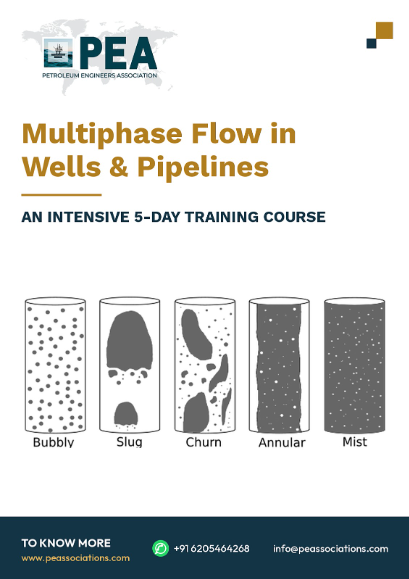
pipe diameter and inclination. Flow patterns such as bubble, slug, churn,
annular and stratified flow each have their own pressure drop and holdup
behaviour, and transitions between them can change the answer significantly.
Common
mistakes include applying correlations outside the conditions they were
developed for, using one method for an entire system that includes vertical
wells, inclined sections and horizontal pipelines, ignoring terrain effects and
liquid accumulation in low spots, and neglecting temperature. This course gives
engineers the understanding needed to choose methods sensibly and check them
against data.
By the end of this training, participants will be able to:
- Define the variables used to describe gas–liquid multiphase flow and calculate them from production data.
- Explain how fluid properties and phase behaviour affect multiphase flow.
- Identify flow patterns in vertical, inclined and horizontal pipe and predict their transitions.
- Calculate liquid holdup and explain the effect of slip.
- Predict pressure gradients in wells using empirical correlations and mechanistic models.
- Evaluate multiphase flow in pipelines, including terrain effects and liquid accumulation.
- Analyse hydrodynamic and severe slugging and their effect on facilities.
- Calculate multiphase flow through chokes and restrictions, and predict temperature profiles.
- Select and calibrate multiphase flow methods against field data.
Organisations sending participants to this training will:
- Get more reliable pressure drop predictions for well, tubing and pipeline design.
- Improve artificial lift and facility design through better multiphase flow input.
- Reduce production losses and trips caused by slugging.
- Improve the selection and calibration of flow methods used in well and network models.
- Identify liquid accumulation and flow assurance risks earlier.
Participants will:
- Understand the physics of gas–liquid flow in wells and pipelines.
- Be able to calculate holdup, pressure gradient and slug characteristics.
- Be able to choose between correlations and mechanistic models for a given case.
- Be able to calibrate flow methods against field data.
- Understand the links between multiphase flow and flow assurance.
- Production engineers
- Pipeline and flowline engineers
- Flow assurance engineers
- Artificial lift engineers
- Facilities and process engineers
- Well performance and modelling engineers
- Subsea engineers
Module 1: Multiphase Flow Fundamentals
- Superficial and mixture velocities
- No-slip and in-situ liquid holdup
- Slip and mixture density
- Dimensionless groups
Module 2: Fluid Properties and Phase Behaviour
- Phase behaviour along the flow path
- Black oil and compositional descriptions
- Gas–liquid surface tension and viscosity
- Water–oil mixtures and emulsions
Module 3: Flow Patterns
- Flow patterns in vertical upward flow
- Flow patterns in horizontal and inclined flow
- Transition mechanisms
- Flow pattern maps and unified models
Module 4: Liquid Holdup
- Holdup measurement
- Holdup correlations
- Holdup in mechanistic models
- Effect of inclination on holdup
Module 5: Pressure Gradient in Wells
- Gravitational, frictional and acceleration components
- Empirical correlations for vertical flow
- Mechanistic models
- Comparing methods against well data
Module 6: Multiphase Flow in Pipelines
- Horizontal and inclined pipeline flow
- Terrain effects and liquid accumulation
- Pigging and liquid inventory
- Pipeline pressure drop methods
Module 7: Slugging
- Hydrodynamic slugging
- Terrain-induced and severe riser slugging
- Slug length and frequency
- Slug catchers and mitigation
Module 8: Flow Through Chokes and Restrictions
- Critical and subcritical multiphase choke flow
- Choke correlations
- Valves and fittings
Module 9: Heat Transfer and Temperature Prediction
- Heat transfer in wells and pipelines
- Overall heat transfer coefficient
- Temperature profiles and their effect on pressure drop
Module 10: Method Selection, Calibration and Flow Assurance Links
- Selecting methods for wells and pipelines
- Calibrating against field data
- Multiphase flow and hydrate, wax and corrosion risk
Upon successful completion of this training course, delegates will be awarded an official Certificate of Completion issued by the Petroleum Engineers Association (PEA), an ISO 9001:2015 certified training organization. The certificate carries 10 Credits and formally records the total learning hours completed.
Each certificate is signed by the Course Facilitator and the CEO of the Petroleum Engineers Association, and serves as verifiable proof of professional training that delegates can present to employers and professional bodies worldwide.
Frequently Asked Questions
All course bookings made through PEA are strictly non-refundable. By registering for a course, you acknowledge and accept that all fees are payable in full and are not subject to refund under any circumstances, including changes in personal or professional commitments or partial attendance.
PEA reserves the right to make reasonable adjustments to course content, trainers, or schedules where necessary, without entitling delegates to a refund. Comprehensive details of each course — including objectives, target audience, and content — are clearly outlined before enrolment, and it is the responsibility of the delegate to ensure the course's suitability prior to booking.
For any inquiries related to cancellations or bookings, please contact our support team, who will be happy to assist you.
