


An Interactive 5-Day Training Course
Wireline & Slickline Operations
Running Tools on a Line
Secure your spot now!
Duration
5 Days
Price
$ 3,000
Starting From
25 Oct 2027



Wireline & Slickline Operations
Have Questions ?
Wireline & Slickline Operations - PE-WSO-PEA27
| Code | Date | Time | Duration | Location | Currency | Early Bird Fee Per Person |
|---|---|---|---|---|---|---|
| PE-WSO-PEA27 | 25 - 29 Oct 2027 | 10 AM CST | 4 Hours Per Day |
Online |
USD |
3000 |
Need this for a group? We deliver the same course in-house — face-to-face at your location or online — tailored to your assets and team level. Contact info@peassociations.com.
Boost your team's skills and your budget! Enjoy group discounts for collaborative learning. Send an inquiry to info@peassociations.com.
Wireline & Slickline Operations
Description
Wireline and slickline are the workhorses of well intervention. Most routine work in producing wells, including gauge runs, plug setting, valve changes, depth correlation, logging and perforating, is done on a line, because it is quick, cheap and can be performed under pressure with a small crew.
This course covers all three line types. It starts with line properties, strength, stretch and mechanics, then covers pressure control equipment and barrier requirements for live well work. It then covers slickline toolstrings and the use of jars, the setting and pulling of plugs, valves and gas lift equipment, and braided line work. The electric line sections cover cased hole logging services, perforating and setting tools, and depth control. The course closes with conveyance in deviated and horizontal wells, job planning and reporting, and the recovery of stuck tools and broken line.
A wireline job is a controlled operation in which a toolstring is lowered into a live well on a line only a few millimetres thick, passing through a pressure control stack that keeps the well contained. The line gives depth, weight indication and, for electric line, power and telemetry. Everything else depends on the toolstring and the skill of the operator.
The mechanics matter. Line stretch, weight and friction determine what the operator reads at surface and what force reaches the tool. Jars convert stored energy into impact to set, pull or free equipment, and using them correctly is the difference between a successful pull and a fishing job. In deviated wells, gravity is no longer enough to run tools to depth, which is why tractors, pump-down methods and rigid conveyance are used.
The common problems are well known: tools stuck in scale or fill, line broken above the toolstring, tools set at the wrong depth because of poor correlation, and pressure control equipment that was not tested to the right pressure. Each has a recognised response, and most are prevented by planning. This course covers both the routine work and the recovery when it goes wrong.
By the end of this training, participants will be able to:
- Describe slickline, braided line and electric line systems and their capabilities.
- Calculate line stretch, weight and tension limits.
- Specify pressure control equipment and verify barriers for live well work.
- Select and assemble toolstrings for common tasks.
- Apply jarring techniques for setting, pulling and freeing equipment.
- Set and pull plugs, valves, gas lift equipment and other downhole tools.
- Plan cased hole logging and perforating runs, including depth correlation.
- Select conveyance methods for deviated and horizontal wells.
- Plan and report wireline jobs.
- Apply recovery procedures for stuck tools and broken line.
Organisations sending participants to this training will:
- Improve wireline job success rates and reduce repeat runs.
- Strengthen barrier and pressure control discipline.
- Reduce fishing jobs caused by poor jarring and toolstring design.
- Improve depth control accuracy for setting and perforating.
- Improve planning and reporting quality across intervention work.
Participants will:
- Understand how slickline, braided line and electric line work.
- Be able to design toolstrings and calculate line limits.
- Understand pressure control equipment and barrier verification.
- Be able to plan and supervise wireline operations.
- Be able to respond to stuck tools and line breaks.
- Well intervention engineers
- Production engineers
- Wireline and slickline supervisors and operators
- Completion engineers
- Operations engineers and supervisors
- Well services personnel
Module 1: Wireline Systems
- Slickline, braided line and electric line
- Units, winches and measuring systems
- Applications and capability comparison
- Onshore and offshore operations
Module 2: Line Properties and Mechanics
- Line sizes, materials and strength
- Stretch and depth correction
- Weight indicator interpretation
- Tension limits and safe working practice
- Line corrosion and inspection
Module 3: Pressure Control Equipment
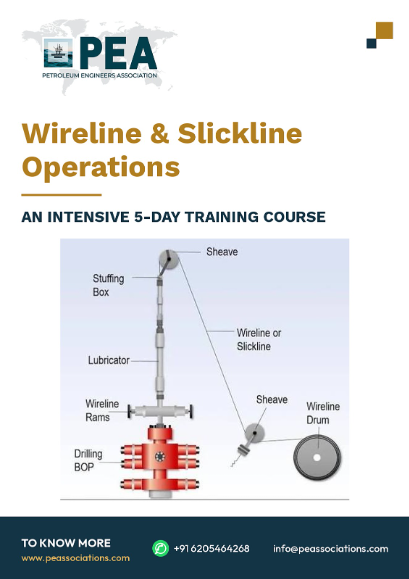
- Stuffing box and grease injection systems
- Lubricator and riser sections
- Wireline blowout preventers and valves
- Barrier requirements and testing
- Rigging up and rigging down
Module 4: Toolstrings and Jars
- Standard slickline toolstring components
- Rope sockets, stems and knuckle joints
- Mechanical, hydraulic and spring jars
- Jarring up and jarring down technique
- Running and pulling tools
Module 5: Setting and Pulling Downhole Equipment
- Landing nipples and lock mandrels
- Plugs and standing valves
- Gas lift valves and dummies
- Sliding sleeves and flow control devices
- Subsurface safety valve work
Module 6: Electric Line Operations
- Cased hole logging services
- Perforating on electric line
- Setting plugs and packers electrically
- Telemetry and surface systems
- Safety around explosives
Module 7: Depth Control and Correlation
- Measuring systems and calibration
- Casing collar locator correlation
- Depth references and tolerance
- Common depth errors
Module 8: Conveyance in Deviated and Horizontal Wells
- Limits of gravity conveyance
- Wireline tractors
- Pump-down and flow-assisted conveyance
- Coiled tubing and tubing conveyed methods
- Selection by well geometry
Module 9: Job Planning and Recovery Operations
- Job programmes and procedures
- Pre-job checks and risk assessment
- Job reporting and records
- Stuck tool diagnosis and recovery
- Line breaks and fishing for wire
- Preventing recurrence
Upon successful completion of this training course, delegates will be awarded an official Certificate of Completion issued by the Petroleum Engineers Association (PEA), an ISO 9001:2015 certified training organization. The certificate carries 10 Credits and formally records the total learning hours completed.
Each certificate is signed by the Course Facilitator and the CEO of the Petroleum Engineers Association, and serves as verifiable proof of professional training that delegates can present to employers and professional bodies worldwide.
Frequently Asked Questions
All course bookings made through PEA are strictly non-refundable. By registering for a course, you acknowledge and accept that all fees are payable in full and are not subject to refund under any circumstances, including changes in personal or professional commitments or partial attendance.
PEA reserves the right to make reasonable adjustments to course content, trainers, or schedules where necessary, without entitling delegates to a refund. Comprehensive details of each course — including objectives, target audience, and content — are clearly outlined before enrolment, and it is the responsibility of the delegate to ensure the course's suitability prior to booking.
For any inquiries related to cancellations or bookings, please contact our support team, who will be happy to assist you.
