


An Interactive 5-Day Training Course
Completion Fluids & Damage Prevention
Protecting the Formation During Completion
Secure your spot now!
Duration
5 Days
Price
$ 3,000
Starting From
26 Jul 2027



Completion Fluids & Damage Prevention
Have Questions ?
Completion Fluids & Damage Prevention - PE-CFD-PEA27
| Code | Date | Time | Duration | Location | Currency | Early Bird Fee Per Person |
|---|---|---|---|---|---|---|
| PE-CFD-PEA27 | 26 - 30 Jul 2027 | 10 AM CST | 4 Hours Per Day |
Online |
USD |
3000 |
Need this for a group? We deliver the same course in-house — face-to-face at your location or online — tailored to your assets and team level. Contact info@peassociations.com.
Boost your team's skills and your budget! Enjoy group discounts for collaborative learning. Send an inquiry to info@peassociations.com.
Completion Fluids & Damage Prevention
Description
Unconventional wells produce only what the completion connects. With permeability measured in nanodarcies, production depends almost entirely on how much rock is contacted by hydraulic fractures and how conductive those fractures are. The completion design, meaning stage count, cluster spacing, perforation strategy, fluid and proppant volumes and diversion, is therefore the main controllable factor in well performance.
This course covers that design and its execution. It starts with unconventional reservoir characteristics and the geomechanics that control fracture growth, then covers completion architecture: cemented plug and perf, uncemented sliding sleeve and hybrid systems. It then covers stage and cluster design, limited entry, diversion methods, fluid systems and proppant selection, and treatment execution including pressure monitoring, screen-out management and real-time decisions. The course closes with well spacing and frac hits, refracturing, and how completion performance is evaluated from production, tracers and diagnostics.
The economics of an unconventional well are set on the day it is completed. Drilling costs are largely fixed by the plan, but completion intensity, which covers stage count, cluster count, proppant and fluid volume, is a variable that can double the cost and change the production profile. Finding the combination that maximises value, rather than initial rate or stage count, is the central problem.
Fracture growth is governed by stress and rock properties that vary along the lateral. Clusters within a stage compete for fluid; without limited entry design or diversion, a few clusters take most of the treatment and the rest contribute little. Production logs and tracer surveys repeatedly show that a significant fraction of perforation clusters contribute almost nothing, which is a direct loss of the money spent stimulating them.
Wells also interfere. As spacing tightens, fractures from a new well intersect depleted regions around existing wells, causing frac hits that can damage the older well and waste the treatment. Completion design in unconventional fields is therefore a field-level problem, not a single-well one. This course covers the engineering and the trade-offs at both levels.
By the end of this training, participants will be able to:
- Identify the main mechanisms of formation damage during completion and workover.
- Select completion brines based on density, crystallisation temperature, compatibility and cost.
- Specify corrosion inhibition, oxygen scavengers and other brine additives.
- Design fluid loss control using bridging agents, viscous pills and mechanical means.
- Specify filtration standards and manage solids at the wellsite.
- Plan displacement and wellbore clean-up procedures.
- Specify compatibility, return permeability and core flow testing.
- Select packer and annulus fluids for long-term integrity.
- Diagnose formation damage from well test and production data.
- Select appropriate remediation methods when damage has occurred
Organisations sending participants to this training will:
- Reduce formation damage and improve initial well productivity.
- Reduce the need for remedial stimulation after completion.
- Improve completion fluid specification and wellsite quality control.
- Reduce fluid-related failures such as corrosion and crystallisation.
- Improve diagnosis when wells underperform after completion or workover.
Participants will:
- Understand how completion practices damage formations.
- Be able to select and specify completion brines and additives.
- Be able to design fluid loss control and filtration requirements.
- Be able to write and supervise displacement and clean-up procedures.
- Be able to diagnose damage and choose remediation.
- Completion engineers
- Production engineers
- Well intervention and workover engineers
- Drilling fluids and completion fluids specialists
- Well services engineers
- Operations engineers and supervisors
Module 1: Formation Damage Mechanisms
- Clay swelling and fines migration
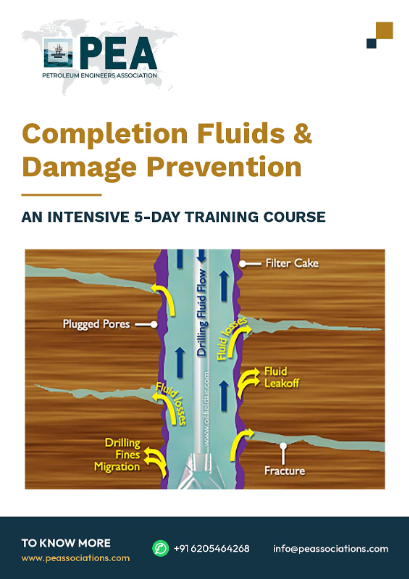
- Solids invasion and pore plugging
- Scale formation from incompatible waters
- Emulsions, water blocks and wettability changes
- Polymer and filter cake damage
- Damage in perforations and gravel packs
Module 2: Completion Brines
- Monovalent and divalent brine systems
- Density and true crystallisation temperature
- Solubility, blending and mixing
- Corrosivity and material compatibility
- Cost, handling and environmental considerations
Module 3: Brine Additives
- Corrosion inhibitors and oxygen scavengers
- Biocides
- Clay stabilisers
- Surfactants and mutual solvents
- Additive compatibility
Module 4: Fluid Loss Control
- Sized salt and calcium carbonate bridging systems
- Viscous and crosslinked pills
- Mechanical isolation options
- Designing for removability
- Breakers and clean-up
Module 5: Filtration and Solids Management
- Cleanliness standards and turbidity targets
- Cartridge and diatomaceous earth filtration
- Filtration unit selection and operation
- Sampling and quality control at the wellsite
Module 6: Displacement and Wellbore Clean-Up
- Displacement design and spacer trains
- Chemical wash and pill selection
- Casing scraping and brushing
- Verification of cleanliness
- Common displacement failures
Module 7: Laboratory Testing
- Brine and formation water compatibility tests
- Return permeability and core flow tests
- Emulsion and wettability tests
- Interpreting laboratory results for field application
Module 8: Packer and Annulus Fluids
- Functions and requirements
- Corrosion and thermal considerations
- Long-term stability
- Monitoring annulus fluid condition
Module 9: Diagnosis and Remediation
- Identifying damage from well test skin and production data
- Matching damage type to mechanism
- Acid and solvent treatments for induced damage
- Mechanical remediation options
- Learning and prevention for future wells
Upon successful completion of this training course, delegates will be awarded an official Certificate of Completion issued by the Petroleum Engineers Association (PEA), an ISO 9001:2015 certified training organization. The certificate carries 10 Credits and formally records the total learning hours completed.
Each certificate is signed by the Course Facilitator and the CEO of the Petroleum Engineers Association, and serves as verifiable proof of professional training that delegates can present to employers and professional bodies worldwide.
Frequently Asked Questions
All course bookings made through PEA are strictly non-refundable. By registering for a course, you acknowledge and accept that all fees are payable in full and are not subject to refund under any circumstances, including changes in personal or professional commitments or partial attendance.
PEA reserves the right to make reasonable adjustments to course content, trainers, or schedules where necessary, without entitling delegates to a refund. Comprehensive details of each course — including objectives, target audience, and content — are clearly outlined before enrolment, and it is the responsibility of the delegate to ensure the course's suitability prior to booking.
For any inquiries related to cancellations or bookings, please contact our support team, who will be happy to assist you.
