
An Interactive 5-Day Training Course
Wax & Asphaltene Management
Managing Organic Deposition
Secure your spot now!
Duration
5 Days
Price
$ 3,000
Starting From
22 Feb 2027



Wax & Asphaltene Management
Have Questions ?
Wax & Asphaltene Management - PE-WAM-PEA27
| Code | Date | Time | Duration | Location | Currency | Early Bird Fee Per Person |
|---|---|---|---|---|---|---|
| PE-WAM-PEA27 | 22 - 26 Feb 2027 | 10 AM CST | 4 Hours Per Day |
Online |
USD |
3000 |
Need this for a group? We deliver the same course in-house — face-to-face at your location or online — tailored to your assets and team level. Contact info@peassociations.com.
Boost your team's skills and your budget! Enjoy group discounts for collaborative learning. Send an inquiry to info@peassociations.com.
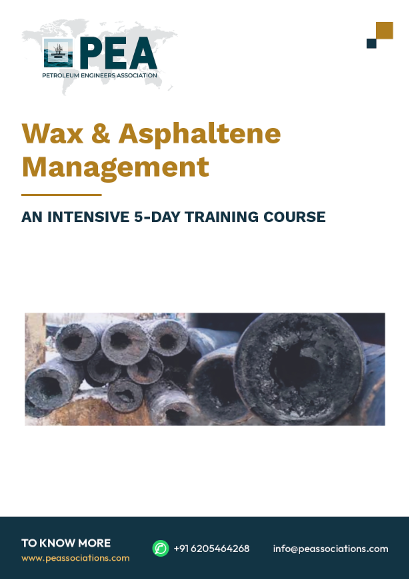
Wax & Asphaltene Management
This course
covers wax and asphaltene deposition in wells and flowlines. Participants study
crude composition and deposition mechanisms, laboratory characterisation, wax
appearance temperature and asphaltene stability prediction, deposition
modelling, chemical inhibition, thermal and mechanical management, pigging,
remediation methods and field management strategy.
Description
Wax and asphaltenes are the two organic deposition problems in production. Wax comes out of solution as crude cools below its wax appearance temperature and builds on cold surfaces, restricting tubing and flowlines and gelling lines during shutdowns. Asphaltenes destabilise as pressure falls near the bubble point and deposit in the near-wellbore region, tubing and surface equipment, often causing sudden losses in productivity.
This course covers both. It starts with crude oil composition, the differences between the two mechanisms, and the laboratory methods used to characterise them, including wax appearance temperature, pour point, wax content, asphaltene content and stability screening. It then covers prediction and deposition modelling, followed by the management options: chemical inhibitors and dispersants, thermal methods including insulation and heating, pigging and mechanical removal, and operating practice such as cool-down and restart management. The course closes with remediation of blocked wells and lines and the design of a field organic deposition management strategy.
Wax deposition is a heat transfer problem as much as a chemistry problem. Wax crystallises where the pipe wall is below the wax appearance temperature, and the deposit grows where the temperature gradient is steepest. That is why flowlines deposit near the inlet of a cold section, why insulation changes the problem and why deposition often worsens as production rates fall and fluid spends longer cooling.
Asphaltene deposition follows pressure. Asphaltenes are stabilised in crude by resins, and that stability is disturbed as pressure drops towards the bubble point, as light ends come out of solution or when incompatible fluids, including some acid treatments and diluents, are introduced. The deposition profile in a well often peaks somewhere in the tubing rather than at the reservoir or the wellhead.
Management differs accordingly. Wax responds to thermal methods, pigging and pour point depressants. Asphaltenes respond to dispersants and to avoiding the destabilising conditions and fluids. Both punish neglect: a line that is left full and cold gels, and a well that has deposited asphaltene in the near-wellbore may need solvent treatment to recover. This course covers the prediction, the prevention and the recovery.
By the end of this training, participants will be able to:
- Explain the mechanisms of wax and asphaltene deposition and their differences.
- Specify laboratory characterisation tests for wax and asphaltenes.
- Determine wax appearance temperature and interpret the result.
- Assess asphaltene stability and identify destabilising conditions and fluids.
- Model wax deposition in wells and flowlines and identify deposition locations.
- Select wax inhibitors, pour point depressants and asphaltene dispersants.
- Design thermal management, including insulation, heating and cool-down limits.
- Plan pigging programmes and mechanical removal.
- Remediate wax and asphaltene blockages in wells and lines.
- Build a field organic deposition management strategy.
Organisations sending participants to this training will:
- Prevent production losses from wax and asphaltene restriction.
- Reduce the risk of gelled lines and blocked wells.
- Improve chemical selection and reduce treatment cost.
- Set defensible cool-down and restart limits for operations.
- Plan pigging and intervention programmes on evidence rather than routine.
Participants will:
- Understand why wax and asphaltenes deposit and where.
- Be able to specify and interpret laboratory characterisation.
- Be able to predict deposition and select management methods.
- Understand thermal management and pigging practice.
- Be able to plan remediation of blockages.
- Production engineers
- Flow assurance engineers
- Production chemists
- Pipeline and facilities engineers
- Well intervention engineers
- Operations engineers in waxy and asphaltenic fields
Module 1: Crude Composition and Organic Deposition
- Paraffins, aromatics, resins and asphaltenes
- Differences between wax and asphaltene problems
- Where deposition occurs in the production system
- Consequences for production and operations
Module 2: Wax Behaviour and Characterisation
- Wax appearance temperature and cloud point
- Pour point and gelation
- Wax content and carbon number distribution
- Rheology of waxy crudes
- Laboratory test methods
Module 3: Wax Deposition Mechanisms
- Molecular diffusion and shear effects
- Heat transfer and temperature gradients
- Deposition rate and ageing of deposits
- Effect of flow rate and water cut
Module 4: Asphaltene Behaviour and Stability
- Asphaltene structure and stabilisation by resins
- Pressure, composition and temperature effects
- Stability screening and onset measurement
- Destabilisation by acids, diluents and commingling
Module 5: Deposition Prediction and Modelling
- Thermal modelling of wells and flowlines
- Wax deposition models and their inputs
- Asphaltene deposition prediction
- Identifying critical locations
- Model calibration against field observations
Module 6: Chemical Management
- Wax inhibitors and pour point depressants
- Asphaltene inhibitors and dispersants
- Solvent selection
- Laboratory screening and field trials
- Injection points and dosage
Module 7: Thermal and Operational Management
- Insulation and burial
- Active heating and hot oiling
- Cool-down time and no-touch time
- Shutdown and restart procedures
- Rate management and commingling decisions
Module 8: Pigging and Mechanical Removal
- Pig types and selection
- Pigging frequency and deposit volumes
- Pig-induced slug management
- Wireline and coiled tubing cutting and scraping
- Risk of stuck pigs and tools
Module 9: Remediation and Field Strategy
- Recovering blocked wells and flowlines
- Solvent soak treatments
- Thermal remediation
- Deciding between chemical, thermal and mechanical methods
- Building a field management strategy and monitoring its performance
Upon successful completion of this training course, delegates will be awarded an official Certificate of Completion issued by the Petroleum Engineers Association (PEA), an ISO 9001:2015 certified training organization. The certificate carries 10 Credits and formally records the total learning hours completed.
Each certificate is signed by the Course Facilitator and the CEO of the Petroleum Engineers Association, and serves as verifiable proof of professional training that delegates can present to employers and professional bodies worldwide.
Frequently Asked Questions
All course bookings made through PEA are strictly non-refundable. By registering for a course, you acknowledge and accept that all fees are payable in full and are not subject to refund under any circumstances, including changes in personal or professional commitments or partial attendance.
PEA reserves the right to make reasonable adjustments to course content, trainers, or schedules where necessary, without entitling delegates to a refund. Comprehensive details of each course — including objectives, target audience, and content — are clearly outlined before enrolment, and it is the responsibility of the delegate to ensure the course's suitability prior to booking.
For any inquiries related to cancellations or bookings, please contact our support team, who will be happy to assist you.
