


An Interactive 5-Day Training Course
ESP Design, Operation & Troubleshooting
Design, Run Life and Diagnostics
Secure your spot now!
Duration
5 Days
Price
$ 3,000
Starting From
19 Apr 2027



ESP Design, Operation & Troubleshooting
Have Questions ?
ESP Design, Operation & Troubleshooting - PE-ESP-PEA27
| Code | Date | Time | Duration | Location | Currency | Early Bird Fee Per Person |
|---|---|---|---|---|---|---|
| PE-ESP-PEA27 | 19 - 23 Apr 2027 | 10 AM CST | 4 Hours Per Day |
Online |
USD |
3000 |
Need this for a group? We deliver the same course in-house — face-to-face at your location or online — tailored to your assets and team level. Contact info@peassociations.com.
Boost your team's skills and your budget! Enjoy group discounts for collaborative learning. Send an inquiry to info@peassociations.com.
ESP Design, Operation & Troubleshooting
Description
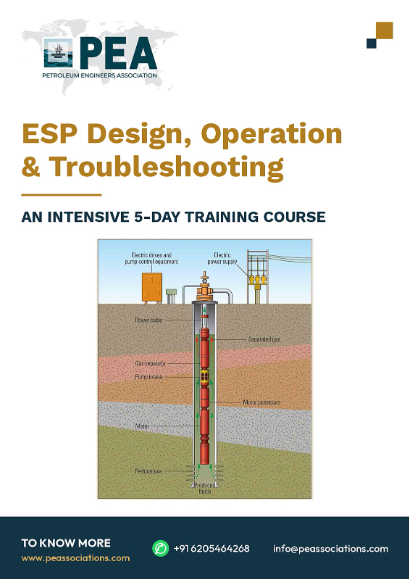
Electrical submersible pumps lift a large share of world oil production and are the method of choice for high-rate wells. They are also unforgiving: a design error, a gas slug, a power quality problem or a poor installation can take a well off production and cost a workover. This course covers the full ESP system, including pump, gas separator, protector, motor, cable, wellhead penetrator, switchboard, transformer and variable speed drive, and how each part is sized.
Participants work through pump performance curves and affinity laws, stage selection, motor and cable sizing, gas handling options and the effect of free gas and viscosity on pump performance. The course then moves to operation: installation and start-up, monitoring with surface and downhole instrumentation, variable speed operation and control. It closes with systematic troubleshooting from ammeter charts, downhole gauge data and pulled equipment, and with the practices that extend run life.
An ESP is a rotating machine placed in one of the least accessible and most hostile environments in industry. It must pump multiphase fluid at high temperature, tolerate solids and gas, and run continuously for years, because every failure means an intervention. Run life is therefore the measure by which ESP operations are judged, and run life is determined largely by design, installation and operating practice.
Design starts with the well inflow. Pump stages are selected for a specific rate and head at expected intake conditions, and a pump run far from its best efficiency range will wear quickly or fail. Free gas at the intake is the most common design problem: gas reduces head, causes gas locking and cycles the motor. Temperature, solids, scale and fluid viscosity all affect both design and run life.
Common failures trace back to a small number of causes: pumps operating outside their range because the inflow was wrong, gas handling that was not designed for the real gas–liquid ratio, cable and splice damage during installation, power quality problems, and operating practices such as frequent restarts and running against closed valves. Careful design and disciplined surveillance prevent most of them.
By the end of this training, participants will be able to:
- Describe the components of an ESP system and the function of each.
- Interpret pump performance curves and apply affinity laws for variable speed operation.
- Size the pump, stages, gas separator, protector, motor and cable for given well conditions.
- Assess the effect of free gas, viscosity, temperature and solids on ESP performance.
- Specify switchboards, transformers and variable speed drives.
- Plan and supervise ESP installation, start-up and commissioning.
- Monitor ESP performance using surface and downhole data.
- Diagnose ESP problems from ammeter charts, gauge data and pulled equipment.
- Apply practices that extend run life and reduce failure rates.
Organisations sending participants to this training will:
- Improve ESP run life and reduce workover frequency and cost.
- Get ESP designs that match real well inflow and gas conditions.
- Improve installation and start-up quality.
- Diagnose ESP problems faster and with fewer unnecessary pulls.
- Build a failure analysis process that feeds back into design.
Participants will:
- Understand how every part of an ESP system works and is sized.
- Be able to produce and check an ESP design for a given well.
- Be able to read ammeter charts and gauge data with confidence.
- Be able to diagnose common ESP failures and their causes.
- Know the practices that extend run life.
- Production engineers
- Artificial lift engineers
- Well operations engineers and supervisors
- Completion engineers
- Electrical engineers supporting production operations
- Field technicians working on ESP wells
Module 1: ESP System Overview
- System components and their functions
- Applications and operating envelope
- ESP compared with other lift methods
Module 2: Pump Hydraulics
- Centrifugal pump principles
- Pump performance curves and best efficiency range
- Affinity laws and variable speed operation
- Stage selection and head requirement
- Effect of viscosity
Module 3: Well Inflow and ESP Design Basis
- Inflow performance and design rate
- Intake pressure and pump setting depth
- Fluid properties and free gas at intake
- Design for changing water cut and reservoir pressure
Module 4: Gas Handling
- Effect of free gas on pump performance
- Gas locking
- Rotary and static gas separators
- Gas handlers and tapered designs
Module 5: Motors, Protectors and Cables
- Motor sizing and cooling
- Protector and seal section selection
- Power cable selection and voltage drop
- Cable splices, bands and penetrators
Module 6: Surface Equipment and Power
- Switchboards and motor controllers
- Transformers
- Variable speed drives and harmonics
- Power quality problems
Module 7: Installation, Start-Up and Commissioning
- Installation procedures and quality control
- Cable handling and testing
- Start-up and initial operating checks
- Documentation and baseline data
Module 8: Monitoring and Surveillance
- Surface and downhole instrumentation
- Ammeter charts and current signatures
- Intake pressure, discharge pressure and motor temperature
- Setting alarms and shutdown limits
Module 9: Troubleshooting and Failure Analysis
- Systematic troubleshooting from operating data
- Common failure modes and their causes
- Dismantle inspection and failure reporting
- Run life analysis and improvement programmes
Upon successful completion of this training course, delegates will be awarded an official Certificate of Completion issued by the Petroleum Engineers Association (PEA), an ISO 9001:2015 certified training organization. The certificate carries 10 Credits and formally records the total learning hours completed.
Each certificate is signed by the Course Facilitator and the CEO of the Petroleum Engineers Association, and serves as verifiable proof of professional training that delegates can present to employers and professional bodies worldwide.
Frequently Asked Questions
All course bookings made through PEA are strictly non-refundable. By registering for a course, you acknowledge and accept that all fees are payable in full and are not subject to refund under any circumstances, including changes in personal or professional commitments or partial attendance.
PEA reserves the right to make reasonable adjustments to course content, trainers, or schedules where necessary, without entitling delegates to a refund. Comprehensive details of each course — including objectives, target audience, and content — are clearly outlined before enrolment, and it is the responsibility of the delegate to ensure the course's suitability prior to booking.
For any inquiries related to cancellations or bookings, please contact our support team, who will be happy to assist you.
