


An Interactive 5-Day Training Course
Emulsions & Demulsification
Breaking Emulsions in Production
Secure your spot now!
Duration
5 Days
Price
$ 3,000
Starting From
08 Mar 2027



Emulsions & Demulsification
Have Questions ?
Emulsions & Demulsification - PE-EMD-PEA27
| Code | Date | Time | Duration | Location | Currency | Early Bird Fee Per Person |
|---|---|---|---|---|---|---|
| PE-EMD-PEA27 | 08 - 12 Mar 2027 | 10 AM CST | 4 Hours Per Day |
Online |
USD |
3000 |
Need this for a group? We deliver the same course in-house — face-to-face at your location or online — tailored to your assets and team level. Contact info@peassociations.com.
Boost your team's skills and your budget! Enjoy group discounts for collaborative learning. Send an inquiry to info@peassociations.com.
Emulsions & Demulsification
Description
Water and oil produced together are rarely separated by gravity alone. Shear through chokes, pumps and valves disperses one phase in the other, and natural surfactants, asphaltenes, waxes and fine solids stabilise the resulting droplets, sometimes so effectively that emulsions survive hours of residence time in a separator. The result is oil off specification, water carrying oil to disposal, and separator upsets.
This course covers the chemistry and the equipment together. It starts with emulsion types, formation and stabilisation mechanisms, the influence of crude composition, water chemistry, solids, temperature and shear, and the analysis methods used to characterise emulsions. It then covers demulsifier chemistry, bottle testing protocols and field selection, followed by separation equipment: gravity separators, heater treaters, electrostatic coalescers, hydrocyclones and their operation. The course closes with produced water treatment and reverse demulsifiers, optimisation of chemical dosage and heat, and systematic troubleshooting of separation problems.
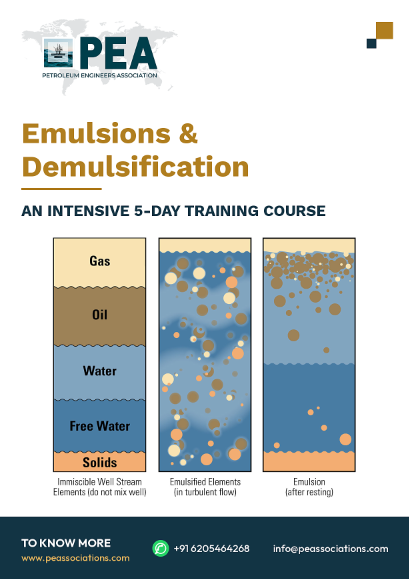
An emulsion is a kinetic problem, not a thermodynamic one. Oil and water will separate eventually; the question is whether they separate within the residence time available in the equipment. Stabilising agents at the droplet interface, particularly asphaltenes and fine solids, form films that resist coalescence, and the finer the droplets the longer separation takes. Shear creates fine droplets, which is why choke and pump arrangements upstream of separation matter as much as the separator itself.
Demulsifiers work by displacing or disrupting those interfacial films so droplets can coalesce. They are crude-specific, which is why bottle testing is standard practice: a chemical that works in one field may do nothing in another, and a change in water cut, temperature or commingling can invalidate a selection that worked for years. Dosage matters in both directions, since overdosing can stabilise an emulsion rather than break it.
Most separation problems in the field are diagnosed from a small set of observations: where the interface sits, what the rag layer looks like, oil in water and water in oil measurements, and the temperature profile. Adding more chemical is the usual first response and is often the wrong one. This course teaches diagnosis before dosing.
By the end of this training, participants will be able to:
- Explain emulsion types, formation and stabilisation mechanisms.
- Assess the effect of crude composition, solids, water chemistry, temperature and shear.
- Characterise emulsions using droplet size, stability and interfacial analysis.
- Design and run bottle tests and interpret the results.
- Select demulsifiers and plan field trials.
- Describe gravity separation, heater treaters and electrostatic coalescers and their operating limits.
- Optimise temperature, residence time and chemical dosage together.
- Manage rag layers and interface problems.
- Specify produced water clarification and reverse demulsifier treatment.
- Troubleshoot separation problems systematically.
Organisations sending participants to this training will:
- Meet crude oil and produced water specifications reliably.
- Reduce chemical consumption and cost through better selection and dosing.
- Reduce separator upsets and rag layer problems.
- Improve produced water quality and reduce disposal issues.
- Improve diagnosis before changing chemicals or equipment settings.
Participants will:
- Understand why emulsions form and what stabilises them.
- Be able to run and interpret bottle tests.
- Be able to select demulsifiers and set dosage.
- Understand separation equipment and its operating limits.
- Be able to troubleshoot separation problems in the field.
- Production chemists
- Production engineers
- Facilities and process engineers
- Operations engineers and supervisors
- Chemical treatment and service company staff
- Laboratory and technical services staff
Module 1: Emulsion Fundamentals
- Water-in-oil and oil-in-water emulsions
- Droplet formation and size distribution
- Coalescence and settling
- Why emulsions are stable
Module 2: Stabilising Agents
- Asphaltenes, resins and waxes
- Fine solids and particle-stabilised emulsions
- Natural and added surfactants
- Water chemistry and pH effects
- Effect of shear through chokes, pumps and valves
Module 3: Emulsion Characterisation
- Water content measurement
- Droplet size analysis
- Stability and separation profile testing
- Interfacial tension and film studies
- Sampling for representative results
Module 4: Demulsifier Chemistry
- Demulsifier families and mechanisms
- Solvent systems and formulations
- Crude specificity
- Interaction with other production chemicals
Module 5: Bottle Testing and Selection
- Bottle test protocol and conditions
- Sample handling
- Reading water drop, interface and oil quality
- Ranking candidates
- Scaling laboratory results to the field
- Field trial design
Module 6: Separation Equipment
- Two-phase and three-phase separators
- Residence time and internals
- Heater treaters and heat requirements
- Electrostatic coalescers
- Desalters
- Free water knockouts
Module 7: Optimisation
- Balancing temperature, chemical and residence time
- Injection point selection
- Dosage optimisation and overdosing effects
- Energy cost considerations
- Monitoring and control
Module 8: Produced Water and Rag Layers
- Oil in water measurement
- Reverse demulsifiers and water clarifiers
- Hydrocyclones, flotation and filtration
- Rag layer formation and management
- Solids handling and sludge
Module 9: Troubleshooting
- Systematic diagnosis of separation problems
- Off-specification crude and water
- Upsets after commingling or water cut changes
- Chemical incompatibility problems
- Case studies
Upon successful completion of this training course, delegates will be awarded an official Certificate of Completion issued by the Petroleum Engineers Association (PEA), an ISO 9001:2015 certified training organization. The certificate carries 10 Credits and formally records the total learning hours completed.
Each certificate is signed by the Course Facilitator and the CEO of the Petroleum Engineers Association, and serves as verifiable proof of professional training that delegates can present to employers and professional bodies worldwide.
Frequently Asked Questions
All course bookings made through PEA are strictly non-refundable. By registering for a course, you acknowledge and accept that all fees are payable in full and are not subject to refund under any circumstances, including changes in personal or professional commitments or partial attendance.
PEA reserves the right to make reasonable adjustments to course content, trainers, or schedules where necessary, without entitling delegates to a refund. Comprehensive details of each course — including objectives, target audience, and content — are clearly outlined before enrolment, and it is the responsibility of the delegate to ensure the course's suitability prior to booking.
For any inquiries related to cancellations or bookings, please contact our support team, who will be happy to assist you.
