


An Interactive 5-Day Training Course
Hydraulic Fracturing: Fundamentals & Principles
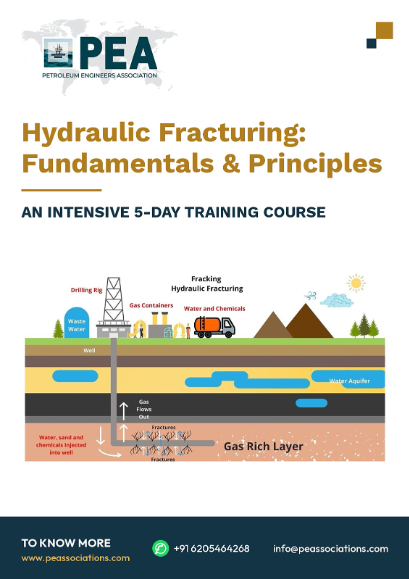
How Hydraulic Fractures Work
Secure your spot now!
Duration
5 Days
Price
$ 3,000
Starting From
23 Aug 2027



Hydraulic Fracturing: Fundamentals & Principles
Have Questions ?
Hydraulic Fracturing: Fundamentals & Principles - PE-HFF-PEA27
| Code | Date | Time | Duration | Location | Currency | Early Bird Fee Per Person |
|---|---|---|---|---|---|---|
| PE-HFF-PEA27 | 23 - 27 Aug 2027 | 10 AM CST | 4 Hours Per Day |
Online |
USD |
3000 |
Need this for a group? We deliver the same course in-house — face-to-face at your location or online — tailored to your assets and team level. Contact info@peassociations.com.
Boost your team's skills and your budget! Enjoy group discounts for collaborative learning. Send an inquiry to info@peassociations.com.
Hydraulic Fracturing: Fundamentals & Principles
Description
Hydraulic fracturing creates a conductive path from the reservoir to the wellbore by splitting the rock with pressurised fluid and holding the fracture open with proppant. It is used to increase productivity in low permeability formations, to bypass near-wellbore damage in higher permeability rock, and to provide sand control through frac packing. This course explains how it works, from rock mechanics to production response.
Participants study in-situ stress, rock properties and how they determine fracture orientation and containment, fracture initiation and propagation, and the geometry models used to predict length, height and width. The course then covers fracturing fluids, additives and proppants, fracture conductivity and dimensionless fracture conductivity, and the basics of treatment design including volumes, pump schedules and proppant staging. It closes with field execution, quality control, flowback and the production behaviour of fractured wells.
A hydraulic fracture opens against the smallest of the three principal stresses, which in most reservoirs means it grows vertically and extends horizontally away from the well. Where it grows, how far it goes and whether it stays within the target zone are controlled by the stress profile, the rock properties and the treatment itself. Understanding that stress profile is the first step in any fracture design.
The production benefit depends on conductivity relative to the reservoir. In tight rock a long fracture is needed because the reservoir cannot deliver fluid quickly; in higher permeability rock a short, highly conductive fracture is better, because the constraint is getting fluid through the fracture rather than into it. This trade-off, expressed through dimensionless fracture conductivity, governs most design decisions.
Treatments fail for practical reasons as often as technical ones: proppant that screens out early, fluid that does not break and leaves gel damage, fracture height growth into water-bearing zones, and insufficient clean-up after the job. This course gives the physical foundation needed to understand both the design and the things that go wrong.
By the end of this training, participants will be able to:
- Describe in-situ stress and the rock properties that control fracture growth.
- Explain fracture initiation, propagation and containment.
- Interpret fracture geometry models and their assumptions.
- Select fracturing fluids and additives for given well conditions.
- Select proppant type, size and concentration for required conductivity.
- Calculate fracture conductivity and dimensionless fracture conductivity.
- Outline a fracture treatment design, including fluid volumes, rates and proppant schedule.
- Describe field execution, surface equipment and quality control.
- Explain flowback and clean-up practice.
- Predict and interpret the production response of a fractured well.
Organisations sending participants to this training will:
- Build a common technical foundation across teams involved in fracturing.
- Improve the quality of discussion between operators and service companies.
- Reduce treatment failures caused by misunderstanding of basic design principles.
- Improve candidate screening for fracture stimulation.
- Prepare staff for advanced fracture design and diagnostics training.
Participants will:
- Understand how hydraulic fractures are created and why they grow as they do.
- Be able to read and interpret a fracture treatment design.
- Understand fluid and proppant selection.
- Be able to calculate fracture conductivity and judge design adequacy.
- Understand what happens during a fracturing job at the wellsite.
- Production engineers
- Completion engineers
- Reservoir engineers
- Drilling and well engineering staff
- Well services and field engineers
- Graduate engineers entering stimulation work
Module 1: Introduction to Hydraulic Fracturing
- Purpose and applications
- Fracturing in low and high permeability formations
- History and current practice
- Overview of a fracturing job
Module 2: Rock Mechanics and In-Situ Stress
- Principal stresses and stress regimes
- Rock elastic properties and fracture toughness
- Pore pressure and effective stress
- Stress profiles and barriers
- Measuring stress and rock properties
Module 3: Fracture Initiation and Propagation
- Breakdown pressure and fracture initiation
- Fracture orientation
- Fracture propagation and net pressure
- Height growth and containment
- Near-wellbore tortuosity
Module 4: Fracture Geometry Models
- Two-dimensional models
- Pseudo three-dimensional and three-dimensional models
- Material balance and fluid efficiency
- Leak-off behaviour
- Model assumptions and limits
Module 5: Fracturing Fluids
- Water-based, crosslinked and energised fluids
- Slickwater systems
- Additives: gelling agents, breakers, biocides and surfactants
- Fluid rheology and proppant transport
- Fluid damage and clean-up
Module 6: Proppants
- Sand, resin-coated and ceramic proppants
- Proppant strength and closure stress
- Size, sphericity and conductivity
- Proppant flowback control
- Proppant selection criteria
Module 7: Fracture Conductivity
- Propped fracture conductivity
- Dimensionless fracture conductivity
- Optimum fracture length and conductivity trade-off
- Conductivity damage: gel residue, embedment and multiphase effects
Module 8: Treatment Design Basics
- Design objectives and constraints
- Pad volume and fluid efficiency
- Proppant staging and ramp design
- Pump rate and pressure limits
- Design for frac packs and high permeability wells
Module 9: Field Execution and Production Response
- Surface equipment and location layout
- Quality control of fluids and proppant
- Treatment pressure monitoring
- Flowback and clean-up practice
- Production behaviour of fractured wells
- Post-job evaluation basics
Upon successful completion of this training course, delegates will be awarded an official Certificate of Completion issued by the Petroleum Engineers Association (PEA), an ISO 9001:2015 certified training organization. The certificate carries 10 Credits and formally records the total learning hours completed.
Each certificate is signed by the Course Facilitator and the CEO of the Petroleum Engineers Association, and serves as verifiable proof of professional training that delegates can present to employers and professional bodies worldwide
Frequently Asked Questions
All course bookings made through PEA are strictly non-refundable. By registering for a course, you acknowledge and accept that all fees are payable in full and are not subject to refund under any circumstances, including changes in personal or professional commitments or partial attendance.
PEA reserves the right to make reasonable adjustments to course content, trainers, or schedules where necessary, without entitling delegates to a refund. Comprehensive details of each course — including objectives, target audience, and content — are clearly outlined before enrolment, and it is the responsibility of the delegate to ensure the course's suitability prior to booking.
For any inquiries related to cancellations or bookings, please contact our support team, who will be happy to assist you.
