


An Interactive 5-Day Training Course
Well Intervention Fundamentals
Working Safely on Live Wells
Secure your spot now!
Duration
5 Days
Price
$ 2,500
Starting From
11 Oct 2027



Well Intervention Fundamentals
Have Questions ?
Well Intervention Fundamentals - PE-WIF-PEA27
| Code | Date | Time | Duration | Location | Currency | Early Bird Fee Per Person |
|---|---|---|---|---|---|---|
| PE-WIF-PEA27 | 11 - 15 Oct 2027 | 10 AM CST | 4 Hours Per Day |
Online |
USD |
2500 |
Need this for a group? We deliver the same course in-house — face-to-face at your location or online — tailored to your assets and team level. Contact info@peassociations.com.
Boost your team's skills and your budget! Enjoy group discounts for collaborative learning. Send an inquiry to info@peassociations.com.
Well Intervention Fundamentals
Description
Well intervention covers everything done to a well after it is completed and before it is abandoned: measuring, cleaning, repairing, isolating, stimulating and replacing equipment. It ranges from a slickline run that takes a few hours to a rig workover that takes weeks, and the choice of method has a large effect on cost, risk and deferred production.
This course gives a working understanding of the whole subject. It starts with why wells are intervened and how candidates are chosen, then covers well barriers and pressure control, which are the foundation of every live well operation. It then covers each intervention method in turn, including what it can and cannot do, and the common tasks: logging, setting and pulling plugs, perforating, scale and fill removal, tubing repair, water shut-off and equipment replacement. The course closes with job planning, procedures, execution control, contingency planning and intervention cost estimation.
Every well needs work at some point. Gauges fail, valves stick, scale builds, tubing corrodes, zones water out and lift equipment wears out. The question is not whether to intervene but how, and the answer lies in a trade-off between what the method can achieve, what it costs and what risk it carries.
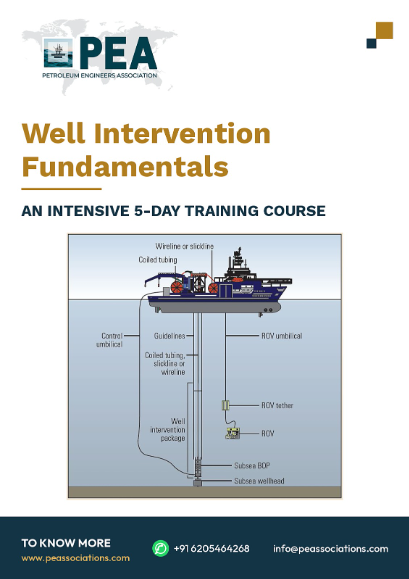
The hierarchy is straightforward. Slickline is cheapest and fastest but carries limited force and no circulation. Electric line adds measurement and power. Coiled tubing adds circulation and chemical placement under pressure. Snubbing allows heavy work under pressure. A rig workover can do anything but is the most expensive and requires the well to be killed, which risks damaging the formation. Choosing the lightest method that can do the job is the guiding principle.
Safety in intervention rests on barriers. Any operation on a live well requires two tested barriers between the reservoir and the environment, and every tool entering or leaving the well must pass through pressure control equipment that maintains them. Most intervention incidents trace to barrier failures, inadequate pressure control or procedures that did not anticipate what happened. This course puts barriers and planning at the centre.
By the end of this training, participants will be able to:
- Explain the reasons for well intervention and how candidates are identified.
- Describe the well barrier principle and verify barriers during intervention.
- Describe pressure control equipment for each intervention method.
- Compare slickline, wireline, coiled tubing, snubbing and rig workover capabilities and limits.
- Select the most suitable intervention method for a given task.
- Describe the common intervention tasks and the tools used for each.
- Plan an intervention job, including procedures, equipment and personnel.
- Apply execution control, including job safety analysis and management of change.
- Develop contingency plans for the common failure scenarios.
- Estimate intervention cost and deferred production.
Organisations sending participants to this training will:
- Build a common understanding of intervention options across the asset.
- Select the lightest and cheapest method capable of doing each job.
- Improve barrier discipline and reduce intervention incidents.
- Improve the quality of intervention programmes and procedures.
- Improve intervention cost and deferment estimating.
Participants will:
- Understand the full range of intervention methods and what each can do.
- Understand well barriers and pressure control in live well work.
- Be able to select a method for a given task.
- Be able to write and review an intervention programme.
- Be prepared for specialist training in coiled tubing, wireline or workover operations.
- Production engineers
- Well intervention and workover engineers in their early career
- Completion engineers
- Operations engineers and supervisors
- Well services personnel
- Graduate engineers entering well engineering roles
Module 1: Why Wells Are Intervened
- Diagnostic, remedial and enhancement interventions
- Common well problems that require intervention
- Candidate identification
- Intervention in the well life cycle
Module 2: Well Barriers and Pressure Control
- The two-barrier principle
- Primary and secondary barriers
- Barrier verification and testing
- Pressure control equipment for each method
- Well control during intervention
Module 3: Slickline and Braided Line
- Capabilities and limits
- Equipment and toolstrings
- Common slickline tasks
- Job planning basics
Module 4: Electric Line and Logging
- Capabilities and limits
- Cased hole logging services
- Perforating and setting tools on electric line
- Conveyance in deviated wells
Module 5: Coiled Tubing
- Capabilities and limits
- Surface equipment and reel
- Circulation and chemical placement
- Common coiled tubing tasks
Module 6: Snubbing and Hydraulic Workover
- Working under pressure
- Capabilities and limits
- When snubbing is preferred to a rig
Module 7: Rig Workovers
- Killing the well and its risks
- Pulling and running completions
- Recompletion and sidetracking
- Cost and duration
Module 8: Common Intervention Tasks
- Logging and surveys
- Setting and pulling plugs and valves
- Scale, fill and sand removal
- Perforating and re-perforating
- Water and gas shut-off
- Tubing and equipment repair or replacement
Module 9: Planning, Execution and Cost
- Job objectives and success criteria
- Programmes and procedures
- Equipment and personnel planning
- Job safety analysis and management of change
- Contingency planning
- Cost estimation and deferred production
- Post-job reporting and lessons learned
Upon successful completion of this training course, delegates will be awarded an official Certificate of Completion issued by the Petroleum Engineers Association (PEA), an ISO 9001:2015 certified training organization. The certificate carries 10 Credits and formally records the total learning hours completed.
Each certificate is signed by the Course Facilitator and the CEO of the Petroleum Engineers Association, and serves as verifiable proof of professional training that delegates can present to employers and professional bodies worldwide.
Frequently Asked Questions
All course bookings made through PEA are strictly non-refundable. By registering for a course, you acknowledge and accept that all fees are payable in full and are not subject to refund under any circumstances, including changes in personal or professional commitments or partial attendance.
PEA reserves the right to make reasonable adjustments to course content, trainers, or schedules where necessary, without entitling delegates to a refund. Comprehensive details of each course — including objectives, target audience, and content — are clearly outlined before enrolment, and it is the responsibility of the delegate to ensure the course's suitability prior to booking.
For any inquiries related to cancellations or bookings, please contact our support team, who will be happy to assist you.
