


An Interactive 5-Day Training Course
Fracture Diagnostics & Post-Frac Evaluation (DFIT, PTA)
Measuring What the Fracture Did
Secure your spot now!
Duration
5 Days
Price
$ 3,500
Starting From
20 Sep 2027



Fracture Diagnostics & Post-Frac Evaluation (DFIT, PTA)
Have Questions ?
Fracture Diagnostics & Post-Frac Evaluation (DFIT, PTA) - PE-FDE-PEA27
| Code | Date | Time | Duration | Location | Currency | Early Bird Fee Per Person |
|---|---|---|---|---|---|---|
| PE-FDE-PEA27 | 20 - 24 Sep 2027 | 10 AM CST | 4 Hours Per Day |
Online |
USD |
3500 |
Need this for a group? We deliver the same course in-house — face-to-face at your location or online — tailored to your assets and team level. Contact info@peassociations.com.
Boost your team's skills and your budget! Enjoy group discounts for collaborative learning. Send an inquiry to info@peassociations.com.
Fracture Diagnostics & Post-Frac Evaluation (DFIT, PTA)
Description
A fracture treatment can be pumped exactly as designed and still fail to deliver production. Diagnostics answer what was actually created: how far the fracture went, how much of it is conductive, which clusters took fluid and whether the fracture is connected to the reservoir the model assumed. This course covers the measurement methods and their interpretation.
It starts with the diagnostic fracture injection test, the most widely used pre-treatment diagnostic, covering test design, execution, closure identification and the before-closure and after-closure analysis that yield closure stress, permeability and pore pressure. It then covers pressure transient analysis of fractured wells, including the flow regimes that identify fracture half-length and conductivity, and rate transient analysis for long-term evaluation. The second half covers tracers, temperature and production logging, microseismic and fibre optic sensing, and how to combine several diagnostics into a consistent picture of the created fracture.
Fracture diagnostics exist because the fracture cannot be seen. Everything known about it comes from indirect measurement: pressure behaviour during and after injection, flow regimes seen in a well test, tracer returns, temperature changes, seismic events and strain measured along a fibre. Each method answers part of the question and each has limits.
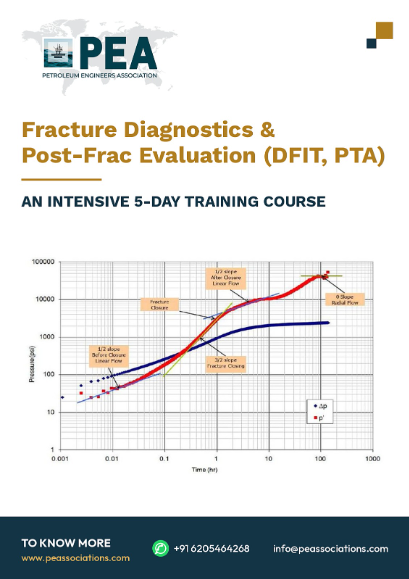
The diagnostic fracture injection test is the most useful single measurement before a treatment. A small volume is injected and the pressure decline is analysed to find closure stress, leak-off behaviour and, from the after-closure period, reservoir permeability and pore pressure. In tight rock these tests can take days to reach closure, and much of the interpretation dispute in the industry concerns how closure is picked and whether the late-time data is in true radial flow.
After the treatment, the question changes to what is producing. Pressure transient and rate transient analysis give effective half-length and conductivity, which are often far smaller than the designed values. Tracers and production logs show which stages and clusters contribute. Microseismic and fibre optic data show where fluid went. Put together, these results are what turn one treatment into a better design for the next well.
By the end of this training, participants will be able to:
- Design and execute diagnostic fracture injection tests.
- Identify fracture closure and interpret before-closure pressure decline.
- Apply after-closure analysis to obtain permeability and pore pressure.
- Identify flow regimes in pressure transient tests of fractured wells.
- Estimate fracture half-length and conductivity from well test analysis.
- Apply rate transient analysis to fractured and unconventional wells.
- Design and interpret chemical and radioactive tracer surveys.
- Interpret temperature and production logs in fractured wells.
- Interpret microseismic and fibre optic sensing results and understand their limits.
- Integrate multiple diagnostics into a consistent fracture evaluation.
Organisations sending participants to this training will:
- Get measured fracture properties instead of designed ones.
- Improve future fracture designs using evidence from completed wells.
- Reduce spend on stages and clusters that do not contribute.
- Improve reservoir property estimates in tight formations.
- Build consistent diagnostic and evaluation practice across the asset.
Participants will:
- Be able to design and interpret diagnostic fracture injection tests.
- Be able to analyse pressure and rate transient data from fractured wells.
- Understand tracer, temperature, microseismic and fibre optic diagnostics.
- Know the limits and uncertainties of each diagnostic method.
- Be able to build an integrated evaluation of a fracture treatment.
- Stimulation and fracturing engineers
- Reservoir engineers in tight and unconventional assets
- Production engineers
- Well test and surveillance engineers
- Completion engineers
- Technical specialists supporting field development
Module 1: Purpose of Fracture Diagnostics
- What can and cannot be measured
- Pre-treatment, during-treatment and post-treatment diagnostics
- Matching diagnostic method to the question
Module 2: Diagnostic Fracture Injection Tests
- Test objectives and design
- Injection volume, rate and shut-in duration
- Field execution and gauge requirements
- Data quality requirements
Module 3: Before-Closure Analysis
- G-function analysis
- Square root of time and log-log diagnostic plots
- Identifying closure pressure
- Leak-off types: normal, pressure dependent, height recession and tip extension
- Common interpretation disputes
Module 4: After-Closure Analysis
- Linear and radial flow after closure
- Permeability and pore pressure estimation
- Test duration requirements in tight rock
- Limits of after-closure interpretation
Module 5: Pressure Transient Analysis of Fractured Wells
- Flow regimes: bilinear, linear, elliptical and pseudo-radial
- Finite and infinite conductivity fracture responses
- Estimating half-length and conductivity
- Test design for fractured wells
Module 6: Rate Transient Analysis
- Linear flow analysis and square root of time plots
- Type curve and flowing material balance methods
- Estimating contacted area and conductivity
- Application to unconventional wells
Module 7: Tracer, Temperature and Production Logging
- Chemical and radioactive tracers
- Stage and cluster contribution from tracer returns
- Temperature logs and warm-back analysis
- Production logging in fractured wells
Module 8: Microseismic and Fibre Optic Diagnostics
- Microseismic acquisition and processing
- Interpreting event clouds and their limits
- Distributed acoustic and temperature sensing
- Cross-well strain measurement
- Fracture geometry and cluster efficiency from fibre data
Module 9: Integrated Fracture Evaluation
- Combining diagnostics into one interpretation
- Reconciling designed and effective fracture properties
- Identifying why treatments underperformed
- Feeding evaluation results into future designs
Upon successful completion of this training course, delegates will be awarded an official Certificate of Completion issued by the Petroleum Engineers Association (PEA), an ISO 9001:2015 certified training organization. The certificate carries 10 Credits and formally records the total learning hours completed.
Each certificate is signed by the Course Facilitator and the CEO of the Petroleum Engineers Association, and serves as verifiable proof of professional training that delegates can present to employers and professional bodies worldwide.
Frequently Asked Questions
All course bookings made through PEA are strictly non-refundable. By registering for a course, you acknowledge and accept that all fees are payable in full and are not subject to refund under any circumstances, including changes in personal or professional commitments or partial attendance.
PEA reserves the right to make reasonable adjustments to course content, trainers, or schedules where necessary, without entitling delegates to a refund. Comprehensive details of each course — including objectives, target audience, and content — are clearly outlined before enrolment, and it is the responsibility of the delegate to ensure the course's suitability prior to booking.
For any inquiries related to cancellations or bookings, please contact our support team, who will be happy to assist you.
