


An Interactive 5-Day Training Course
Plunger Lift & Gas Well Deliquification
Keeping Gas Wells Unloaded
Secure your spot now!
Duration
5 Days
Price
$ 3,500
Starting From
17 May 2027



Plunger Lift & Gas Well Deliquification
Have Questions ?
Plunger Lift & Gas Well Deliquification - PE-PLD-PEA27
| Code | Date | Time | Duration | Location | Currency | Early Bird Fee Per Person |
|---|---|---|---|---|---|---|
| PE-PLD-PEA27 | 17 - 21 May 2027 | 10 AM CST | 4 Hours Per Day |
Online |
USD |
3500 |
Need this for a group? We deliver the same course in-house — face-to-face at your location or online — tailored to your assets and team level. Contact info@peassociations.com.
Boost your team's skills and your budget! Enjoy group discounts for collaborative learning. Send an inquiry to info@peassociations.com.
Plunger Lift & Gas Well Deliquification
Description
Gas wells stop producing long before the reservoir is empty if liquid accumulates in the tubing. Liquid loading is the single most common cause of lost gas production in mature fields, and it is usually treatable. This course covers the physics of loading and the full range of deliquification methods: velocity strings, surfactants and foamers, plunger lift, compression, intermittent and gas lift, and downhole pumps.
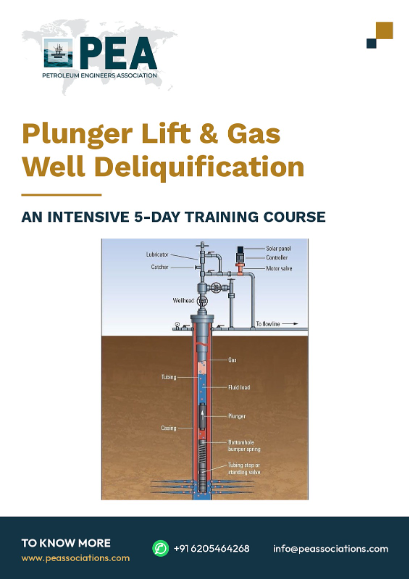
Plunger lift is covered in detail, since it is the most widely used method for onshore gas wells. Participants work through plunger and equipment selection, well suitability screening, cycle design, controller settings, surface equipment and automation, and troubleshooting of wells that fail to cycle or lose production. The course closes with the selection of deliquification methods over field life and the economics of each option.
A gas well carries liquid to surface only while the gas velocity is high enough to lift droplets and sweep the liquid film up the tubing wall. As reservoir pressure and gas rate decline, velocity falls below the critical value, liquid falls back and accumulates in the tubing. The hydrostatic head of the accumulated liquid increases back-pressure on the reservoir, which reduces gas rate further and accelerates the process until the well cycles, loads and dies.
The signs appear well before the well dies. Erratic production, slugging, rising and falling tubing pressure, increasing difference between tubing and casing pressure and changing decline behaviour are all indicators. Recognising them early means the well can be treated before it stops producing and while cheaper options remain available.
Method selection depends on rate, depth, liquid volume, well construction and available infrastructure. Foamers suit low liquid volumes and are cheap to start. Velocity strings suit steady moderate declines. Plunger lift suits wells with sufficient reservoir energy to build casing pressure. Compression benefits every well but costs most. Common mistakes include leaving loading undiagnosed, installing plunger lift on wells with insufficient energy, and never revisiting settings once installed.
By the end of this training, participants will be able to:
- Explain the mechanisms of liquid loading in gas wells.
- Calculate critical velocity and critical rate using standard methods.
- Diagnose liquid loading from production, pressure and decline data.
- Compare the available deliquification methods and their operating ranges.
- Screen wells for plunger lift suitability.
- Design a plunger lift installation, including plunger type, bumper spring, lubricator and controller.
- Set and adjust plunger cycle parameters for maximum production.
- Troubleshoot plunger lift wells that fail to arrive, cycle poorly or lose production.
- Select deliquification methods over field life on technical and economic grounds.
Organisations sending participants to this training will:
- Recover gas production currently lost to liquid loading.
- Extend the productive life of mature gas wells.
- Select deliquification methods on evidence rather than habit.
- Improve plunger lift performance through better cycle control.
- Reduce well intervention costs on loaded wells.
Participants will:
- Understand why and when gas wells load up.
- Be able to calculate critical rates and diagnose loading from field data.
- Know the full range of deliquification options and where each fits.
- Be able to design and set up a plunger lift installation.
- Be able to troubleshoot plunger lift wells
Module 1: Liquid Loading in Gas Wells
- Sources of liquid: condensate and water
- Droplet and film transport
- Critical velocity and critical rate methods
- Effect of tubing size, pressure and well deviation
Module 2: Diagnosing Loading
- Production and pressure signatures
- Tubing and casing pressure behaviour
- Decline curve indications
- Acoustic fluid level surveys
- Downhole gauge data
Module 3: Deliquification Options
- Velocity strings and tubing changes
- Surfactants and foaming agents
- Compression and wellhead pressure reduction
- Intermittent production and gas lift
- Downhole pumps in gas wells
- Comparison of operating ranges
Module 4: Plunger Lift Principles
- The plunger lift cycle
- Energy requirements and casing pressure build-up
- Well screening criteria
- Advantages and limits
Module 5: Plunger Lift Equipment
- Plunger types and selection
- Bumper springs and standing valves
- Lubricators, catchers and arrival sensors
- Surface valves and controllers
Module 6: Plunger Lift Design and Cycle Control
- Cycle design: shut-in, afterflow and sales time
- Controller settings and optimisation
- Pressure, time and flow-based control
- Adjusting for declining reservoir pressure
Module 7: Plunger Lift Troubleshooting
- Plunger fails to arrive or arrives late
- Dry cycles and wet cycles
- Worn plungers and sticking
- Sand, scale and paraffin problems
- Surface equipment and sensor faults
Module 8: Method Selection and Economics
- Matching method to well conditions and field life
- Staged deliquification strategies
- Cost, gain and payback comparison
- Monitoring results after installation
Upon successful completion of this training course, delegates will be awarded an official Certificate of Completion issued by the Petroleum Engineers Association (PEA), an ISO 9001:2015 certified training organization. The certificate carries 10 Credits and formally records the total learning hours completed.
Each certificate is signed by the Course Facilitator and the CEO of the Petroleum Engineers Association, and serves as verifiable proof of professional training that delegates can present to employers and professional bodies worldwide.
Frequently Asked Questions
All course bookings made through PEA are strictly non-refundable. By registering for a course, you acknowledge and accept that all fees are payable in full and are not subject to refund under any circumstances, including changes in personal or professional commitments or partial attendance.
PEA reserves the right to make reasonable adjustments to course content, trainers, or schedules where necessary, without entitling delegates to a refund. Comprehensive details of each course — including objectives, target audience, and content — are clearly outlined before enrolment, and it is the responsibility of the delegate to ensure the course's suitability prior to booking.
For any inquiries related to cancellations or bookings, please contact our support team, who will be happy to assist you.
