


An Interactive 5-Day Training Course
Gas Well Production Operations & Liquid Loading
Operating Gas Wells to Depletion
Secure your spot now!
Duration
5 days
Price
$ 3,500
Starting From
02 Aug 2027



Gas Well Production Operations & Liquid Loading
Have Questions ?
Gas Well Production Operations & Liquid Loading - PE-GWP-PEA27
| Code | Date | Time | Duration | Location | Currency | Early Bird Fee Per Person |
|---|---|---|---|---|---|---|
| PE-GWP-PEA27 | 02 - 06 Aug 2027 | 10 AM CST | 4 Hours Per Day |
Online |
USD |
3500 |
Need this for a group? We deliver the same course in-house — face-to-face at your location or online — tailored to your assets and team level. Contact info@peassociations.com.
Boost your team's skills and your budget! Enjoy group discounts for collaborative learning. Send an inquiry to info@peassociations.com.
Gas Well Production Operations & Liquid Loading
Description
Gas wells are simple until they start making liquid. Condensate drops out as pressure falls, water arrives from the reservoir or from condensation, and once gas velocity falls below the critical value, liquid accumulates and the well cycles, loads and dies with substantial reserves left behind. Managing that transition is the main work of gas well production operations.
This course covers gas well operation from start-up to abandonment. It starts with gas well performance, deliverability and tubing performance, and the behaviour of condensate and water production over field life. It then covers liquid loading in detail: prediction, diagnosis from production and pressure data, and the full set of deliquification options from foamers and velocity strings through plunger lift, compression and pumps. The course then covers wellhead and field compression, hydrate and freezing problems in gas operations, gas measurement and sales quality requirements, surveillance and testing practice, and end-of-life management including intermittent production and abandonment timing.
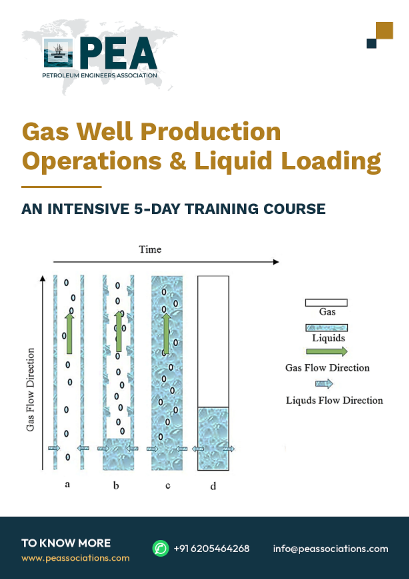
A gas well's life is a race between declining reservoir pressure and rising liquid load. Early on, gas velocity is high enough to carry liquid easily. As pressure and rate fall, the well passes through a period of instability and slugging, and then begins to load. Each stage has its own remedies, and applying them at the right time is what keeps the well producing to its economic limit rather than dying prematurely.
Compression is the most powerful lever. Lowering wellhead pressure increases drawdown, raises gas velocity and directly attacks liquid loading, and in many gas fields the compression strategy determines total recovery more than anything done downhole. It is also the most capital intensive option, which is why the sequencing of cheaper measures, such as foamers, velocity strings and plunger lift, matters.
Gas operations bring their own hazards and problems. Hydrates form at chokes and in flowlines, freezing occurs across pressure drops, glycol systems need maintenance, and gas must meet water dewpoint, hydrocarbon dewpoint and contaminant specifications to be sold. Measurement is fiscal and unforgiving of error. This course covers the whole picture as it applies to gas field operations.
By the end of this training, participants will be able to:
- Analyse gas well deliverability and tubing performance over field life.
- Predict condensate and water production and their effects.
- Calculate critical velocity and predict the onset of liquid loading.
- Diagnose liquid loading from production, pressure and surveillance data.
- Select and apply deliquification methods appropriate to well conditions.
- Evaluate wellhead and field compression options and their timing.
- Manage hydrate and freezing problems in gas production systems.
- Meet gas measurement and sales quality requirements.
- Design gas well surveillance and testing programmes.
- Manage gas wells at end of life and decide abandonment timing.
Organisations sending participants to this training will:
- Extend the productive life of gas wells and increase recovery.
- Reduce production lost to liquid loading.
- Time compression and deliquification investments correctly.
- Reduce hydrate and freezing related downtime.
- Improve gas measurement accuracy and sales specification compliance.
Participants will:
- Understand gas well performance and how it changes with depletion.
- Be able to predict and diagnose liquid loading.
- Know the deliquification options and their operating ranges.
- Understand compression, hydrate management and gas quality requirements.
- Be able to manage gas wells through to their economic limit.
- Production engineers in gas fields
- Operations engineers and supervisors
- Well surveillance and optimisation engineers
- Facilities and process engineers
- Field technicians working on gas wells
Module 1: Gas Well Performance
- Gas deliverability and inflow
- Tubing performance and outflow
- Operating point and stability
- Effect of depletion on performance
- Condensate banking near the wellbore
Module 2: Liquids in Gas Wells
- Sources of water and condensate
- Condensate dropout along the well
- Water of condensation
- Changes in liquid production over field life
Module 3: Liquid Loading
- Loading mechanisms and critical velocity
- Critical rate calculation methods
- Diagnosis from production and pressure data
- Fluid level and downhole gauge evidence
- Stages from instability to death
Module 4: Deliquification Methods
- Foamers and surfactants
- Velocity strings and tubing changes
- Plunger lift
- Intermittent production and cycling
- Downhole pumps in gas wells
- Selection and sequencing over field life
Module 5: Compression
- Effect of wellhead pressure on deliverability
- Wellhead, satellite and central compression
- Compression staging and timing
- Compressor operation and reliability
- Economics of compression projects
Module 6: Hydrates and Freezing
- Hydrate formation in wells, chokes and flowlines
- Methanol and glycol injection
- Heating and insulation
- Freezing across pressure drops
- Prevention and remediation practice
Module 7: Gas Measurement and Quality
- Orifice, turbine and ultrasonic metering
- Measurement uncertainty and calibration
- Water and hydrocarbon dewpoint specifications
- Contaminant limits and treatment
- Sales contract requirements
Module 8: Surveillance and Testing
- Gas well test practice
- Deliverability testing frequency
- Pressure monitoring and build-up analysis
- Surveillance indicators of loading and damage
- Data requirements for forecasting
Module 9: End-of-Life Management
- Economic limit for gas wells
- Intermittent and cycled production
- Low pressure operation and compression limits
- Abandonment timing
- Recovering remaining reserves
Upon successful completion of this training course, delegates will be awarded an official Certificate of Completion issued by the Petroleum Engineers Association (PEA), an ISO 9001:2015 certified training organization. The certificate carries 10 Credits and formally records the total learning hours completed.
Each certificate is signed by the Course Facilitator and the CEO of the Petroleum Engineers Association, and serves as verifiable proof of professional training that delegates can present to employers and professional bodies worldwide.
Frequently Asked Questions
All course bookings made through PEA are strictly non-refundable. By registering for a course, you acknowledge and accept that all fees are payable in full and are not subject to refund under any circumstances, including changes in personal or professional commitments or partial attendance.
PEA reserves the right to make reasonable adjustments to course content, trainers, or schedules where necessary, without entitling delegates to a refund. Comprehensive details of each course — including objectives, target audience, and content — are clearly outlined before enrolment, and it is the responsibility of the delegate to ensure the course's suitability prior to booking.
For any inquiries related to cancellations or bookings, please contact our support team, who will be happy to assist you.
